
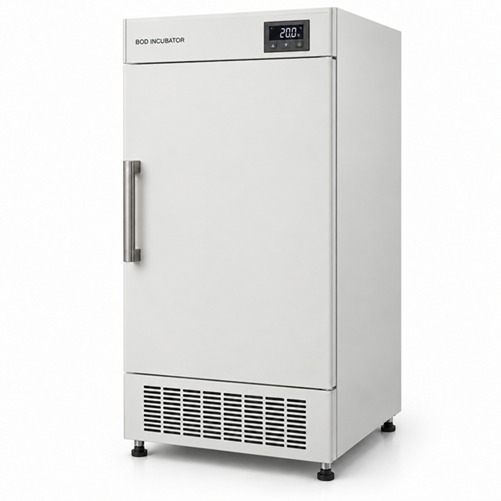
A BOD incubator is a temperature-controlled chamber used to incubate water and wastewater samples during biochemical oxygen demand testing. The Pacorr BOD Incubator combines a 5°C to 60°C temperature range with PID control, a PT100 sensor and an LED display for routine laboratory incubation.
An SS304 inner chamber, powder-coated mild-steel exterior and insulated double-walled construction form the cabinet. Two shelves support sample placement, castor wheels allow repositioning, and a safety thermostat provides over-temperature protection. Share your test method, bottle dimensions, batch size and laboratory conditions with Pacorr to request a quotation.
- Shipping Area: All over the world
- Model: PCBOD-216
- Brand: Pacorr
- Availability: In Stock


What is a BOD incubator used for?
A BOD incubator supports the incubation stage of biochemical oxygen demand analysis. BOD describes the oxygen consumed by microorganisms as they break down organic matter under specified test conditions. Water and wastewater laboratories use the measurement to investigate oxygen demand associated with biodegradable pollution.
The incubator's task is to maintain the required thermal environment throughout the test. A dissolved oxygen measurement procedure or a compatible respirometric measurement system performs the analytical measurement; the chamber alone does not report a BOD result.
Selecting an incubator therefore involves more than checking its nominal temperature range. Laboratories should evaluate performance at their actual test temperature, the number of bottles that can be accommodated with suitable spacing, and how incubation conditions will be monitored and recorded.
Why use a refrigerated incubator?
When the required incubation temperature is below the surrounding room temperature, heating alone cannot maintain the setpoint. A refrigerated incubator provides cooling as well as heating, allowing temperature control around the required operating point. Refrigerated incubators are used for BOD applications and other suitable temperature-controlled laboratory work.
For a purchase enquiry, state both the required chamber temperature and the laboratory's expected ambient temperature. A temperature range without its operating conditions does not fully describe the equipment's suitability.
How to compare temperature specifications
Display resolution, accuracy, stability and uniformity answer different questions. Resolution describes the smallest increment shown on the display. Accuracy concerns agreement with a reference measurement. Stability describes variation over time, while uniformity describes differences between locations in the chamber.
For BOD work, request performance information at the intended incubation setpoint and under a relevant loading condition. A finely divided display does not, by itself, demonstrate an equally small temperature error throughout a loaded chamber.
How Does a BOD Incubator Work?
The PT100 sensor supplies temperature feedback to the PID controller. The control system regulates heating and cooling around the selected setpoint within the specified 5°C–60°C range. The LED display shows the indicated temperature, while the insulated double-walled body helps limit heat exchange with the laboratory. The incubator controls the sample environment; the selected BOD method determines how oxygen demand is measured.
For a conventional dilution-based BOD workflow, the incubation stage fits into the process as follows:
- Prepare and identify the samples, dilutions and quality-control bottles required by the laboratory's approved method.
- Determine the initial dissolved oxygen using the specified analytical procedure.
- Load the prepared bottles onto the shelves of a stabilised incubator, following the loading and spacing instructions.
- Maintain the method's specified incubation conditions and record temperature checks and any interruptions.
- Determine dissolved oxygen after incubation and calculate the result using the method's dilution and correction requirements.
This overview is not a replacement for the laboratory's test method or operating procedure. Sample pretreatment, seeding, controls and result acceptance must follow the procedure being used.
Why are BOD samples incubated in the dark?
Light can allow photosynthetic organisms to produce oxygen, interfering with interpretation of oxygen depletion. Dark incubation helps avoid that interference. An opaque door can help exclude external light, but the laboratory must also consider any internal light and its operating settings.
Applications
Water and wastewater analysis
BOD incubation is relevant to environmental laboratories evaluating oxygen demand in water and wastewater. Sample selection and interpretation depend on the purpose of the investigation and the analytical method.
Sewage and industrial effluent testing
Laboratories associated with sewage treatment and industrial wastewater treatment may use BOD testing as part of their analytical programme. When enquiring about equipment, identify whether the sample batches include inlet samples, treated effluent, process investigations or a combination of these.
Research and other incubation work
Refrigerated incubators can also serve selected research and sample-incubation applications. Suitability must be checked against the actual temperature, lighting, containment and other requirements. Do not assume that a BOD incubator provides humidity control, sterilisation or every function of a dedicated environmental chamber.
Selecting the Right BOD Incubator
Start with the test method and the laboratory workload. The most useful enquiry explains how the chamber will be used, rather than requesting capacity in litres alone.
Plan for overlapping batches. Bottles remain in the chamber during incubation, so several days of incoming samples may occupy it at the same time. Include dilution series, duplicates and quality-control bottles in the capacity estimate.
Check the usable loading arrangement. Ask how many of your actual bottles fit on the supplied shelves while preserving clearance and access. External cabinet size is not a reliable guide to usable bottle capacity.
Confirm continuous operation. Five days equals 120 hours. If a controller includes a shorter timer, establish whether the incubator supports the required continuous operating mode and how the laboratory will track incubation timing. A timer limit and a chamber's continuous operating capability are different specifications.
Define monitoring needs. Establish whether routine temperature records will be manual or electronic, whether an independent reference probe is needed, and how excursions will be reviewed.
Check installation requirements. Include the available floor space, door clearance, electrical supply, ventilation clearance and room conditions in the purchase discussion.
Discuss Your Requirements with Pacorr
Send Pacorr your application details to request a quotation with a clear technical scope. Include the required incubation temperature, approximate bottle count, bottle dimensions, expected room temperature and any documentation requirements.
Ask for written confirmation of the supplied accessories, commissioning arrangements, warranty terms and service coverage. Where calibration or qualification documentation is required by your laboratory, identify the required scope at the enquiry stage.
BOD Incubator Price
Request a Pacorr BOD incubator quotation for your required configuration. To compare offers meaningfully, use the same schedule of requirements for chamber capacity, temperature performance, shelves, monitoring features, documentation and delivery scope.
For a complete purchase comparison, ask which items are included in the quoted amount and which are optional. Confirm applicable taxes, freight, installation and accessories in the final offer.
Related Laboratory Equipment
Depending on the laboratory workflow, related equipment may include pH meters, water baths and other temperature-conditioning equipment. These instruments perform different tasks and do not replace the incubator or the oxygen measurement procedure.
Frequently Asked Questions
Q. What is the temperature range of the Pacorr BOD Incubator?
A. The specified temperature range is 5°C to 60°C. For a particular test method, check the required setpoint, tolerance and laboratory operating conditions before use.
Q. What are the dimensions and construction materials?
A. The listed dimensions are 24″ × 24″ × 36″. The inner chamber is SS304 stainless steel and the outer body is powder-coated mild steel, with insulated double-walled construction.
Q. Does a least count of 0.1°C mean an accuracy of ±0.1°C?
A. No. The 0.1°C least count describes the display increment. Temperature accuracy, stability and uniformity are separate performance characteristics and should be assessed independently.
Q. Which temperature control and safety features are provided?
A. The incubator uses microprocessor-based controls, a PID temperature controller, a PT100 sensor and an LED display. A safety thermostat provides over-temperature protection.
Q. What does BOD stand for?
A. BOD stands for biochemical oxygen demand. It describes oxygen consumption associated with microbial breakdown of organic matter under defined test conditions.
Q. Does a BOD incubator measure oxygen demand directly?
A. No. A standalone BOD incubator maintains the incubation environment. Dissolved oxygen analysis or a compatible BOD measurement system supplies the measurements used to determine oxygen demand.
Q. What temperature is used for a five-day BOD test?
A. The conventional BOD5 procedure uses incubation at 20°C in the dark for five days. Apply the temperature tolerance, timing and other requirements of the specific method adopted by your laboratory.
Q. How is a BOD incubator different from a heating-only incubator?
A. A refrigerated BOD incubator can provide cooling as well as heating within its operating range. A heating-only incubator cannot actively cool the chamber below ambient temperature. Select equipment according to the required setpoint and laboratory conditions.
Q. Is a solid door suitable for BOD incubation?
A. A solid outer door can help exclude external light. Suitability also depends on the actual thermal performance, seals, internal lighting and the laboratory's procedure. Door appearance alone does not demonstrate method compliance.
Q. What capacity should my laboratory choose?
A. Choose capacity from the maximum number of bottles present at one time, including overlapping batches, dilutions, duplicates and controls. Confirm the usable bottle layout, shelf capacity and necessary clearance rather than relying only on the chamber's litre rating.
Q. Can one incubator be used for different incubation temperatures?
A. Different methods may use the same chamber at different times if its verified operating range and other functions are suitable. A single-zone chamber cannot maintain two independent temperature setpoints simultaneously.
Q. What should I check before requesting a price?
A. Provide the test method, incubation setpoint, bottle quantity, bottle size, room conditions and required records. Ask for the exact model specification and an itemised scope so that the quotation matches the laboratory's needs.
Q. Does buying a BOD incubator make a laboratory compliant with a test standard?
A. No. Equipment selection is one part of the workflow. The laboratory must establish that the complete procedure, including sample preparation, measurement, incubation conditions and quality control, meets the applicable method requirements.
Q. How do I request a Pacorr BOD incubator quotation?
A. Submit an enquiry on pacorr.com with your application, required temperature, bottle capacity and delivery location. Include any documentation or monitoring requirements so that they can be addressed in the quotation.
Write Your Review
Get a Quote
Share your requirement and our team will reply shortly.
+91-8882149230
Related Products
Our Clients
























Our USP's
Demonstration of Machine
- Try Before You Decide
- Experience Before You Invest
- See It in Action – Free Demo
Global Reach
- Delivering Excellence Worldwide
- Serving Across Borders
- Your Global Supply Partner
On-Site Support
- Support That Comes to You
- On-Ground Assistance, Anywhere
- We Reach Where You Are
Team Strength
- Powered by Expert Minds
- Driven by Skilled Professionals
- Engineering Excellence Team
Manufacturing
- Precision-Driven Manufacturing
- Smart & Automated Production
- Engineered In-House Excellence
