
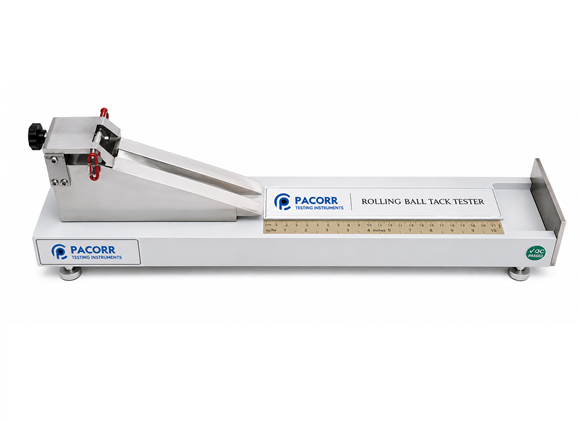
Pacorr’s Rolling Ball Tack Tester is designed to evaluate the initial tack of pressure-sensitive adhesive materials. The instrument measures how far a standard stainless-steel ball travels after rolling down an inclined track and coming into contact with an adhesive-coated specimen. It is commonly used for testing adhesive tapes, labels, protective films, medical tapes, self-adhesive sheets and coated laminates. The simple test method makes it suitable for routine quality control, comparative testing and adhesive product development. The instrument is designed in accordance with ASTM D3121.
- Shipping Area: All over the world
- Model: PCRBT-1
- Brand: Pacorr
- Availability: In Stock

What is a Rolling Ball Tack Tester?
A Rolling Ball Tack Tester is a laboratory instrument used to determine the immediate stickiness, or initial tack, of a pressure-sensitive adhesive. Initial tack refers to the ability of an adhesive to grip another surface after light contact and without applying prolonged pressure. This property is important for materials such as packaging tapes, labels and protective films that need to adhere quickly during application.
During the test, a stainless-steel ball rolls down an inclined track and moves across the adhesive surface. The adhesive slows the ball and eventually stops it. The distance travelled by the ball is measured and used to compare the tack of different samples. This test helps manufacturers identify variations in adhesive formulation, coating quality and production consistency.
Working Principle
The Rolling Ball Tack Tester works by measuring the resistance created by an adhesive against a moving steel ball. A clean stainless-steel ball is placed at a fixed position on the inclined track. Once released, the ball rolls down the slope under gravity and enters the adhesive test area. The adhesive coating resists its movement until the ball comes to a complete stop. The distance travelled over the adhesive surface is then recorded. A ball that stops over a shorter distance generally indicates higher comparative tack. A longer travelling distance usually indicates lower tack. Accurate comparison requires the same ball size, release position, incline angle, specimen condition and laboratory environment for every test.
Test Procedure
Clean the stainless-steel ball and inclined track before starting the test. Any adhesive residue, oil, dust or dirt can affect the movement of the ball and produce an incorrect result. Cut the adhesive specimen to the required dimensions and place it at the lower end of the inclined track. The adhesive-coated side should face upward. Ensure that the specimen is flat, properly aligned and free from wrinkles, bubbles or contamination. Place the steel ball at the specified release point. Release it carefully without applying any external force. Allow the ball to roll freely down the inclined track and across the adhesive specimen. Measure the distance from the point where the ball first contacts the adhesive to the position where it stops. Repeat the test on additional specimens and compare the recorded values.
For reliable results, all samples should be tested under the same preparation and environmental conditions.
Understanding the Test Result
The test result is expressed as the distance travelled by the steel ball over the adhesive surface. A shorter stopping distance generally represents stronger initial tack because the adhesive stops the ball quickly. A longer distance suggests lower initial tack. The result should be used for comparative evaluation rather than as the only measurement of adhesive performance. Factors such as peel strength, shear strength, bonding pressure, surface condition and application temperature can also influence the final performance of an adhesive product.
Applications
The Rolling Ball Tack Tester is suitable for testing:
- Packaging tapes
- Pressure-sensitive adhesive tapes
- Self-adhesive labels
- Protective plastic films
- Medical and surgical tapes
- Masking tapes
- Double-sided tapes
- Electrical insulation tapes
- Adhesive-coated laminates
- Self-adhesive sheets
- Pressure-sensitive adhesive formulations
- Research and development samples
Industries Served
The instrument is widely used in:
- Adhesive manufacturing
- Packaging tape production
- Label printing and converting
- Flexible packaging
- Protective film manufacturing
- Medical product manufacturing
- Electrical tape production
- Automotive component manufacturing
- Research laboratories
- Quality-control laboratories
Benefits of Using a Rolling Ball Tack Tester
Regular tack testing helps manufacturers maintain consistent adhesive performance from one production batch to another. It can identify changes caused by raw materials, coating thickness, adhesive formulation or manufacturing conditions. The test is simple to perform and provides quick comparative results without requiring complicated controls. It is particularly useful during product development, incoming-material inspection and finished-product quality checks.
By detecting low or inconsistent tack at an early stage, manufacturers can reduce material rejection, customer complaints and product failures. The instrument also helps research teams compare different adhesive formulations and select the most suitable option for a particular application.
ASTM D3121 Rolling Ball Tack Test
ASTM D3121 describes a rolling-ball method for comparing the tack of pressure-sensitive adhesive materials. The method is especially useful for evaluating relatively low-tack adhesive samples under controlled laboratory conditions.
The test should be used to compare samples tested with the same equipment, ball size, specimen preparation and environmental conditions. It does not independently predict the complete service life or final bonding performance of an adhesive product.
Rolling Ball Tack and Peel Adhesion
Rolling-ball tack and peel adhesion represent different properties of an adhesive. Rolling-ball tack evaluates how quickly an adhesive grips a surface during brief contact. Peel adhesion measures the force required to remove a bonded adhesive material from a standard surface. A product may show good initial tack but different peel or shear performance. For a complete adhesive assessment, the rolling-ball tack test can be combined with peel adhesion, loop tack and shear-holding tests.
Why Choose Pacorr?
Pacorr manufactures the Rolling Ball Tack Tester for routine adhesive testing in production and laboratory environments. Its controlled incline, stainless-steel ball and clearly marked scale provide a practical arrangement for comparative tack evaluation. The instrument is suitable for manufacturers that require a straightforward method to check adhesive consistency, compare formulations and monitor finished-product quality. Pacorr also provides technical guidance, product demonstrations and customised testing solutions according to application requirements.
For product specifications, pricing or a live demonstration, contact Pacorr Testing Instruments.
Frequently Asked Questions
What does a Rolling Ball Tack Tester measure?
It measures the comparative initial tack of pressure-sensitive adhesive materials by recording the distance travelled by a steel ball over the adhesive surface.
What does a shorter stopping distance indicate?
A shorter stopping distance generally indicates higher initial tack because the adhesive stops the ball more quickly.
Which materials can be tested?
The instrument can test adhesive tapes, labels, protective films, medical tapes, self-adhesive sheets and other pressure-sensitive materials.
Which standard is followed?
The instrument is designed in accordance with ASTM D3121 for comparative rolling-ball tack testing.
What is the standard incline angle?
The standard incline angle is 21.5°. Other configurations may be supplied according to specific testing requirements.
Why must the steel ball be cleaned?
Dust, oil and adhesive residue can affect the movement of the ball and create inconsistent test results.
Is tack the same as adhesive strength?
No. Tack represents immediate stickiness, while adhesive strength may include peel resistance, shear strength and long-term bonding performance.
Can two different adhesive samples be compared?
Yes, provided both samples are tested using the same ball size, incline angle, release position, specimen preparation and environmental conditions.
Is the tester suitable for quality-control laboratories?
Yes. Its simple operating method and quick results make it suitable for regular production and laboratory quality checks.
Can the instrument be customised?
Customisation may be available according to specimen type, test method and customer requirements.
Write Your Review
Related Products
Our Clients
























Our USP's
Demonstration of Machine
- Try Before You Decide
- Experience Before You Invest
- See It in Action – Free Demo
Global Reach
- Delivering Excellence Worldwide
- Serving Across Borders
- Your Global Supply Partner
On-Site Support
- Support That Comes to You
- On-Ground Assistance, Anywhere
- We Reach Where You Are
Team Strength
- Powered by Expert Minds
- Driven by Skilled Professionals
- Engineering Excellence Team
Manufacturing
- Precision-Driven Manufacturing
- Smart & Automated Production
- Engineered In-House Excellence
