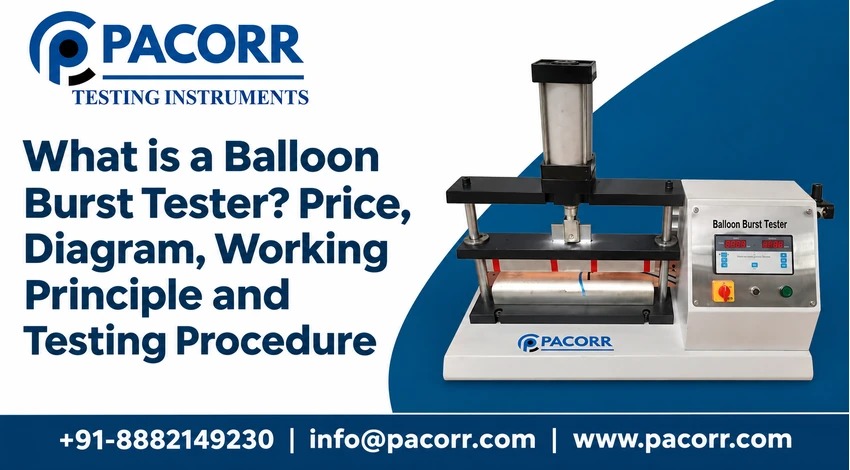
What is a Balloon Burst Tester?
A Balloon Burst Tester is an instrument that introduces air into a flexible package and measures its resistance to increasing internal pressure. In a burst test, the reported endpoint is the pressure associated with package failure under a defined setup. The name describes the inflation of the pouch; this article concerns flexible packaging, not party balloons, medical balloon catheters or pressure vessels.
For a packaging buyer, the useful question is whether a pouch, its seals and its material construction can withstand the specified pressure challenge. For a production team, the result can help investigate changes in sealing conditions or laminate supply. A meaningful comparison requires the same package geometry, preparation, inflation conditions and failure definition. A high number obtained with a different fixture is not automatically evidence of a better seal.
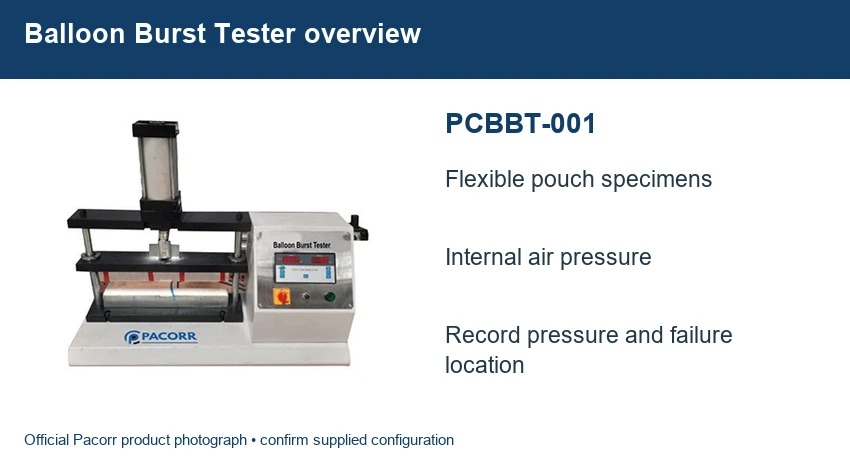
Pacorr lists the PCBBT-001 for flexible packaging applications. Its Balloon Burst Tester product page is the starting point for configuration enquiries. Confirm the specimen connection and measurement range against the particular pouch before ordering. This guide provides an educational workflow and purchasing questions; operating settings must come from the supplied machine manual, the selected method and the approved laboratory procedure.
How does the working principle differ from other burst tests?
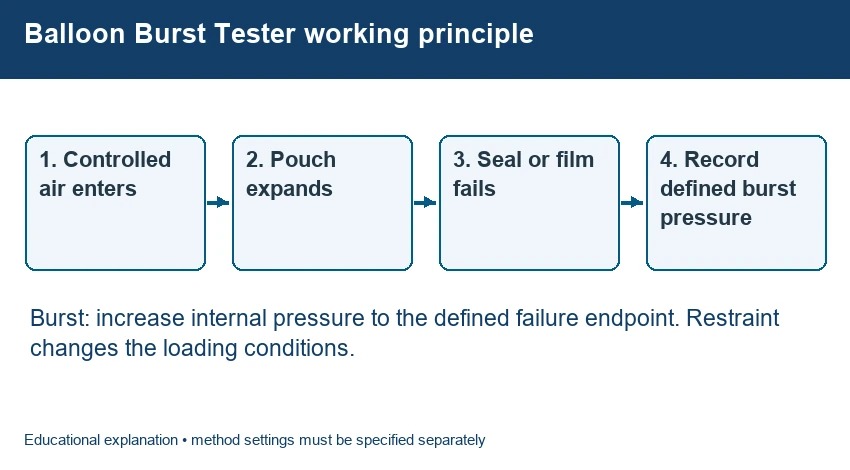
Air enters the package through an appropriate connection while a pressure sensor monitors the internal pressure. The package expands, putting its film and seals under stress. When a seal opens or the material ruptures, pressure can fall and the test reaches its defined failure endpoint. The instrument must capture the relevant peak rather than simply display the pressure remaining after the package has opened.
Airflow and package pressure describe different things. Airflow is the rate at which air enters; pressure is the resulting loading condition inside the pouch. A regulator setting at the compressed-air supply is not automatically the pressure at the specimen. Restrictions in tubing, leakage at the connection and the changing volume of the inflating package affect the relationship. Record the actual measurement channel and units used for the test result.
A flexible pouch is also different from a flat paper specimen held over a rubber diaphragm. In a hydraulic bursting strength test, fluid pressure expands the diaphragm against the sheet. In this pneumatic package test, air acts inside the package. Results from these instruments must not be substituted for each other simply because both names contain the word burst.
Restraining plates change how a pouch is allowed to expand. They can direct attention towards the perimeter seals, but they also change the test boundary conditions. Plate spacing, rigidity and specimen positioning therefore belong in the test record. An unrestrained result and a restrained result should be treated as different test configurations unless a justified correlation has been established.
Balloon Burst Tester diagram and component functions
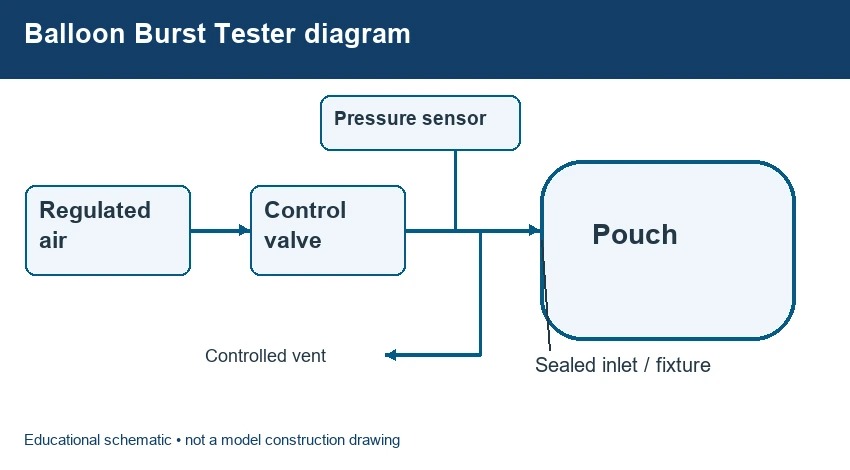
The educational diagram shows the functional air path rather than the internal construction of a particular Pacorr model. Read it from the regulated supply through the control valve to the specimen connection. The pressure-sensing branch monitors the test circuit; the exhaust path permits controlled depressurisation. A package fixture supports the specimen without unintentionally restraining the area being evaluated.
| Component | Function and point to confirm |
|---|---|
| Regulated air supply | Provides a suitable, controlled source; confirm cleanliness and inlet-pressure requirements. |
| Control valve and air path | Introduce air under the chosen test conditions; confirm available flow or pressure controls. |
| Connection and clamp | Establish a repeatable seal around an opening or an approved puncture connection. |
| Pressure sensor and display | Measure and report pressure; confirm range, resolution and calibration coverage. |
| Exhaust arrangement | Releases trapped air before the specimen is handled. |
| Optional restraining plates | Limit expansion for a compatible method; record the spacing and fixture. |
A puncture port and an open-edge clamp are not interchangeable preparation instructions. Some packages are connected through a sealed insertion point; others are held at an open side. The correct arrangement depends on the package and instrument accessories. Ask for a demonstration using your actual pouch construction and have the connection procedure documented. A poorly sealed insertion point can create an apparent low-strength result that is actually a preparation problem.
Which configurations and specimens are suitable?
Unrestrained burst testing evaluates the package while allowing it to expand under the defined conditions. Restrained burst testing uses plates and needs a compatible fixture. A pressure-hold or creep test asks a different question: whether a package withstands a selected pressure for a specified time, or how long it survives at that pressure. A peak-hold display alone does not establish that an instrument can perform a controlled creep test.
Typical candidate specimens include flexible film pouches, laminated sachets and bags that can be connected and pressurised appropriately. Packaging engineers should consider the film structure, seal geometry, pouch dimensions, gussets and intended filling condition. A porous material may require equipment with appropriate airflow capability and a validated procedure. Do not assume that every breathable, blister or irregular package can be tested on the same standard fixture.
An empty pouch can be useful for evaluating packaging construction, but its result does not automatically represent a filled production pack. Contents change the available air volume and may affect the way the package expands. If an empty configuration is chosen for routine quality control, define that choice in the specification and establish how the result supports the manufacturing decision.
The test is destructive. Plan sample collection so that quality decisions are based on representative production rather than unusually neat laboratory samples. Include the relevant sealing positions, production times and material lots in the sampling plan. The number of specimens must come from the applicable method or approved quality plan, not an arbitrary universal rule.
Which technical specifications should buyers verify?
Pacorr's published listing gives the following selected details. They describe a listed configuration rather than guaranteed suitability for every pouch. Obtain a signed specification sheet identifying the offered model and accessories. In particular, clarify whether a quoted pneumatic pressure describes the specimen measurement range, the control range or the required air supply.
| Published item | Listed value or clarification |
|---|---|
| Model | PCBBT-001 |
| Specimen accommodation | Up to 5 × 5 inches, approximately 127 × 127 mm |
| Listed pressure range | 2–5 bar; confirm the meaning and usable specimen measurement range |
| Listed resolution | 0.1 bar; resolution is not an accuracy statement |
| Electrical supply | 220 V AC, 50 Hz, single phase |
Source: Pacorr PCBBT-001 listing, checked 10 November 2026. One bar equals 100 kPa, so 0.1 bar corresponds to 10 kPa. This conversion explains the displayed increment; it does not establish measurement uncertainty or a suitable acceptance tolerance.
Ask how quickly the instrument samples pressure and captures a sudden failure. Also ask whether reports include the pressure history, whether test recipes can be retained, and which settings are actually adjustable. These are purchasing questions, not claims that every listed model includes those functions. If your expected results lie close to the bottom of a measurement range, request evidence of performance there.
How is a balloon burst test prepared and performed?
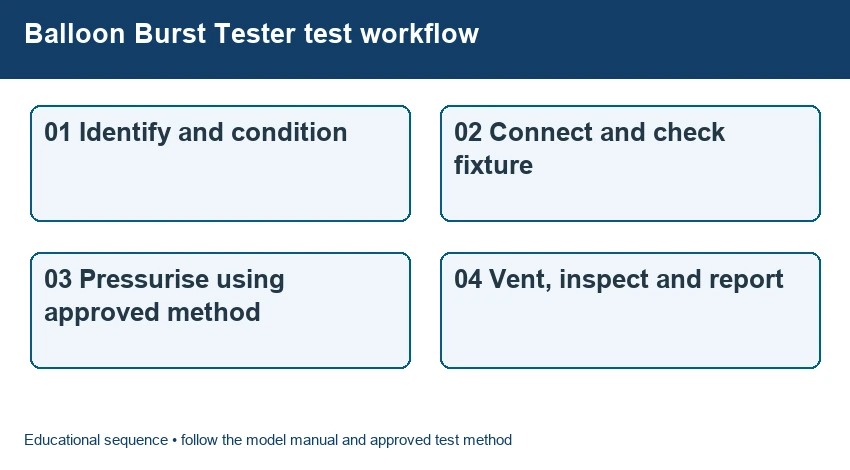
The sequence below is educational. It deliberately does not prescribe pressure ramps, airflow settings, dwell times, clamp forces or acceptance limits. Those parameters must be selected for the method, specimen and equipment. Only trained operators should use the machine, with suitable protection from sudden pouch failure and moving clamps.
- Define the purpose. Decide whether you are comparing seal settings, investigating a complaint, qualifying a laminate or checking a production lot. Identify the required method, specimen condition, endpoint and decision rule before testing begins.
- Identify the samples. Record the material construction, pouch dimensions, seal arrangement, production lot and sample location. Preserve relevant information about sealing equipment and process changes so that an unusual result can be traced.
- Complete conditioning. Follow the specified storage and environmental conditions. Keep conditioned samples identified and avoid mixing them with newly collected specimens. Record deviations instead of assuming that laboratory exposure has no effect.
- Inspect the instrument. Check the condition of tubing, connections, clamps and any protective enclosure. Verify that the measurement system has suitable calibration coverage and that the selected range can accommodate the expected result without exceeding equipment limits.
- Install the correct fixture. Choose the approved open-package or closed-package connection. If restraining plates are required, set and record their spacing according to the method. Do not add improvised restraints merely to obtain a higher number.
- Connect the specimen. Position it consistently and create the required seal at the inlet. Avoid folds, wrinkles and damage introduced by the fixture. Keep the intended test seals clear of accidental contact that could alter their loading.
- Enter the authorised settings. Select the correct units, test mode and endpoint. Clear the previous peak only as instructed. Check that a stored result has not been mistaken for the current sample's live reading.
- Run the pressure challenge. Keep clear of the specimen and clamp assembly. Observe only from the safe operating position. Record abnormal inflation, connection leakage or fixture movement without attempting to correct them while the package is pressurised.
- Depressurise and examine. Follow the manufacturer's stop and vent procedure before handling the sample. Locate the failure and distinguish seal opening, film rupture and leakage around the test connection. Preserve photographs when they support an investigation.
- Review and report. Apply the method's validity rules, document excluded results with reasons, and compare valid results with the approved specification. Retain individual measurements as well as any summary statistics.
Do not retest a damaged pouch as though it were a new specimen. Even an interrupted inflation can change the specimen. Record interrupted tests and follow the agreed replacement-sample procedure. Repeating only low results until a satisfactory result appears would distort the evidence and conceal a possible process problem.
How should burst pressure and failure location be interpreted?
Burst pressure describes performance under the recorded test conditions. It does not isolate every possible cause of failure. If the film ruptures away from the seal, the result does not directly establish the ultimate strength of every seal segment. If air escapes at the connection, the test may say more about specimen preparation than package construction. Failure location is therefore part of the result, not an optional comment.
Review individual values before looking only at an average. A similar average with a much wider spread may indicate inconsistent sealing or preparation. A cluster of failures at one corner may suggest a geometry or handling issue worth investigating. These observations are starting points for investigation; they do not prove a particular root cause without supporting process evidence.
When comparing two pouch designs, keep the test conditions equivalent and state any unavoidable differences. Changing pouch size can change expansion and loading. Changing restraint can change which region fails first. A purchasing specification should describe the accepted test configuration so that supplier and customer are comparing the same property.
An educational unit example illustrates reporting: a recorded pressure of 1.2 bar is 120 kPa. This is a hypothetical conversion, not a recommended test setting, a claimed PCBBT-001 operating point or a pass threshold. Preserve the original displayed value and its units, then document any conversion used in the final report.
Burst testing is not a substitute for all leak testing. A small leak may be important to package integrity without defining the burst endpoint. Likewise, a package that resists pressure may still have a defect relevant to its intended use. Combine test methods according to the package risk assessment rather than asking one instrument to establish every aspect of protection or shelf life.
Which standards apply, and what do they actually cover?
ASTM F1140/F1140M addresses internal-pressurisation failure resistance of unrestrained packages. Burst and creep approaches ask different questions. ASTM F2054/F2054M concerns flexible-package perimeter seals tested by internal air pressure within restraining plates. The presence or absence of plates is an essential distinction.
ASTM F2054 also explains that the restrained test does not establish overall package integrity or seal uniformity, and results need not correlate with unrestrained burst or peel-strength measurements. Keep the selected method with the reported value. Referencing a standard number without identifying the actual test arrangement can make otherwise accurate data misleading.
ASTM's F2095 research-report listing identifies pressure-decay leak testing, which is a different measurement from burst strength. Do not relabel a burst result as a pressure-decay leak result. Similarly, a reference to ISO 11607 in a supplier's literature is not proof that one burst test validates a complete sterile-barrier system. Confirm the applicable packaging requirements with the responsible quality team.
Use the edition specified by the contract or quality system and obtain the complete standard for implementation. Public scope summaries help select a method; they do not replace the full requirements for apparatus, sampling, conditioning, calculations and reporting. Ask the supplier to identify which requirements the proposed machine configuration can support.
What is the Balloon Burst Tester price in India?
The official Pacorr product page lists an indicative range of ₹55,000–₹1,50,000, checked on 10 November 2026. This is a published category guide, not a current binding quotation for your application. Confirm availability, model, accessories, taxes and commercial validity directly with Pacorr before budgeting or ordering.
Configuration affects the quotation. A basic arrangement for one pouch format differs from a system requiring special clamps, restraining plates, a different measurement range or additional reporting functions. The compressed-air installation and any required treatment equipment should be considered separately if they are not included in the supply.
Request an itemised offer covering the instrument, fixtures, software where applicable, calibration documents, installation, training and delivery. Ask whether GST is included and whether the quotation covers the actual specimens you intend to test. A lower total is only useful when the offered scope meets the same technical requirement.
How do you select equipment and establish a useful QC method?
Begin with a specimen brief rather than a catalogue price. Include drawings or dimensions, laminate construction, seal layout, expected pressure, required standard and the daily number of tests. State whether samples are open or closed, empty or filled, and whether they include gussets, spouts or unusual features. These details determine the connection and fixture requirements.
Ask for a trial using representative samples, including difficult formats rather than only the easiest pouch. Review how the specimen is mounted, how failure is identified and how the operator records the result. A demonstration should establish practical suitability, not merely show that a package can be inflated until it breaks.
For production implementation, write down the complete method and train operators using the same examples. Compare results obtained by different operators with a controlled sample set. Investigate variation in preparation and failure classification before setting tight process limits. Instrument repeatability alone does not establish the repeatability of the complete sampling and testing process.
When a process change is evaluated, retain both the measurements and relevant production conditions. If sealing temperature, dwell or pressure changes, record the actual process settings without importing them into the laboratory test as universal recommendations. The aim is to understand the relationship for that packaging system, not to create a rule for every laminate.
For a broader view of flexible-package evaluation, read Pacorr's guide to mechanical testing of poly films and laminates. Its discussion of seal and film tests helps place whole-package burst testing within a wider quality programme. Pacorr's article on plastic pouch sealing and testing provides related packaging context; select each test according to the failure mode you need to investigate.
What errors, maintenance tasks and calibration checks matter?
Before investigating a suspected sealing problem, review the records from the air connection and fixture checks. If several unrelated pouch lots suddenly produce unusual results, the common test system deserves attention alongside the production process. If only one format behaves differently, examine its connection geometry and expansion pattern before drawing conclusions about the whole material supply.
For a useful comparison study, prepare a result sheet that records both numerical and descriptive information. Include the sample identity, material lot, pouch size, preparation method, restraint condition, units, settings and failure location. Add a field for observations such as connection leakage or an interrupted cycle. This makes it possible to distinguish a manufacturing trend from a change in laboratory practice.
Keep the approved method under revision control. When a fixture, software setting or specimen preparation step changes, assess whether the change affects comparability with earlier results. Train operators on the revised procedure and record its effective date. Historical data are most useful when the laboratory can explain how they were produced, rather than merely retrieve a column of pressure values.
Connection leaks, inconsistent restraint and unrecorded test-mode changes are common sources of misleading comparisons. Another error is treating display resolution as accuracy. A display that changes in small increments can still have a larger uncertainty, especially outside the verified working range. Request calibration evidence for the pressure measurement that is actually used in the result.
Inspect seals, tubing and clamps at the intervals required by the manufacturer. Clean fixtures using compatible methods and keep contamination away from the air path. Replace damaged parts with approved equivalents. Do not compensate for a worn seal by tightening a clamp beyond the documented procedure; that can introduce new specimen damage or equipment risk.
Calibration intervals should follow the laboratory's quality system, usage, service history and manufacturer guidance. Repairs, suspect readings or changes to the pressure-measuring circuit may require additional verification. A zero check is useful but is not a complete calibration. Check the entire measurement chain and keep the equipment identification with the certificate and test records.
Frequently asked questions
Does a Balloon Burst Tester test ordinary latex balloons?
This guide covers Pacorr's flexible-package application. Testing latex balloons or medical balloon devices requires a separately verified instrument, fixture and method; the shared word balloon does not establish suitability.
Can burst pressure prove that a pouch has no leaks?
No. Burst pressure measures resistance to a defined internal-pressure challenge. Small-leak detection and overall package integrity may require additional methods suited to the package and its intended use.
Are restrained and unrestrained burst values interchangeable?
No. Restraining plates change package expansion and loading. Compare values only under equivalent, documented conditions or through a justified correlation study.
What is the difference between resolution and accuracy?
Resolution is the smallest displayed increment. Accuracy concerns closeness to the reference value under stated conditions. The listed 0.1 bar increment does not by itself establish an accuracy tolerance.
What details should I send for a quotation?
Send pouch dimensions, material structure, seal layout, open or closed condition, expected pressure, required method, restraint needs, reporting requirements and installation location. Include representative specimens where possible.
Can I use one result as the acceptance limit for all pouches?
No. Acceptance criteria must be established for the package, intended use and approved test method. A convenient number from another pouch or instrument is not a justified quality limit.
Discuss your pouch testing requirement with Pacorr
A useful burst-testing programme connects the instrument, specimen preparation and quality decision. Specify the pressure measurement you need, keep the test conditions consistent and examine where the package fails. This produces more useful evidence than a peak value without context.
For a configuration review, share your pouch samples, dimensions and required method through Pacorr's enquiry page. Call +91-8882149230 or email info@pacorr.com. Request a written specification and quotation for the actual application, including fixtures and documentation.