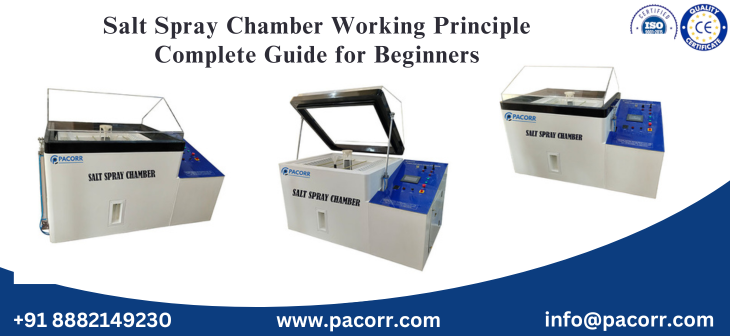
Pacorr provides advanced corrosion testing equipment designed to help manufacturers evaluate the durability, reliability, and corrosion resistance of materials, coatings, and finished products. In industries where metal parts, painted surfaces, plated components, and protective coatings are exposed to moisture, salt, and changing environments, corrosion testing becomes an essential part of quality control.
Corrosion can reduce product life, affect appearance, weaken mechanical strength, and lead to costly failures. This is especially important in automotive, electronics, packaging, metal fabrication, aerospace, marine, and coating industries. To prevent such failures, manufacturers use a salt spray test chamber to perform accelerated corrosion testing under controlled laboratory conditions.
Understanding the Salt Spray Chamber Working Principle helps beginners and industrial users know how this equipment creates a corrosive environment, how test specimens are exposed, and how results are interpreted for quality assurance.
What is a Salt Spray Chamber?
A salt spray chamber is an environmental test chamber used to evaluate the corrosion resistance of materials and surface coatings. It creates a controlled salt-laden fog environment inside a closed chamber, allowing test samples to be exposed continuously for a specific duration.
The main purpose of a salt spray test chamber is to simulate corrosive conditions in an accelerated manner. Instead of waiting months or years to observe rust or coating failure in real-world environments, manufacturers can conduct salt fog testing within hours or days.
Salt spray chambers are widely used in:
- Automotive components
- Painted and powder-coated parts
- Zinc-plated, nickel-plated, and chrome-plated metals
- Fasteners, nuts, bolts, and screws
- Electronic enclosures and connectors
- Packaging materials with metal closures
- Marine and industrial metal parts
In quality assurance, salt spray testing helps manufacturers compare coating performance, verify production consistency, validate surface treatments, and comply with international testing standards.
Detailed Salt Spray Chamber Working Principle
The Salt Spray Chamber Working Principle is based on creating a controlled corrosive atmosphere using a salt solution, compressed air, atomization, temperature control, and continuous exposure. The chamber converts a prepared sodium chloride solution into a fine salt fog and maintains a stable environment to accelerate corrosion on test specimens.
1. Preparation of Salt Solution
The first step in the salt spray test procedure is preparing the salt solution. In most standard tests, a sodium chloride solution is used. For the commonly followed ASTM B117 salt spray test and ISO 9227 corrosion test, the solution typically contains 5% sodium chloride by weight.
This means 5 parts of sodium chloride are dissolved in 95 parts of purified or distilled water. The quality of water is important because impurities can affect test results.
Important parameters include:
- Sodium chloride concentration
- pH value of the solution
- Water purity
- Solution temperature
- Cleanliness of the reservoir tank
For neutral salt spray testing, the pH is generally maintained between 6.5 and 7.2. If the pH is too acidic or too alkaline, corrosion behavior may change and results may not comply with standards.
2. Role of Compressed Air and Atomization
Compressed air plays a key role in the Salt Spray Chamber Working Principle. The chamber uses clean, oil-free compressed air to convert the salt solution into a fine mist.
Before entering the spray nozzle, compressed air usually passes through an air saturator. The air saturator warms and humidifies the air so that the fog formation remains stable and consistent. This step helps prevent excessive drying and supports uniform salt fog generation.
When compressed air meets the salt solution at the spray nozzle, atomization occurs. Atomization means breaking the liquid into very tiny droplets. These droplets form a fine salt fog that spreads throughout the chamber.
3. Formation of Salt Fog or Mist
The spray nozzle and fog tower are responsible for generating and distributing the salt mist. The salt solution is drawn from the reservoir and mixed with compressed air at the nozzle. This produces a continuous fog inside the chamber.
The fog must be fine, uniform, and evenly distributed. If the droplets are too large, they may fall directly on the specimens and cause uneven corrosion. If the fog is too weak, the test may not create enough corrosive exposure.
A properly designed salt spray test chamber ensures that the mist settles gently on all test samples, creating a consistent corrosive environment.
4. Controlled Temperature and Humidity Environment
Temperature control is another important part of the Salt Spray Chamber Working Principle. Most neutral salt spray tests are conducted at around 35°C, depending on the standard and test type.
The heating system maintains a stable chamber temperature, while the humidified salt fog creates a high-moisture environment. This combination of salt, moisture, and heat accelerates the corrosion process.
Humidity and temperature control in testing is essential because corrosion rate changes significantly with environmental conditions. Even small variations in temperature, air pressure, or fog density can affect test accuracy.
5. Continuous Exposure of Test Specimens
Once the chamber reaches the required test conditions, specimens are placed inside on specimen holders. These holders are designed to keep samples at a proper angle, usually between 15° and 30° from vertical, depending on the test requirement.
The samples are then exposed continuously to the salt fog for a fixed duration. Test duration may range from a few hours to hundreds or even thousands of hours, depending on product specifications and customer requirements.
During exposure, salt droplets settle on the specimen surface. The salt solution acts as an electrolyte and supports corrosion reactions. Over time, signs of corrosion may appear, such as:
- Red rust
- White rust
- Blistering
- Peeling
- Coating breakdown
- Surface discoloration
- Loss of adhesion
6. Corrosion Acceleration Mechanism
Salt spray testing is a form of accelerated corrosion testing. It speeds up the natural corrosion process by providing continuous salt, moisture, oxygen, and controlled heat.
In simple terms, corrosion is an electrochemical reaction. When a metal surface is exposed to salt water and oxygen, tiny electrical cells form on the surface. Some areas of the metal act as anodes, while others act as cathodes.
At the anodic area, metal atoms lose electrons and turn into metal ions. This is where corrosion starts. At the cathodic area, oxygen reacts with water and electrons. The salt solution improves electrical conductivity, allowing the corrosion reaction to happen faster.
For iron or steel, this process eventually forms rust. Protective coatings slow down this reaction by creating a barrier between the metal and the corrosive environment. Salt spray testing helps determine how long that barrier can resist failure.
Key Components of a Salt Spray Chamber and Their Functions
A salt spray chamber works efficiently because several components operate together in a controlled system. Each part contributes directly to the Salt Spray Chamber Working Principle.
Air Saturator
The air saturator humidifies and heats compressed air before it reaches the spray nozzle. This helps maintain stable fog formation and prevents dry air from disturbing the chamber environment.
Fog Tower
The fog tower helps distribute the salt mist evenly inside the chamber. It supports uniform fog circulation and reduces direct spray impact on test specimens.
Spray Nozzle
The spray nozzle atomizes the salt solution using compressed air. It is one of the most critical parts of the chamber because it controls fog quality, droplet size, and spray consistency.
Specimen Holder
Specimen holders support test samples at the required angle. They are usually made from corrosion-resistant materials so they do not react with the salt fog or contaminate the test.
Heating System
The heating system maintains the required chamber temperature. Accurate temperature control ensures repeatable results and compliance with ASTM B117 and ISO 9227 requirements.
Control Panel
The control panel allows users to set and monitor test parameters such as temperature, test duration, air pressure, and operating status. Advanced chambers may include digital controllers, alarms, timers, and data logging features.
Reservoir Tank
The reservoir tank stores the prepared salt solution. It supplies the solution continuously to the spray system during testing. A clean and properly maintained reservoir is necessary for accurate corrosion resistance testing.
Types of Salt Spray Tests
Different products and coatings require different salt spray test methods. The most common types are NSS, AASS, and CASS.
Neutral Salt Spray Test
Neutral Salt Spray, or NSS, is the most widely used method. It uses a 5% sodium chloride solution with a neutral pH. This test is commonly used for painted parts, plated coatings, automotive components, and general metal products.
Acetic Acid Salt Spray Test
Acetic Acid Salt Spray, or AASS, uses a salt solution acidified with acetic acid. It creates a more aggressive environment than neutral salt spray. This method is often used for decorative coatings and certain plated surfaces.
Copper Accelerated Acetic Acid Salt Spray Test
Copper Accelerated Acetic Acid Salt Spray, or CASS, is even more aggressive. It includes copper chloride in an acidic salt solution. CASS testing is commonly used for evaluating nickel-chromium coatings, decorative plating, and high-performance surface finishes.
The main difference between these tests is the severity of the corrosive environment. NSS is milder, AASS is more aggressive, and CASS is the most severe among the three.
Testing Standards and Compliance
Salt spray testing must be performed according to recognized standards to ensure accuracy, repeatability, and global acceptance.
ASTM B117 Salt Spray Test
The ASTM B117 salt spray test is one of the most commonly used corrosion testing standards. It defines conditions for neutral salt spray testing, including salt concentration, chamber temperature, fog collection rate, pH range, and sample placement.
ISO 9227 Corrosion Test
The ISO 9227 corrosion test covers neutral salt spray, acetic acid salt spray, and copper accelerated acetic acid salt spray methods. It is widely used by manufacturers, laboratories, and quality control departments across different industries.
Standardization is important because it ensures that test results are comparable. Without standard conditions, two laboratories may produce different results for the same material.
Applications Across Industries
Salt spray testing has practical importance in many industries where corrosion protection is critical.
Automotive Industry
Automotive manufacturers use salt spray testing for fasteners, painted panels, brake components, exhaust parts, suspension parts, and plated fittings. Vehicles often face road salt, rain, humidity, and harsh outdoor conditions.
Coatings and Paints
Paint manufacturers and coating applicators use salt spray testing to check coating adhesion, blister resistance, and corrosion protection performance.
Electronics Industry
Electronic enclosures, connectors, terminals, and metal housings are tested to ensure they can resist moisture and salt exposure, especially in coastal or industrial environments.
Packaging Industry
Metal caps, closures, containers, and packaging components are tested for corrosion resistance to protect product appearance and safety.
Metals and Alloys
Steel, aluminum, zinc, copper, and coated alloys are tested to compare surface treatments and select suitable materials for specific applications.
Advantages of Salt Spray Testing
Salt spray testing remains popular because it provides several practical benefits.
- It gives faster results than natural exposure testing.
- It supports comparison between coatings and materials.
- It helps detect defects in plating, painting, and surface treatment.
- It is cost-effective for routine quality control.
- It supports compliance with customer and industry standards.
- It helps manufacturers improve product durability before market release.
For production teams, salt spray testing is useful because it can quickly identify process issues such as poor cleaning, weak coating thickness, improper curing, or defective plating.
Limitations of Salt Spray Testing
Although salt spray testing is valuable, it has limitations. The chamber creates a continuous salt fog environment, but real-world conditions are more complex. In actual use, products may experience drying cycles, UV exposure, pollution, temperature changes, mechanical wear, and different chemical contaminants.
Because of this, salt spray test results should not always be treated as exact predictions of real service life. A product that performs well for 500 hours in a salt spray chamber may not directly equal a fixed number of years outdoors.
For more complete evaluation, salt spray testing may be combined with:
- Humidity testing
- Cyclic corrosion testing
- UV weathering
- Adhesion testing
- Coating thickness measurement
- Outdoor exposure testing
This balanced approach gives a better understanding of long-term product performance.
Why Choose Pacorr Salt Spray Chambers?
Pacorr Salt Spray Chambers are designed for reliable, precise, and standards-based corrosion resistance testing. They help manufacturers perform accurate salt fog testing for metals, coatings, plated parts, painted components, and industrial products.
Pacorr focuses on strong chamber construction, uniform fog distribution, accurate temperature control, user-friendly operation, and dependable performance. The chambers are suitable for quality laboratories, production units, research facilities, and industrial testing environments.
Key reasons to choose Pacorr include:
- Reliable performance for accelerated corrosion testing
- Compliance-focused design for ASTM B117 and ISO 9227 testing
- Precise control of temperature, fog, and test duration
- Durable construction for long service life
- Easy operation for beginners and professionals
- Strong technical support and product guidance
For businesses that need dependable corrosion testing equipment, Pacorr provides practical solutions that support product quality, customer confidence, and industry compliance.
Conclusion
The Salt Spray Chamber Working Principle is based on creating a controlled salt fog environment that accelerates corrosion on test specimens. By using a prepared sodium chloride solution, compressed air, atomization, temperature control, and continuous exposure, the chamber helps manufacturers evaluate corrosion resistance in a shorter time.
From automotive parts and coatings to electronics, packaging, and metal products, salt spray testing plays a major role in quality assurance. When performed according to standards such as ASTM B117 and ISO 9227, it provides useful data for comparing materials, validating coatings, and improving product durability.
For product inquiries, technical guidance, or expert consultation on Pacorr Salt Spray Chambers, contact:
Email: info@pacorr.com
Phone: +91 8882149230
Get in touch with Pacorr today to choose the right salt spray chamber for your corrosion testing requirements.
Recent Blogs
Enhance your understanding of testing and precise quality control indistinct applications with our
knowledge based articles coming from top editors of industry leaders.

Our USP's
Demonstration of Machine
- Try Before You Decide
- Experience Before You Invest
- See It in Action – Free Demo
Global Reach
- Delivering Excellence Worldwide
- Serving Across Borders
- Your Global Supply Partner
On-Site Support
- Support That Comes to You
- On-Ground Assistance, Anywhere
- We Reach Where You Are
Team Strength
- Powered by Expert Minds
- Driven by Skilled Professionals
- Engineering Excellence Team
Manufacturing
- Precision-Driven Manufacturing
- Smart & Automated Production
- Engineered In-House Excellence
