
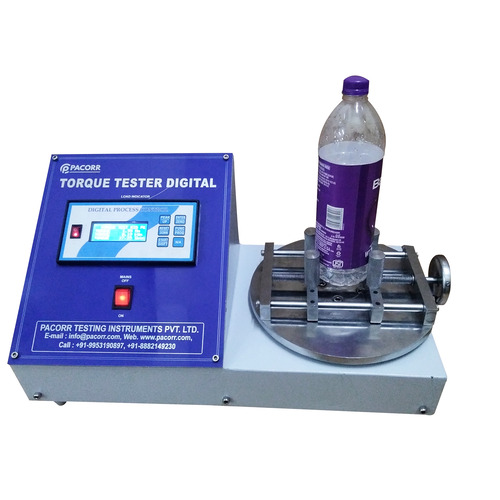
A Bottle Cap Torque Tester measures the turning effort required to apply or remove a threaded bottle closure. It helps packaging teams check cap tightness, investigate opening difficulties and assess whether closure performance stays within an approved specification. Instead of relying on how tight a cap feels, manufacturers can record a measurement and compare samples under defined conditions. Pacorr offers bottle cap torque testing solutions for routine inspection, packaging development and documented quality control. The appropriate configuration depends on the container, closure, expected torque and testing procedure. Digital, motorised and computerised options address different needs, from individual measurements to controlled rotation and electronic reporting.
- Shipping Area: All over the world
- Model: PCBCTT-001
- Brand: Pacorr
- Availability: In Stock


Why Closure Tightness Needs to Be Measured
A bottle can look correctly capped and still behave differently from the next bottle on the line. Small changes in the closure assembly or capping process may affect how securely the cap sits and how difficult it is to remove. Tightening a cap further is not always the right solution. Excessive tightening can make opening difficult or damage packaging components. Insufficient tightening may leave the closure inadequately secured. The aim is to establish a suitable operating window for the complete package. Torque measurements help manufacturers evaluate that window. They provide evidence for adjusting a process, comparing packaging components and investigating complaints. Their value depends on a consistent method and meaningful acceptance limits.
What Does a Bottle Cap Torque Tester Measure?
Torque describes rotational effort around an axis. It is commonly expressed in units such as N·m, N·cm or lbf·in. The selected unit should remain consistent throughout an inspection record. Bottle closure testing can involve several different measurements.
| Measurement | Meaning Question | It helps answer |
| Application torque | Torque applied while tightening a cap | Was the closure applied under the intended conditions? |
| Initial removal torque | Torque associated with starting to loosen the cap | How much effort is needed to begin opening? |
| Peak torque | Highest torque captured within the selected test interval | What was the maximum measured resistance during that interval? |
| Torque retention | Evaluation of torque behaviour after defined periods or conditioning | How does closure performance change over time? |
These results should be labelled accurately. A recorded maximum is only useful when the test interval and the event being measured are understood.
For example, a closure with a tamper-evident band may produce distinct events during opening. A tester that displays one overall maximum may not distinguish initial loosening from band breakage. Select the measurement function around the information required.
Application Torque and Removal Torque Are Different
Application torque is measured during tightening. Removal torque is measured during loosening. They describe different stages of the closure’s use and should not be substituted for one another. A removal measurement taken from a finished bottle does not directly reveal the exact torque originally applied by the capper. The relationship must be evaluated for the particular packaging assembly and test conditions. This distinction matters when investigating a complaint. If customers report difficult opening, testing only the application setting may leave an important question unanswered. Conversely, an acceptable opening reading does not establish that every part of the capping process is operating correctly. A useful inspection procedure states what is measured, when it is measured and how the result will be interpreted.
How Bottle Cap Torque Testing Works
The instrument holds the container securely while the closure is turned manually or through a motor-driven mechanism. A sensing system measures the torque generated during the movement. The reading may be observed on a display, retained as a peak value or recorded through a connected system, depending on the configuration. The fixture is part of the measurement process. It must prevent unwanted movement without distorting the bottle. Where a cap-engagement fixture is used, it must also transfer the rotational movement without slipping or changing the closure’s shape. Good alignment allows the test to focus on the intended rotational action. Poor positioning can introduce unwanted loading and make results harder to interpret.
Which Type of Tester Should You Choose?
Digital Bottle Cap Torque Tester
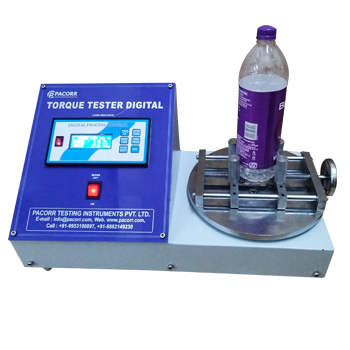
A manually operated digital configuration is suitable when the operator turns the cap and reads the measurement electronically. It can support routine sample checks where the method is straightforward and operator technique is controlled. Evaluate the display functions, suitable measurement range and fixture arrangement before selecting the model.
Motorised Bottle Cap Torque Tester
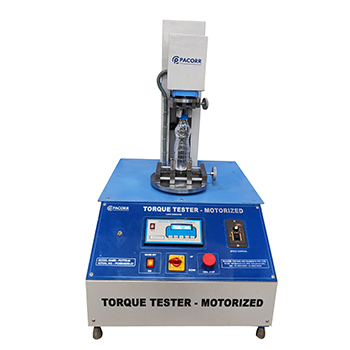
A motorised configuration provides the rotational movement through the machine. It is worth considering when consistency of movement is important or manual turning introduces unwanted variation. Confirm the available movement settings, fixture requirements and test sequence. Motorisation alone does not mean automatic sample loading or unattended batch testing.
Computerised Bottle Cap Torque Tester
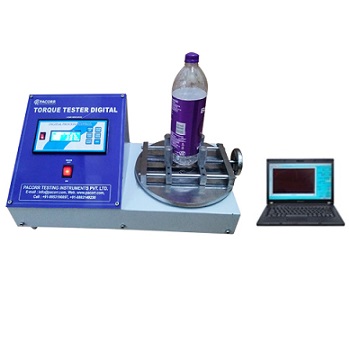
A computerised configuration supports measurement records through a connected computer. It is relevant when sample identification, report preparation and retrieval of previous results are important. Confirm the actual software functions and available report fields. Computer connectivity does not automatically include continuous graphs, audit trails or every export format. These categories can overlap. The final choice should be based on the complete configuration rather than the name alone.
Selecting the Right Measurement Range
Start with the torque expected from representative samples. The instrument must accommodate those values without overload, but choosing the highest available capacity is not necessarily the best approach. Accuracy specifications need careful interpretation. Some are expressed as a percentage of full scale, while others refer to the reading or include additional terms. As an illustration, 0.5% of a 20 N·m full scale equals 0.1 N·m. This example explains the calculation; it is not a specification for every tester. For a low-torque closure with narrow acceptance limits, that distinction can be important. Resolution also needs to suit the task. A display showing many decimal places does not establish that the instrument can measure accurately to every displayed digit. Discuss the normal operating values, tolerance window and calibration requirements when selecting the range.
Checking Bottle and Cap Compatibility
A bottle-diameter range provides only part of the information needed to assess suitability.
Also consider:
- Container height and available fixture clearance
- Round, oval, rectangular or irregular body shape
- Flexible or easily deformed bottle walls
- Closure diameter, height and surface profile
- Access to the cap during testing
- Special opening actions or additional closure components
Do not assume that the bottle-holding range is also the cap-fixture range. They describe different parts of the setup. Physical samples are particularly helpful when the package has an unusual shape or a closure that is difficult to grip. A sample trial can reveal positioning issues that are not obvious from a drawing.
A Practical Procedure for Reliable Results
Define the inspection objective
State whether the test concerns tightening, first opening or performance after conditioning. Identify the exact result to record.
Establish sample identification
Record enough information to trace the bottle, cap, liner and batch. Include the capping source or production details where these are relevant to the investigation.
Control the condition of the samples
Follow a consistent procedure for filling, capping, storage and testing. Record the elapsed time between capping and measurement.
Prepare the holding arrangement
Position the sample centrally and secure it without deformation. Check for movement before beginning the test.
Check the instrument settings
Confirm the unit, calibration status, zero and measurement function. Use the operating instructions for the selected model.
Perform the prescribed movement
For manual testing, use the agreed handling technique. For motorised testing, apply the documented operating settings.
Record observations alongside readings
Note slipping, visible damage or unusual movement. A numerical result from an unstable setup should not be accepted without investigation.
Opening and retightening a cap changes the sample’s history. Use fresh specimens when the method requires an undisturbed first-opening measurement.
Understanding Variation Between Samples
Different readings do not always mean that the instrument is faulty or that the packaging is defective. Variation can arise from both the product and the measurement process.
When results differ unexpectedly, investigate systematically.
| Observation | Useful checks |
| One operator obtains consistently different results | Handling technique, alignment, movement and interpretation of the reading |
| Readings vary across a production sample | Component differences, capping conditions and sample timing |
| The container slips | Fixture suitability, positioning and clamping |
| Results change after storage | Conditioning period, storage environment and closure behaviour |
| A high peak appears unexpectedly | The opening event captured, fixture interference or sample damage |
These checks help narrow the investigation. They do not establish a cause without supporting evidence. Where several operators use the instrument, evaluate whether the measurement procedure produces sufficiently consistent results across the team before using small differences to make production decisions.
Establishing Acceptance Limits
There is no universal torque limit suitable for every bottle cap. Begin with the packaging supplier’s recommendations and evaluate the complete assembly under its intended conditions of use. Opening requirements, closure security and other packaging tests should inform the approved limits. The process target and the acceptance limits also serve different purposes. A target guides the process towards the desired result; limits define the acceptable inspection window. Setting a target too close to a limit can leave little room for normal variation. Document the sampling plan as well as the limits. One acceptable bottle does not establish that an entire batch is acceptable.
When reviewing a group of results, examine individual readings and their spread. An average can appear satisfactory even when some samples fall outside the approved range.
Torque Testing and Leak Testing
Torque testing evaluates rotational effort. Leak testing evaluates whether leakage occurs under specified conditions. The two can support the same packaging investigation, but neither should be treated as a substitute for the other. A closure may produce an acceptable torque reading while a damaged liner or sealing surface still causes leakage. Similarly, a package that passes a particular leak test may still require an opening-effort assessment. Select the combination of tests around the risks and requirements of the finished package.
Applications in Packaging Development and Production
- Routine process checks: Test samples at defined intervals to monitor whether closure measurements remain within the approved window.
- Component evaluation: Compare proposed bottles, caps and liners using equivalent preparation and test conditions.
- Supplier discussions: Support a concern with identified samples and recorded measurements rather than a general statement that closures feel different.
- Complaint investigations: Examine returned or representative samples alongside production records and packaging history.
- Packaging changes: Reassess closure behaviour when a component, supplier or process condition changes.
These applications are relevant to compatible threaded packaging used in food, beverages, pharmaceuticals, personal care, household products and other industries.
Calibration and Ongoing Care
Calibration helps establish how the instrument compares with reference measurements. Routine checks and correct use help maintain confidence between calibrations. Define the calibration interval through the quality procedure, considering usage, measurement importance, operating history and manufacturer guidance. Overload, damage or repair may require an earlier assessment. Keep the holding components clean and inspect them for wear or damage. Follow the operating instructions when installing fixtures, zeroing the instrument and applying loads. A calibration certificate does not compensate for a slipping sample or an unsuitable test method. Measurement confidence depends on the instrument and the way it is used.
Bottle Cap Torque Tester Price
Price depends on the measurement configuration, actuation, fixtures, reporting functions and documentation included.
For an accurate quotation, share:
- Bottle and cap dimensions or representative samples
- Expected torque values and acceptance limits
- Required test direction and procedure
- Number of samples tested during normal use
- Report or data-transfer requirements
- Calibration and accessory requirements
Compare quotations against the same scope. Confirm which fixtures, cables, software and documents are included so that the equipment can support the intended inspection task.
Frequently Asked Questions
Can the instrument check whether a cap is too tight?
It measures torque for comparison with an approved limit. Whether a result is too high depends on the packaging specification and test method.
Can the same tester measure both opening and closing torque?
Suitable configurations can support both directions. Confirm the measurement functions and fixture arrangement for the model being selected.
Why does opening torque change after a bottle has been stored?
The closure assembly can behave differently over time. Compare samples using controlled storage conditions and consistent intervals between capping and testing.
Can it test glass bottles and plastic jars?
Potentially, provided the sample geometry and closure suit the holding arrangement. The container must remain secure without damage or deformation.
Can it measure a flip-top lid’s opening force?
Lifting a hinged lid is different from rotating a threaded cap. The correct equipment depends on which opening action needs to be measured.
Is a higher-capacity tester always better?
No. Capacity must suit the expected load, while accuracy, resolution and calibration coverage must suit the measurement requirement.
Does computerised testing automatically provide compliant records?
No. Confirm the software functions against your organisation’s documentation requirements. Record control also depends on the procedures used to create, review and store the data.
What should I provide for a product demonstration?
Send representative packaging samples, the intended measurement and any existing inspection procedure. This allows the demonstration to address your actual application.
Request a Bottle Cap Torque Tester Quotation
Discuss your closure-testing requirements with Pacorr Testing Instruments. Share your bottle and cap samples, expected torque range and documentation needs to help identify a suitable configuration.
Phone: +91-8882149230
Email: info@pacorr.com
Website: www.pacorr.com
Write Your Review
Get a Quote
Share your requirement and our team will reply shortly.
+91-8882149230
Related Products
Our Clients























Our USP's
Demonstration of Machine
- Try Before You Decide
- Experience Before You Invest
- See It in Action – Free Demo
Global Reach
- Delivering Excellence Worldwide
- Serving Across Borders
- Your Global Supply Partner
On-Site Support
- Support That Comes to You
- On-Ground Assistance, Anywhere
- We Reach Where You Are
Team Strength
- Powered by Expert Minds
- Driven by Skilled Professionals
- Engineering Excellence Team
Manufacturing
- Precision-Driven Manufacturing
- Smart & Automated Production
- Engineered In-House Excellence
