
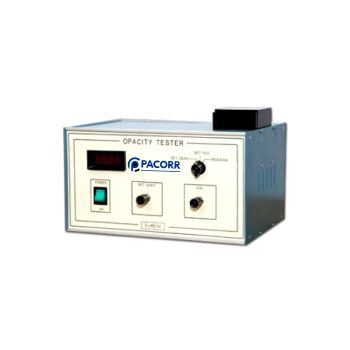
An Opacity Tester is a precision optical testing instrument used to determine the opacity or light-blocking ability of plastic materials. It helps manufacturers evaluate whether a test specimen allows or restricts the required amount of light transmission. Accurate opacity measurement is particularly useful in plastic processing and quality-control laboratories where material composition, pigmentation, additives and wall thickness can influence the optical properties of the finished product. The instrument provides direct digital measurement, making routine opacity testing faster and easier to reproduce during incoming material inspection, production control and final product evaluation.
- Shipping Area: All over the world
- Model: PCOT-1
- Brand: Pacorr
- Availability: In Stock


What is an Opacity Tester?
An Opacity Tester measures how effectively a material prevents light from passing through it. When a specimen is exposed to a controlled light source, a detector measures the amount of light transmitted through the test area. The instrument processes this optical response and provides the result as percentage opacity. Opacity testing can help manufacturers identify variations between production batches that may result from changes in material formulation, pigment concentration, wall thickness or processing conditions. The tester is particularly useful for rigid plastic samples and plastic pipe sections where controlled light transmission can be an important quality parameter. Its digital measurement system eliminates the uncertainty associated with visual comparison and provides numerical results that can be recorded for quality-control purposes.
Working Principle of Opacity Tester
The Opacity Tester works on the principle of controlled light transmission.
A prepared specimen is positioned between the light source and the optical detector. Light emitted from the source falls on the specimen, while the detector measures the light reaching the opposite side. The measured optical signal is converted into an opacity value and displayed digitally. A material that blocks a greater proportion of incident light will show higher opacity, whereas a material allowing more light to pass will have comparatively lower opacity.
For reliable comparison between samples, specimens should be tested under consistent positioning, surface condition and thickness wherever applicable.
Key Features
- Digital LED display for clear test-result observation
- Direct measurement in percentage opacity
- Measurement range from 0 to 99.9%
- High measurement resolution of 0.01%
- Controlled optical measurement system
- Convenient sample positioning for routine laboratory testing
- Compact construction suitable for quality-control laboratories
- Powder-coated body for regular industrial use
- Simple operating procedure for repetitive testing
- Suitable for comparative evaluation of plastic samples
Applications of Opacity Tester
The instrument can be used for quality evaluation of materials where light-blocking performance needs to be monitored, including:
- Plastic pipe specimens
- Rigid plastic components
- Plastic sheets
- Moulded plastic samples
- Pigmented plastic products
- Polymer-based components
- Production and batch comparison samples
- Research and quality-control specimens
The exact application and test method should always be selected according to the material, product specification and applicable testing standard.
Why is Opacity Testing Important?
Opacity is not simply an appearance parameter. In many plastic products, light transmission can indicate whether the required material formulation and product construction have been achieved. Changes in pigment loading, additives, raw-material composition, processing conditions or specimen thickness can affect optical performance. Measuring opacity therefore provides manufacturers with objective data that can be compared between different batches or against an established product specification. Routine testing can help identify unexpected production variations before material is approved for dispatch or further processing.
Benefits of Using an Opacity Tester
Using a digital Opacity Tester provides an objective method of evaluating light-blocking performance instead of depending on visual judgment.
The instrument is useful for:
- Comparing opacity between production batches
- Monitoring consistency in plastic manufacturing
- Evaluating the effect of pigment or formulation changes
- Checking finished products against internal quality requirements
- Supporting laboratory documentation and inspection records
- Detecting unexpected variation in material optical properties
- Improving repeatability of routine quality-control testing
Because the result is displayed numerically, operators can document and compare measurements more effectively than with subjective visual inspection.
How to Use an Opacity Tester
Before testing, ensure that the instrument and sample area are clean and that the specimen is suitable for the test method.
- Switch on the instrument and allow it to stabilize as required.
- Perform the required zero/reference setting according to the operating procedure.
- Prepare a representative specimen from the product or production batch.
- Position the specimen correctly between the light source and detector.
- Ensure that the test area is properly covered and consistently positioned.
- Take the measurement.
- Record the displayed percentage opacity.
- Repeat the measurement at additional locations when required by the applicable test procedure.
- Compare the results with the specified acceptance criteria.
Consistent specimen preparation and positioning are important when comparing results between different samples.
Factors That Can Affect Opacity Test Results
Several material and testing variables can influence the measured opacity of plastic products, including:
- Specimen thickness
- Pigment concentration
- Carbon black or other additives
- Polymer formulation
- Surface texture
- Colour of the material
- Sample positioning
- Contamination on the optical path or specimen
- Variation within the manufactured product
For meaningful comparison, test conditions and specimen preparation should therefore remain consistent.
Industries Served
- Plastic Pipe Manufacturing
- Polymer Processing
- Plastic Product Manufacturing
- Raw Material Testing Laboratories
- Quality Control Laboratories
- Research and Development Laboratories
- Plastic Components Manufacturing
Frequently Asked Questions
What does an Opacity Tester measure?
An Opacity Tester measures the ability of a specimen to block the transmission of light and provides the measurement as an opacity value.
What is the difference between opacity and transparency?
Opacity represents the ability of a material to restrict light transmission, while transparency describes its ability to allow light to pass through. A highly opaque material generally transmits less light.
Can an Opacity Tester be used for plastic pipes?
Yes. Opacity measurement is commonly used for evaluating plastic pipe and fitting specimens where light transmission is a specified quality parameter.
What factors affect the opacity of plastic?
Material thickness, pigment concentration, additives, polymer formulation, colour, surface condition and processing variation can influence opacity.
Why should multiple locations on a specimen be tested?
Testing different locations can help identify variation across the product and provide a more representative understanding of its optical performance.
What is the measuring range of this Opacity Tester?
The instrument has a measurement range of 0 to 99.9% opacity with a resolution of 0.01%.
Is opacity testing the same as haze testing?
No. Opacity primarily evaluates the extent to which a material blocks transmitted light, while haze measures scattering that reduces the clarity of transmitted light. The two parameters should not be treated as interchangeable.
Write Your Review
Get a Quote
Share your requirement and our team will reply shortly.
+91-8882149230
Related Products
Our Clients
























Our USP's
Demonstration of Machine
- Try Before You Decide
- Experience Before You Invest
- See It in Action – Free Demo
Global Reach
- Delivering Excellence Worldwide
- Serving Across Borders
- Your Global Supply Partner
On-Site Support
- Support That Comes to You
- On-Ground Assistance, Anywhere
- We Reach Where You Are
Team Strength
- Powered by Expert Minds
- Driven by Skilled Professionals
- Engineering Excellence Team
Manufacturing
- Precision-Driven Manufacturing
- Smart & Automated Production
- Engineered In-House Excellence
