
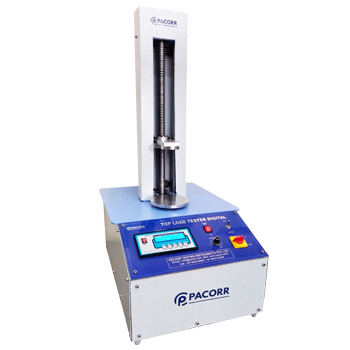
A Pouch Compression Tester is designed to evaluate how flexible and filled packaging pouches behave when subjected to controlled compressive force. During storage, stacking, transportation and handling, pouches may experience pressure from surrounding packages or secondary packaging. Insufficient compression strength can result in deformation, seal damage, leakage or complete package failure. The tester applies a controlled compressive load to the pouch and helps quality-control teams study its structural resistance under repeatable laboratory conditions. It is useful for evaluating flexible packaging used for food, beverages, personal care products, pharmaceuticals and other packaged goods.
- Shipping Area: All over the world
- Model: PCPCT-100
- Brand: Pacorr
- Availability: In Stock


What is a Pouch Compression Tester?
A Pouch Compression Tester is a laboratory testing instrument used to determine the compression resistance of flexible packages and filled pouches. The sample is positioned between compression surfaces and subjected to gradually increasing force at a controlled test speed. As compression increases, the instrument measures the load being applied to the package. This allows manufacturers to determine how much external pressure the pouch can withstand before excessive deformation, seal failure, leakage or structural collapse occurs.
Compression testing is particularly important for pouches because their performance depends on several factors, including film structure, laminate thickness, sealing quality, product filling level, pouch geometry and internal pressure. Testing the complete pouch provides practical information about the performance of the finished package rather than evaluating only the packaging material.
What Does a Pouch Compression Test Measure?
Pouch compression testing can help evaluate:
- Maximum load sustained by the pouch
- Resistance to external compressive pressure
- Deformation under increasing load
- Structural stability of a filled package
- Performance of heat-sealed areas
- Comparative strength of different pouch designs
- Effect of filling volume on package resistance
- Potential weakness during stacking and handling
The exact acceptance criteria should be defined according to the packaging design, product characteristics and internal quality requirements.
Working Principle of Pouch Compression Teste
The working principle is based on controlled compression of the test specimen. A prepared pouch is placed in the testing area between the compression surfaces. The moving compression mechanism approaches the sample at a selected test speed. As the pouch is compressed, the load sensor continuously measures the force acting on it. The force increases as the package resists deformation. The operator observes the measured compression load and the physical condition of the package during the test.
Depending on the test objective, the test can be stopped at a predetermined load, specified deformation or package failure point. Comparing these results across multiple samples helps identify variations in package strength and manufacturing consistency.
Why Compression Strength Matters in Flexible Packaging
Flexible pouches may appear lightweight, but they frequently experience mechanical pressure throughout the supply chain. During bulk packing, transportation or warehouse storage, one pouch may press against another. Filled pouches packed inside cartons can also experience localised pressure from adjacent packs. A weak package may distort, lose its intended shape or place excessive stress on the seal. Compression testing helps packaging engineers understand whether the finished pouch has enough mechanical resistance for its intended handling conditions.
It can also help compare changes in:
- Packaging film structure
- Laminate construction
- Seal parameters
- Pouch dimensions
- Filling quantity
- Packaging material supplier
- Product formulation
This makes compression testing useful during both routine quality control and packaging development.
Key Features
The Pouch Compression Tester is designed to provide controlled and repeatable compression testing for flexible packaging.
Key features include:
- Load capacity suitable for pouch compression evaluation
- Precision load sensing system
- Controlled motorized compression movement
- Adjustable testing speed
- Digital or microprocessor-based load indication
- Fine measurement resolution
- Stable compression arrangement for repeatable testing
- Suitable clearance for different pouch dimensions
- Easy sample placement and test operation
These features help improve consistency when comparing different production batches or packaging configurations.
Applications of Pouch Compression Tester
The tester can be used for evaluating packaging such as:
- Stand-up pouches
- Flexible laminated pouches
- Food packaging pouches
- Liquid-filled pouches
- Sachets
- Pharmaceutical flexible packs
- Personal care product pouches
- Household product packaging
- Trial and prototype pouch designs
Actual sample suitability should always be confirmed according to pouch size, test load and machine configuration.
How to Perform a Pouch Compression Test
Place the pouch centrally in the testing area so that the compressive load is applied in a repeatable manner. Select the required testing speed according to the internal test method. Begin the test and allow the compression mechanism to apply force gradually to the pouch. Observe both the displayed load and the physical behaviour of the package. Note any visible deformation, seal opening, leakage or sudden loss of resistance. Record the required value, such as maximum compression load or load at a defined deformation. Multiple samples from the same batch should preferably be tested because flexible packaging can show variation due to filling, sealing and material differences.
Understanding Pouch Compression Test Results
A compression value should not be viewed as an isolated number.
The result becomes more useful when compared with:
- Approved reference samples
- Previous production batches
- Different laminate structures
- Alternative pouch designs
- Different sealing parameters
- Different filling levels
For example, if two pouch structures contain the same product but one consistently withstands greater compression without leakage or seal failure, that design may offer better mechanical resistance.
However, compression test results should not automatically be interpreted as the exact stacking life or transport life of a package. Real distribution conditions can also involve vibration, impact, temperature variation and prolonged loading.
Benefits of Using a Pouch Compression Tester
Using a Pouch Compression Tester provides manufacturers with objective data rather than relying only on visual inspection.
It can help:
- Identify weak pouch constructions
- Detect variations between production batches
- Compare different packaging materials
- Evaluate seal and package performance
- Improve packaging development decisions
- Reduce the risk of leakage during handling
- Establish internal compression acceptance limits
- Support supplier and material comparison
The test is especially valuable where leakage or package deformation can lead to product rejection, contamination or secondary packaging damage.
Specifications should be selected according to the expected pouch dimensions, filling condition and maximum compression load.
Industries Using Pouch Compression Testing
The instrument is suitable for quality-control and packaging development laboratories in industries such as:
- Food and beverages
- Flexible packaging
- FMCG
- Pharmaceuticals
- Personal care and cosmetics
- Household products
- Chemical packaging
- Packaging research and development
Why Choose the Right Pouch Compression Tester?
Selecting the correct tester requires more than checking maximum load capacity. The equipment should provide sufficient testing clearance for the intended pouch size, suitable load resolution, stable sample positioning and controlled compression speed. The machine capacity should also be comfortably above the normal expected test load so that measurements can be performed without operating continuously near the instrument's maximum limit.cFor repeatable results, the same sample orientation, filling quantity, conditioning procedure and test speed should be maintained during comparative testing.
Frequently Asked Questions
What is a Pouch Compression Tester used for?
It is used to measure the resistance of flexible or filled pouches against controlled compressive force and to evaluate deformation or package failure under load.
Can filled pouches be tested?
Yes. Filled pouch testing is particularly useful because it evaluates the behaviour of the complete packaging system, including the film, seals, pouch design and product filling condition.
What can cause a pouch to fail during compression?
Failure may be influenced by weak seals, insufficient laminate strength, incorrect filling level, pouch geometry, material variation or excessive external load.
Does a higher compression value always mean better packaging?
Not necessarily. Compression strength should be evaluated together with seal integrity, material usage, product protection and actual distribution requirements.
Can compression testing help compare two pouch materials?
Yes. When pouch dimensions, filling conditions and test parameters are kept consistent, compression testing can provide useful comparative data between different packaging structures.
Why should multiple pouch samples be tested?
Flexible packaging can vary because of sealing conditions, film thickness, filling quantity and manufacturing variation. Testing multiple samples provides a more representative understanding of batch performance.
Is pouch compression strength the same as burst strength?
No. Compression testing applies an external compressive force to the package, while burst-related testing evaluates resistance to pressure that causes material or package rupture. The test methods measure different aspects of packaging performance.
What test speed should be used?
The test speed should be defined according to the laboratory's validated test method, product specification or customer requirement. The same speed should be maintained when comparing different samples.
Write Your Review
Get a Quote
Share your requirement and our team will reply shortly.
+91-8882149230
Related Products

Our Clients
























Our USP's
Demonstration of Machine
- Try Before You Decide
- Experience Before You Invest
- See It in Action – Free Demo
Global Reach
- Delivering Excellence Worldwide
- Serving Across Borders
- Your Global Supply Partner
On-Site Support
- Support That Comes to You
- On-Ground Assistance, Anywhere
- We Reach Where You Are
Team Strength
- Powered by Expert Minds
- Driven by Skilled Professionals
- Engineering Excellence Team
Manufacturing
- Precision-Driven Manufacturing
- Smart & Automated Production
- Engineered In-House Excellence
