What is a Bottle Cap Torque Tester?
A Bottle Cap Torque Tester measures the turning moment involved in applying or removing a bottle closure. It holds the container in a fixture while a torque-measuring system records the rotational loading associated with cap movement. The result is torque, commonly expressed in newton metres, rather than a straight pulling force or a pressure reading.
For manufacturers, the instrument helps investigate the balance between closure security and practical opening. A closure that is insufficiently tightened may behave differently from one that is overtightened, but the torque number alone does not establish sealing performance or usability. The bottle neck, cap, liner, contents, capping process and storage conditions form a packaging system that must be evaluated together.
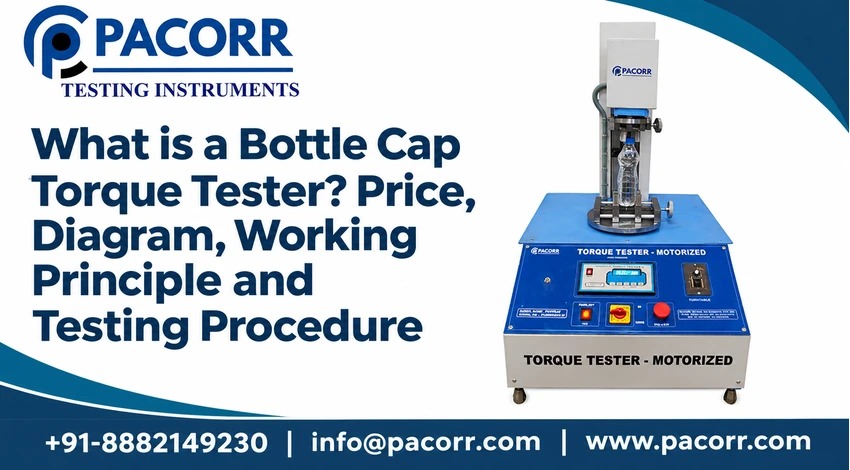
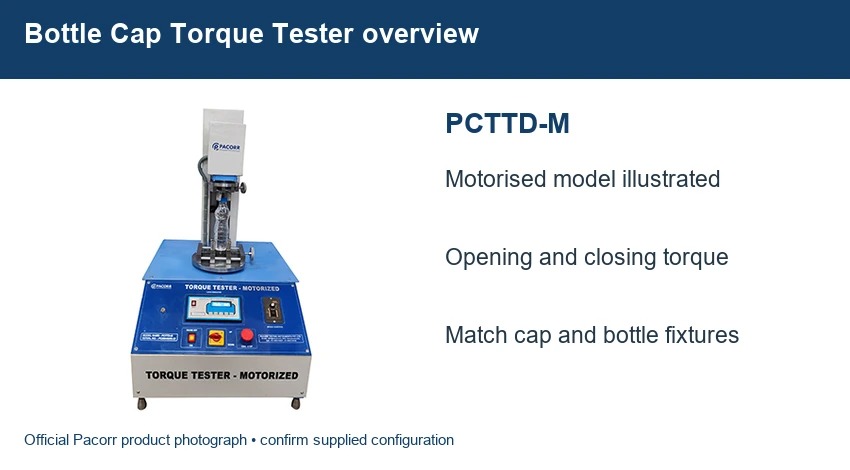
This article explains the test principle, apparatus, educational procedure and purchasing considerations. It uses Pacorr's motorised Bottle Cap Torque Tester as a documented product example. Manual and motorised configurations must not be confused. Follow the instructions for the delivered model and the test method specified by your quality system; the discussion below is not a substitute for those operating documents.
How does a cap torque tester work?
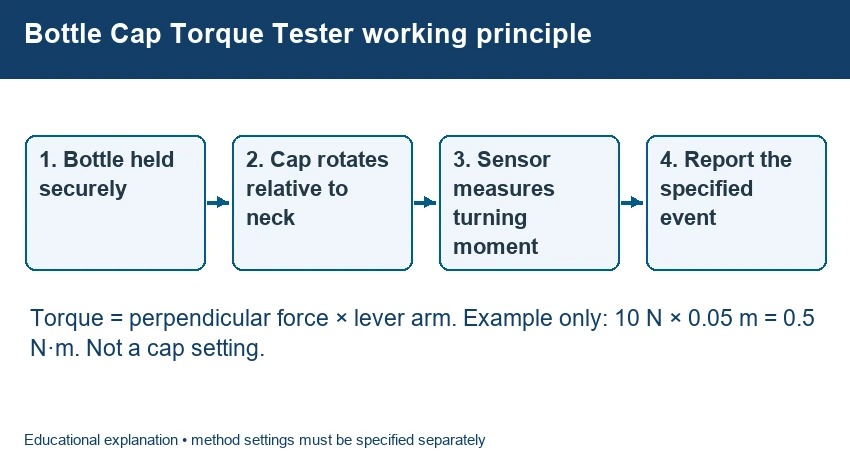
Torque is the turning effect of a force about an axis. For a force acting perpendicular to a lever arm, torque equals the force multiplied by the perpendicular distance from the axis. The SI unit is N·m. In a closure test, the measuring system senses the rotational loading transmitted through the cap, bottle and fixture arrangement.
The container is restrained while the cap rotates relative to the neck. In a manual test, an operator applies the rotation using the specified handling technique. In a motorised test, a drive rotates the closure through a suitable gripping head. The machine records the relevant torque response, which may include a peak associated with initial movement or another endpoint defined by the method.
Application torque and removal torque are different measurements. Application torque concerns closing the cap; removal torque concerns opening it. A cap's removal result after storage cannot simply be assumed equal to the torque applied on the filling line. Changes in the closure system over time make the elapsed interval and conditioning important parts of the record.
The initial breakaway event may also differ from subsequent running torque. A tamper-evident band can introduce an additional event during removal. If the equipment reports only the largest peak, confirm which physical event produced it. A number labelled opening torque is incomplete unless the procedure explains what was measured and how competing events were treated.
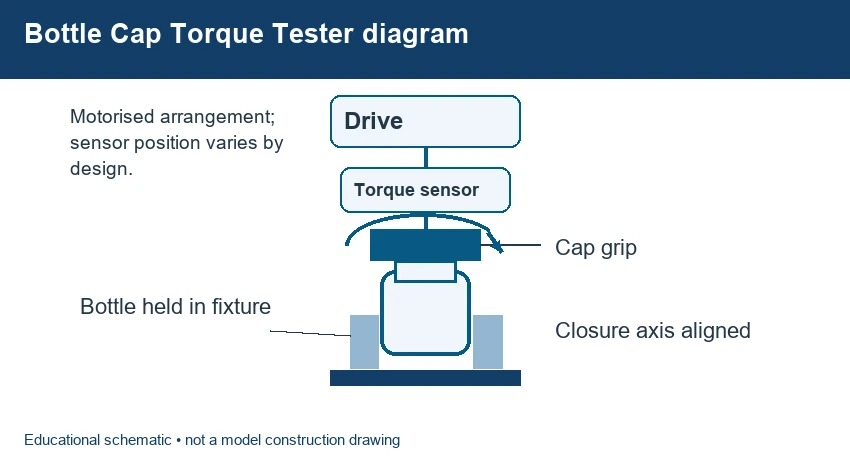
Bottle Cap Torque Tester diagram and components
The diagram represents a generic motorised closure-test arrangement. It separates the drive, cap grip, bottle fixture and torque-measuring path so that their functions are clear. Actual sensor positions and transmissions vary between designs. The illustration is educational and does not claim to expose the internal construction of Pacorr's instrument.
| Component | Function and selection question |
|---|---|
| Motor and rotating head | Turn the closure under controlled conditions; confirm available speed and control options. |
| Cap chuck or gripping adapter | Transmit rotation without slipping or distorting the closure. |
| Bottle-holding fixture | Restrain the container while preserving its relevant shape. |
| Torque sensor | Measure rotational loading within the specified range. |
| Controller and display | Indicate units and the selected result; reporting features depend on configuration. |
| Vertical adjustment | Accommodate the bottle and align the closure with the rotating axis. |
Alignment deserves particular attention. If the cap axis and drive axis do not coincide, the fixture can introduce bending or side loading. If the container slips, part of the measured movement no longer represents cap removal. If the cap chuck squeezes a thin closure excessively, the test arrangement can change the behaviour it is intended to measure.
A useful supplier demonstration should include fitting the actual bottle and cap, setting the height and gripping the closure correctly. A fixture advertised for a range of bottle diameters may still need a special adapter for a non-circular bottle, a fragile container or a closure with unusual geometry. Confirm the complete gripping arrangement rather than relying on one diameter figure.
Which tester configuration should you choose?
Manual testers can be appropriate when the chosen method specifies manual torque testing and the procedure controls operator technique. They are often used to obtain defined application or removal measurements. The operator's grip, movement and consistency remain part of the test system and should be covered by training and verification.
Motorised testers control the rotational action through a drive. They may help standardise the motion, but automation does not remove errors caused by poor alignment, unsuitable fixtures or incorrect endpoint selection. Confirm the actual capabilities of the offered controller. A motorised label alone does not guarantee a stored torque-angle curve, programmable axial loading or every required reporting function.
Computerised reporting is another separate feature. A digital display is not the same as computer connectivity, and a stored peak is not the same as a complete time history. If your quality system requires traceable electronic results, ask for an example export containing specimen identity, units, test direction, settings and result definition.
Child-resistant closures can require combined motions, such as an axial action with rotation, depending on the design. Do not assume that an ordinary cap torque test evaluates child resistance or that a standard chuck can operate every closure. Child-resistance assessment and consumer-use requirements need the appropriate methods and equipment beyond a simple turning measurement.
Where is bottle cap torque testing useful?
Cap torque testing is relevant to threaded closures on compatible bottles and jars used for beverages, personal-care products, household chemicals and other packaged goods. The application is defined by the closure system rather than by industry name alone. A screw cap, a pump dispenser and a snap-fit lid may require different test arrangements and different reported properties.
During packaging development, the test can support comparisons between cap and neck combinations. During production, it can help investigate changes in capping behaviour. During a complaint investigation, it can provide evidence about opening characteristics when representative retained samples and relevant storage histories are available. None of these uses makes the torque result a direct measurement of leakage.
For supplier comparisons, use equivalent bottles, closures, contents and conditioning. A cap tested on a different neck finish may not provide a fair comparison. Keep the capping process and elapsed time consistent, or explicitly study them as separate variables. The best experiment changes the intended variable while documenting the rest.
What do the published specifications mean?
Pacorr's motorised product listing and its PCTTD-M brochure provide the following selected values. Treat them as model-specific catalogue information and obtain confirmation for the unit being quoted.
| Specification | Published PCTTD-M detail |
|---|---|
| Torque capacity | 20 N·m |
| Stated accuracy | 0.5% of full-scale deflection |
| Sample diameter range | 15–200 mm; confirm the actual bottle and fixture |
| Maximum vertical traverse | 400 mm |
| Power supply | 230 V AC |
| Opening and closing | Motorised |
At a nominal 20 N·m full scale, 0.5% corresponds arithmetically to 0.1 N·m. This explains a full-scale percentage; it is not a substitute for the calibration certificate, a statement of uncertainty, or proof of performance at every low torque. Ask the supplier how the accuracy specification is applied and what range has been verified.
Select capacity using both the highest expected torque and the lowest measurement that matters. An instrument with ample maximum capacity can still be unsuitable if low-level readings need finer performance. Ask about overload protection, both rotational directions, available units and the correct calibration accessories. Confirm the usable test space after the cap chuck and bottle fixture are installed.
How should specimens and the test method be prepared?
Write the test objective before collecting samples. Are you measuring initial removal, torque retention after storage, application behaviour or a particular event during opening? These objectives can require different preparation and different specimens. A test sheet should name the method, units, direction, endpoint, elapsed time and acceptance rule.
Record bottle and closure identification separately. Include the cap liner and tamper-band design where relevant, the contents or filling condition, and the capping equipment used. If samples come from different capping heads, preserve that identity. Otherwise an average can hide a recurring issue associated with one production position.
Avoid opening a closure before an initial-removal test. Opening and reclosing changes the history of the specimen. If a study requires multiple time intervals, plan the sampling accordingly instead of repeatedly measuring the same package and treating each result as its untouched condition. Record any handling that could influence the closure.
Complete the required conditioning and storage period. Keep timing consistent across the sample set, especially when comparing results soon after capping. Record the actual elapsed time rather than a vague label such as fresh sample. Use the complete standard and approved internal procedure for environmental conditions and specimen numbers.
What is the educational testing procedure?
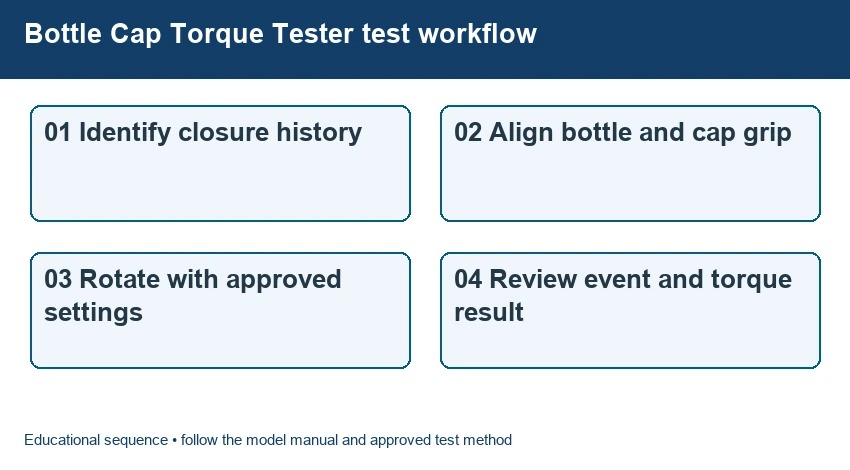
The following sequence explains a motorised workflow. It does not prescribe rotational speed, gripping force, axial force, dwell time or acceptance limits. Those settings depend on the closure, method and machine. Manual testing follows its own equipment instructions and should not silently inherit a motorised procedure.
- Review the test plan. Confirm whether the test concerns application or removal and identify the required endpoint. Check that the instrument and fixture support the selected method and the expected torque range.
- Inspect the equipment. Check the bottle fixture, cap adapter, moving head and protective arrangements. Confirm suitable calibration status and investigate damage or suspect readings before using the machine for acceptance testing.
- Select units and direction. Use the units required by the specification. Confirm the opening or closing direction for the actual closure; do not rely on an assumed direction without checking the package design.
- Install the container. Centre it in the holder and secure it using the approved fixture procedure. Avoid crushing the bottle or changing its shape through excessive clamping. Confirm that it cannot rotate within the holder.
- Align and engage the cap grip. Adjust the head so that rotation follows the closure axis. Use an adapter suited to the cap profile and avoid gripping a part that is not intended to transmit the test torque.
- Zero or tare as instructed. Follow the machine's procedure for the unloaded reference and fixture condition. Do not zero away a genuine preload or use tare to conceal a misaligned or binding setup.
- Apply the authorised test settings. Enter the specified motion and stopping conditions. Confirm how the instrument handles peak detection and any additional events, such as tamper-band breakage, that may affect the reported result.
- Run the test from a safe position. Keep hands clear of rotating components. Observe whether the bottle and chuck remain secure. Stop according to the machine instructions if slipping, abnormal motion or a fixture problem occurs.
- Examine the closure system. Record visible thread damage, cap deformation, liner displacement or tamper-band behaviour where relevant. Separate these observations from the numerical result rather than treating every high peak as a normal opening event.
- Save and review the record. Retain specimen identity, elapsed time, conditions, direction, units and result definition. Apply the approved validity and acceptance rules before releasing a production decision.
Do not compare a hand-operated result with a motorised result without considering method differences. If equipment is being replaced, conduct a planned comparison with representative specimens and documented conditions. Agreement at one convenient torque does not establish equivalence across every closure format or working range.
How do you interpret torque measurements?
A torque value is useful only when it is tied to a defined event. Initial cap movement, continued rotation and tamper-band separation can generate different responses. Review the available trace when the system provides one, and retain observations when it does not. If the largest recorded peak is caused by an unexpected event, investigate before labelling it normal removal torque.
Application and removal values should be recorded separately. The relationship between them is something to establish for the actual package, capping process and storage conditions. Avoid applying a universal percentage conversion or a cap-diameter rule without supporting validation. Different liners, neck finishes and closure constructions can behave differently.
For a retention study, compare samples prepared under the same application conditions and tested at defined intervals. Use an appropriate sampling plan and preserve individual results. Report both the central tendency and the variation requested by the quality procedure. A mean within limits can conceal individual packages that fail an individual-result requirement.
As a purely educational mechanics example, a perpendicular force of 10 N applied at a 0.05 m lever arm produces 0.5 N·m. This is not a recommended cap torque or an instruction to calibrate a tester using an improvised lever. Calibration fixtures, loading geometry and reference equipment must follow an authorised procedure.
Keep force and torque units distinct. A force result in N cannot be substituted for N·m, and a display using kgf·cm is expressing torque, not mass. Preserve the original units and document conversions when data are transferred into spreadsheets or supplier reports. Unit confusion can make an apparently plausible result wrong by a large factor.
Which standards should be considered?
ASTM D2063/D2063M concerns torque retention of packages with continuous-thread closures using non-automated testing equipment. ASTM D7860 addresses torque retention using automated equipment for the closure types within its scope. The manual-versus-automated distinction matters when selecting apparatus and reporting a method.
ASTM's packaging standards catalogue also lists D3474 for calibration and use of torque meters in packaging applications. Use the required edition and the complete document when establishing the laboratory procedure. A general product claim that equipment follows international standards does not establish conformity with every clause for every cap.
Do not treat a torque-retention method as a universal closure acceptance specification. The customer or responsible quality team must define the applicable performance requirement. Additional tests may be needed for leakage, tamper evidence, compatibility or intended-user opening. A torque tester supplies one part of the evidence for those broader packaging decisions.
What is the Bottle Cap Torque Tester price in India?
The live Pacorr motorised product page requests a configuration-specific quotation, as checked on 10 November 2026. A current numerical price could not be verified on that page. Request a written offer for the required instrument and fixtures, and clarify whether the total includes taxes and supporting services. Older cached price ranges should not be treated as current quotations.
Cost depends on the torque range, drive and control capabilities, cap adapters, bottle fixtures and data requirements. A laboratory testing one round bottle may need a different fixture scope from a facility handling many shapes and closure sizes. Requirements for special closure motions should be identified before quotations are compared.
Ask for an itemised offer covering the instrument, adapters, calibration documentation, installation, training, delivery and any software. Review warranty terms and the cost and availability of replacement gripping parts. Confirm whether future bottle formats can be accommodated through additional fixtures or would require a different machine.
What should a buyer demonstrate before ordering?
Prepare an application list with bottle dimensions, cap geometry, expected torque, method and reporting needs. Include the smallest and largest formats as well as any fragile or irregular containers. A nominal diameter range does not show whether the fixture will hold every listed shape without deformation.
During a demonstration, watch the complete sequence from loading to result export. Check the time required to change fixtures, the clarity of recipe selection and the ability to identify a slipping specimen. Request results from representative samples, including low-torque cases, rather than relying only on a demonstration near the middle of the range.
For a production laboratory, consider how operator access and recordkeeping fit the daily workload. A fast measurement is not useful if sample identity is lost during transfer to a spreadsheet. Define naming conventions, result review responsibilities and how invalid tests are recorded. These practical controls often matter as much as the display itself.
For a research laboratory, consider whether the instrument provides the measurement history needed to distinguish different opening events. Confirm the export format and review a real example. Do not purchase on the assumption that a feature can be added later without checking hardware, software and fixture compatibility.
For related reading, Pacorr's explanation of why torque testing matters for bottle caps introduces application and removal measurements. To plan a separate closure-integrity assessment, see the Secure Seal Tester and ASTM D4991 bottle leak-testing guide. Use these as complementary topics: a torque reading and a leak-test result answer different questions about the bottle and closure system.
What causes errors, and how should calibration be managed?
Common errors include a slipping bottle, an unsuitable cap chuck, off-axis rotation, inconsistent specimen history and an incorrectly selected direction or unit. A high value may arise from binding or deformation rather than the intended closure resistance. Record unusual behaviour and investigate the setup instead of simply repeating the test until the number looks expected.
Clean gripping surfaces using methods compatible with the fixtures and the packaging materials. Product residue can change gripping behaviour or interfere with movement. Inspect adapters and moving parts for wear according to the manufacturer schedule. Keep unauthorised lubricants away from cap and neck surfaces because they can alter the test specimen.
Calibration should address the relevant torque range and directions with suitable reference equipment. The interval depends on the quality system, usage, service history and manufacturer guidance. An overload, repair or unexplained shift may require verification before routine testing resumes. A zero indication does not prove the whole range is calibrated.
Keep the instrument identification, fixture details and calibration records linked to the test method. If a replacement sensor or adapter changes the measurement arrangement, assess the impact rather than assuming historical results remain directly comparable. Periodic checks with a controlled procedure can help identify drift, but they should not be described as a complete calibration unless they meet that requirement.
Frequently asked questions
Is cap torque the same as cap sealing strength?
No. Torque measures rotational loading during a defined closing or opening event. Sealing performance depends on the complete container-closure system and may require separate leakage or integrity testing.
Should removal torque equal application torque?
No universal equality should be assumed. The relationship depends on the package, capping process, elapsed time and storage conditions, and should be established for the actual closure system.
Does a motorised tester eliminate every operator error?
No. Controlled rotation can improve consistency of motion, but alignment, gripping, specimen history, method selection and result interpretation still require control.
Can the largest peak always be reported as initial opening torque?
No. A peak may arise from tamper-band separation, binding or another event. The test procedure must identify the intended endpoint and distinguish relevant events.
Can one fixture hold every bottle within its diameter range?
Not necessarily. Bottle shape, stiffness, height and cap geometry also matter. Demonstrate the actual formats and confirm any required adapters before ordering.
What should I send Pacorr for a quotation?
Provide bottle and cap dimensions, closure design, expected torque range, manual or motorised method, required outputs, daily workload and installation details. Representative samples help confirm fixture suitability.
Discuss cap torque testing with Pacorr
Reliable cap torque testing starts with a clearly defined event and a well-controlled specimen history. Match the fixture to the bottle and cap, select the correct method, and keep the result connected to its units and conditions. This makes the measurement useful for development, production review and supplier discussions.
Send your application through Pacorr's enquiry page, call +91-8882149230, or email info@pacorr.com. Request a model-specific demonstration and written quotation covering the fixtures and documentation your laboratory needs.