
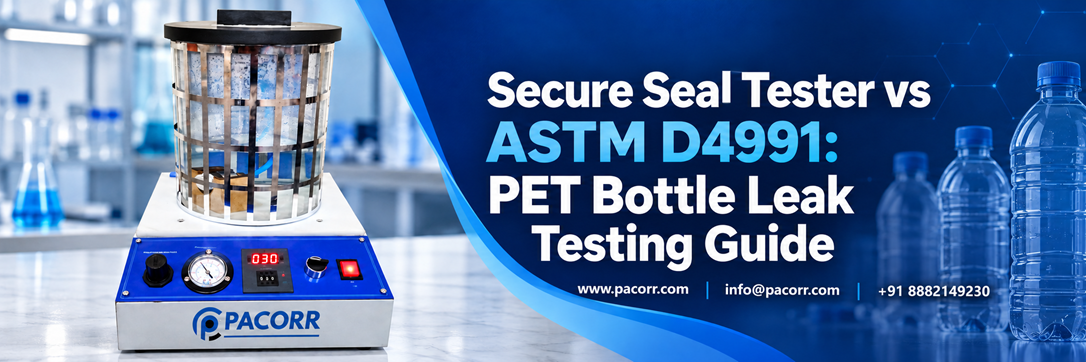
A Secure Seal Tester using internal air pressure raises pressure inside a specimen to evaluate its sealing performance. The ASTM D4991 test method uses external vacuum to evaluate empty rigid containers under differential-pressure conditions. Both approaches create a pressure difference across the package, but their specimen preparation, equipment arrangements and procedures are not interchangeable.
A Secure Seal Tester is an equipment category, while ASTM D4991 is a published test method. Understanding that distinction helps PET bottle manufacturers, beverage packaging teams and quality-control engineers choose testing equipment that matches their actual requirements.
For a packaging team investigating leakage, the starting point is the problem that needs to be assessed. A cap-sealing investigation, a production consistency check and a customer requirement naming a particular standard may require different test arrangements. Defining the objective before selecting settings makes the results more useful.
What Is a Secure Seal Tester?
A Secure Seal Tester evaluates the sealing performance of a suitably prepared specimen under controlled pressure. In PET bottle cap leakage testing, attention usually centres on the bottle–cap interface, where the closure’s sealing element contacts the bottle neck finish.
A cap can look correctly applied while an incomplete seal allows leakage. Visual inspection may identify obvious damage or poor fit, but testing provides additional information about the assembly’s performance under defined conditions.
Seal integrity testing should also be distinguished from burst-strength testing. A seal test evaluates leakage under specified conditions. A burst test investigates structural failure under pressure. A pressure reading alone does not make these tests equivalent.
The specimen determines the scope of the result. Testing a prepared neck-and-cap assembly provides information about that assembly. It cannot establish the integrity of the bottle body that has been removed.
Why Do PET Bottles Leak Around the Cap?
Leakage around the cap can arise from several interacting factors. The closure must match the bottle neck finish, seat correctly and maintain suitable contact at the sealing surface.
Possible causes include:
- Incompatible bottle-neck and closure dimensions.
- Unsuitable or inconsistent closure application torque.
- Damaged threads or incorrectly seated caps.
- Uneven, damaged or contaminated sealing surfaces.
- Variation in the closure’s liner or sealing element.
- Material or moulding variation affecting component fit.
Application torque is the twisting force used to fit a cap. Insufficient application may leave the sealing element inadequately seated, while excessive application can distort or damage components. Increasing torque without investigating the problem is therefore not a reliable corrective action.
Inspect the bottle’s sealing surface as well as the closure. Damage or contamination at either mating surface may interrupt sealing contact.
A failed leak test identifies a performance problem under the applied conditions. It does not prove that the cap alone caused the failure. Bottle condition, closure application, specimen preparation and fixture leakage must also be considered.
How Does Internal Air-Pressure Seal Testing Work?
An internal air-pressure arrangement connects a regulated air supply to the specimen through a suitable fixture. Increasing pressure inside the specimen creates a driving force for air to escape through an available leakage path.
One documented Pacorr arrangement uses a cut bottle-neck specimen fitted with a cap. The assembly is mounted on a fixture and submerged in water. Escaping air can then be observed as bubbles.
Operators must follow the manual for their actual equipment and fixture. Preparation instructions for a cut neck specimen should not automatically be applied to a complete bottle or another packaging format.
The leakage-detection method also needs to be clearly understood. Bubble observation identifies escaping air visually. Pressure-decay measurement requires equipment capable of isolating the test volume, allowing stabilization and measuring pressure change over a defined period.
A digital pressure display does not, by itself, establish pressure-decay capability. Before selecting equipment, confirm whether the proposed configuration provides visual bubble observation, measured pressure decay or another documented output.
What Does ASTM D4991 Cover?
The current edition, ASTM D4991-25, addresses leakage testing of empty rigid containers using a vacuum method. Its scope includes differential-pressure conditions associated with air transport.
External vacuum reduces the pressure surrounding the container. This creates a higher pressure inside relative to outside without requiring direct internal pressurization through a modified closure or container body.
The complete standard must be consulted for specimen preparation, conditioning, test liquid, immersion arrangement, pressure sequence, timing, leakage observations and reporting. A publicly available scope summary is not sufficient to reproduce the procedure.
Test-fluid compatibility also matters because some packaging materials may deteriorate through contact with the liquid used during testing.
For PET packaging, confirm that the intended specimen and application fall within the method’s scope. A procedure for an empty rigid container should not automatically be transferred to a filled beverage bottle or a cut neck assembly.
Selecting the Approach for Your Application
The choice should follow the engineering question and the agreed specification. Internal air-pressure testing may support investigations focused on a closure assembly under approved conditions. Where a customer specifically requires ASTM D4991, the proposed apparatus and procedure need to be assessed against that method.
Similar pressure differences do not establish equivalent test results. Differences in specimen preparation, fixture support, test medium and leakage observation can affect what a test reveals.
Neither approach is universally superior. If a quality team needs to compare results obtained through different methods, it should establish a planned correlation study using representative specimens and defined failure modes.
A product-page standards statement alone does not establish compliance. Any claim that a particular machine can perform a named method should be supported by documentation covering both its capabilities and the procedure used.
Planning a PET Bottle Seal Test
Reliable PET bottle leak testing begins before pressure is applied. The specimen, fixture, settings and acceptance requirements must be defined so that results can be interpreted consistently.
The following considerations support test planning. They do not replace the machine manual or an applicable standard.
Identify the Specimen and Closure Preparation
Assign each specimen an identity linked to its bottle lot, closure lot and relevant production conditions. Record whether it is an intact bottle or a prepared neck assembly.
Include the neck finish, closure design and liner or sealing-element details where applicable. These records help identify whether failures are associated with a particular component combination.
Define how closures are applied and the elapsed time before testing. If the investigation concerns production capping, removing and refitting the cap may change the condition being assessed. Document any preparation that alters the original assembly.
Check Fixture Suitability
The fixture should hold the specimen securely without damaging it or unintentionally supporting the seal under investigation. Connections and fixture seals must also be suitable for the approved operating conditions.
Establish a procedure for checking fixture integrity. Otherwise, leakage from the mounting arrangement could be incorrectly attributed to the bottle or cap.
Where specimen cutting is required, follow the approved preparation instructions. Damage introduced during cutting or mounting may affect the result.
Establish Pressure, Timing and Acceptance Criteria
Test pressure and holding time should come from the validated application procedure, customer requirement or applicable method. There is no universal setting for every PET bottle and closure combination.
The instrument’s maximum pressure capacity is not a recommended test pressure. Safe operating limits must consider the specimen, fixture, connections and equipment together.
Record the pressure units and reference. Gauge pressure is measured relative to ambient pressure, while absolute pressure is measured relative to a vacuum. Clear identification helps prevent incorrect comparisons between reports.
Acceptance criteria should be agreed before testing. Operators need to know what constitutes failure, what makes a test invalid and when a repeat test is permitted.
Recording PET Bottle Seal Test Results
A useful record connects the result with the conditions under which it was obtained. This allows another reviewer to understand the test and supports investigation when performance changes.
A practical test record can include:
- Specimen identification: Unique ID, lot, sampling point and sampling date.
- Bottle details: Material, nominal size, neck finish and specimen form.
- Closure details: Design, size, lot and sealing-element information.
- Preparation: Application method, recorded torque where relevant and elapsed time before testing.
- Conditioning: Relevant temperature, conditioning duration and sample state.
- Equipment: Instrument ID, fixture ID and calibration-status reference.
- Procedure: Approved procedure number, revision and standard edition where applicable.
- Applied settings: Medium, pressure, units, pressure reference and timing.
- Observations: Leakage location, bubble behaviour, readings and unusual events.
- Acceptance reference: The specification and decision criterion used.
- Result: Pass, fail or invalid, including the reason for any retest.
- Traceability: Operator, test date and supporting photographs or data files.
These fields form a planning template, not an ASTM reporting form. Adapt them to the actual procedure and reporting requirements.
Understanding Leakage Observations
Keep observations, measurements and acceptance decisions separate. “Bubbles observed near the closure” describes an observation. A recorded pressure is a measurement. A pass or fail decision requires an approved criterion.
For visual testing, record where bubbles appear and how they behave. An isolated bubble with an uncertain origin should be assessed according to the procedure rather than immediately classified as a defective cap.
No visible bubbles means that no leakage was detected by that procedure under those conditions. It does not demonstrate zero leakage at every possible sensitivity or under every storage and transport condition.
For pressure-decay testing, temperature changes can influence pressure readings. Stabilization helps control that influence. A falling pressure reading therefore requires consideration of the measurement sequence, thermal conditions and potential leakage.
Fixture seals and connections are also part of the test boundary. Check them when results are inconsistent or the leakage location is unclear.
Troubleshooting Common Test Observations
Troubleshooting should treat possible causes as hypotheses to investigate. A test result alone rarely establishes the complete explanation.
Repeated bubbles at the cap interface justify checking closure seating, component compatibility and sealing-surface condition. Review the application conditions alongside the specimen inspection.
Bubbles at the adapter or mounting fixture suggest that the test arrangement needs examination. Check fixture seals, connections and seating using the approved verification procedure.
Variation between specimens may reflect component differences, capping variation or inconsistent preparation. Compare lot identities, dimensional records and application conditions before changing production settings.
If a specimen distorts during testing, stop and review its suitability for the fixture and approved test limits. Distortion may affect the sealing arrangement and the interpretation of the result.
A laboratory pass followed by field leakage calls for a broader investigation. The test conditions may not represent the relevant failure mechanism, or sampling may not capture production variation.
For illustration, if several specimens produce bubbles at the same adapter connection, verifying that connection is a reasonable next step before rejecting the closure lot. This is a hypothetical example, not a Pacorr customer case.
Choosing Suitable Equipment
Equipment selection should begin with the intended specimen and approved procedure. The Pacorr Secure Seal Tester product page provides equipment information, including an advertised customizable pressure range of 0–175 psi and model-dependent display and clamping arrangements.
These specifications describe equipment capability. They do not establish the correct settings for a particular PET package.
Before selecting a configuration, confirm:
- Whether its pressure-control and indication capabilities suit the required operating point.
- Whether the fixture accommodates the intended neck finish and specimen dimensions.
- Which leakage-detection method is provided.
- What evidence supports any stated measurement or detection capability.
- Which pressure and timing functions are calibrated.
- How guarding, pressure relief, cutoff and safe venting are provided.
- Whether results are recorded manually or electronically.
Calibration intervals should be established through the manufacturer’s guidance and the organisation’s quality system. Do not assume an interval or measurement accuracy from a general equipment description. Where a named standard is required, request a documented assessment of the apparatus and procedure against that standard.
Frequently Asked Questions
What Does a Secure Seal Tester Measure?
It evaluates sealing performance under applied pressure. The output depends on the configuration. Visual bubble observation, pressure indication and measured pressure decay provide different types of information.
Can It Test PET Bottle Caps?
Yes, with a suitable specimen and fixture. Pacorr documents an arrangement for testing a capped PET neck assembly. Confirm that the supplied configuration represents the bottle and closure combination you need to assess.
Is Internal Air-Pressure Testing the Same as ASTM D4991?
No. Internal air-pressure testing raises pressure inside the specimen, while ASTM D4991 uses external vacuum. Their preparation and procedures are not interchangeable simply because both create a pressure difference.
What Determines Test Pressure and Holding Time?
The validated application procedure, applicable method and agreed packaging requirements determine the settings. Equipment capacity alone does not establish the pressure, duration or acceptance criterion.
Does Leakage Always Indicate a Faulty Cap?
No. The bottle, closure application, specimen preparation or fixture may contribute to the observed leakage. Identify the leakage location and examine supporting evidence before assigning a cause.
How Is a Secure Seal Tester Different from a Bottle Burst Tester?
A seal tester evaluates leakage under defined conditions. A bottle burst tester investigates structural failure under pressure. Select the equipment according to the performance characteristic being evaluated.
Discuss Your PET Bottle Testing Requirements with Pacorr
Effective seal testing combines suitable equipment with controlled specimen preparation, approved settings and clear acceptance criteria. This makes the results more useful for investigating leakage and monitoring packaging consistency.
To discuss a suitable testing arrangement, contact Pacorr with your bottle and closure details, intended specimen preparation, required test method and reporting needs.
Recent Blogs
Enhance your understanding of testing and precise quality control indistinct applications with our
knowledge based articles coming from top editors of industry leaders.


Our USP's
Demonstration of Machine
- Try Before You Decide
- Experience Before You Invest
- See It in Action – Free Demo
Global Reach
- Delivering Excellence Worldwide
- Serving Across Borders
- Your Global Supply Partner
On-Site Support
- Support That Comes to You
- On-Ground Assistance, Anywhere
- We Reach Where You Are
Team Strength
- Powered by Expert Minds
- Driven by Skilled Professionals
- Engineering Excellence Team
Manufacturing
- Precision-Driven Manufacturing
- Smart & Automated Production
- Engineered In-House Excellence
