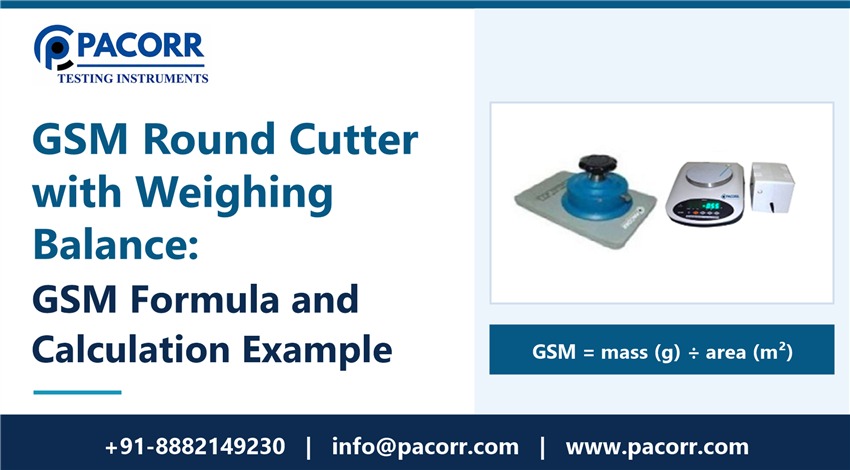
A GSM round cutter with weighing balance prepares a circular specimen of known area and measures its mass. The GSM formula is 10,000 × specimen mass in grams ÷ specimen area in square centimetres. For a verified 100 cm² specimen, multiply the mass in grams by 100. An illustrative disc weighing 1.82 g therefore gives 182 g/m². A different cut area needs its own conversion factor.
The arithmetic can be right while the measurement is wrong. A worn blade may leave missing material. A balance may be set to a direct GSM mode for a different area. A specimen from one side of a roll may miss variation elsewhere. This guide connects the formula to cutting, weighing and reviewing the results. The examples illustrate the calculations. For acceptance testing, follow the controlled procedure for specimen geometry, preparation, conditioning and reporting.
What does a GSM round cutter with weighing balance do?
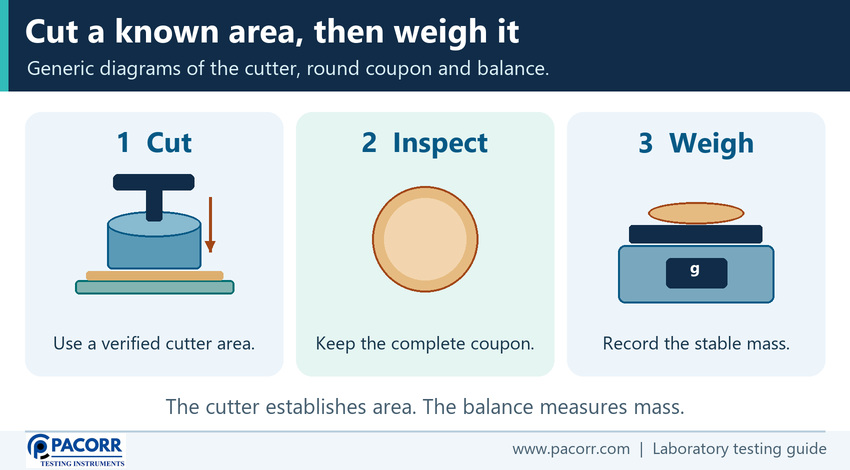
The cutter defines the boundary of the test piece. The weighing balance determines its mass. The operator or an approved instrument mode combines that mass and area to obtain grams per square metre, commonly called GSM. The result describes mass per unit area in the measured condition. In the paper industry this property is known as grammage.
The same formula can be used for eligible paper, board or fabric specimens, with the area and handling rules dictated by each method. This article focuses on the cutter and balance workflow. For everyday uses of GSM in purchasing, manufacturing and converting, see Pacorr's GSM guide for fabric and paper.
What is the difference between specimen diameter and cut area?
Diameter measures a straight line through the centre of a circle. Area is the surface enclosed by the cut. The circular-area formula is A = π × d² ÷ 4. Entering diameter in centimetres gives area in cm². Entering diameter in millimetres gives area in mm². Use the correct square-unit conversion before applying the corresponding GSM formula.
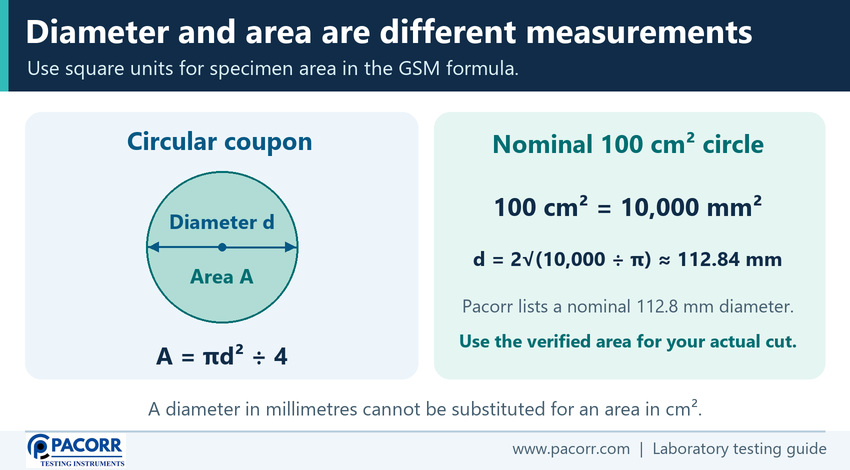
An exact 100 cm² circle has a diameter of about 112.84 mm. The Pacorr product page lists 100 cm² and a nominal 112.8 mm diameter. That decimal dimension is a rounded catalogue figure. It does not establish a cutter tolerance or actual cut area. A 100 mm diameter circle instead has an area of about 78.54 cm², so treating its cut area as 100 cm² would understate the result. For actual work, verify the cutter and follow the method for using nominal or measured area.
How do you derive the GSM formula and conversion factor?
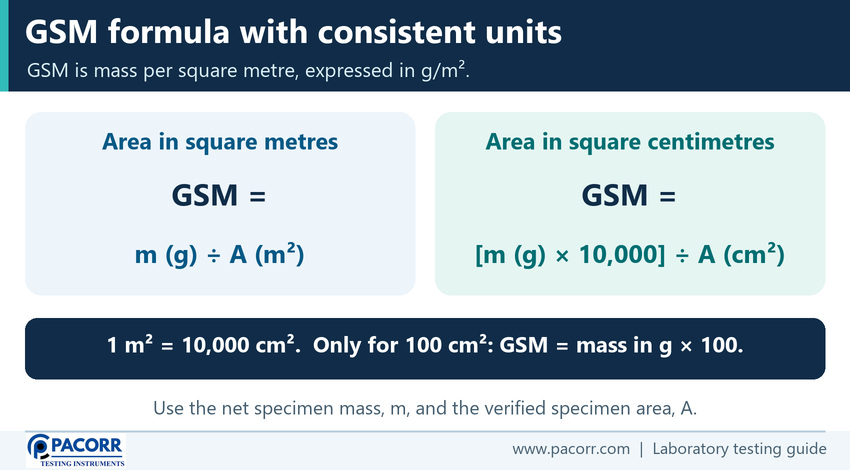
One square metre contains 10,000 square centimetres and 1,000,000 square millimetres. Divide the specimen mass in grams by its area in square metres, or use the equivalent formula for the area unit already on the record.
| Area entry unit | Formula for GSM in g/m² |
|---|---|
| Square metres | Mass in grams ÷ area in m². |
| Square centimetres | 10,000 × mass in grams ÷ area in cm². |
| Square millimetres | 1,000,000 × mass in grams ÷ area in mm². |
The conversion factor for 100 cm² is 10,000 ÷ 100 = 100. A 64 cm² piece has a factor of 156.25. The factor belongs to the piece or combined area being weighed. If mass is entered in milligrams, convert it to grams first. Label every input column with its unit so a valid numerical reading cannot be mistaken for another quantity.
How do you calculate GSM for two different specimen areas?
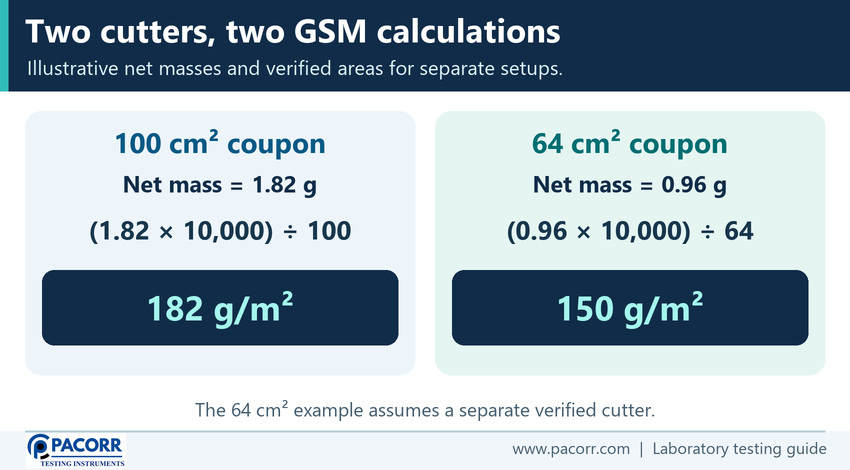
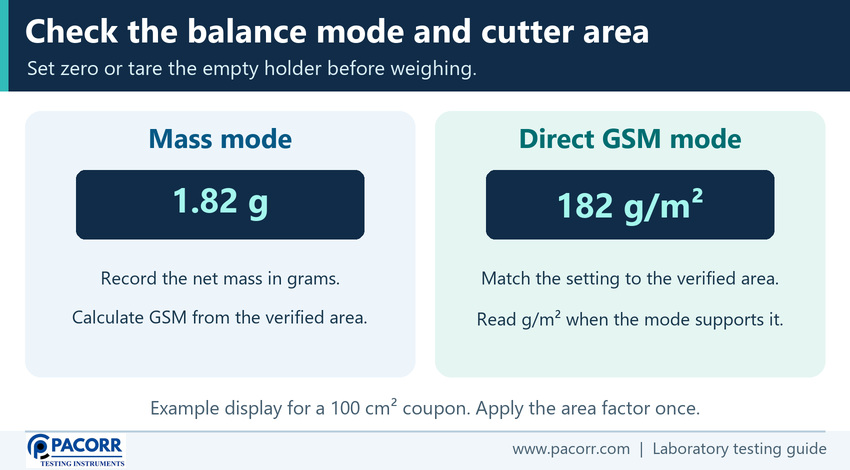
For a 100 cm² disc weighing 1.82 g after tare, divide its mass by 0.0100 m² or multiply 1.82 by 100. Both calculations give 182 g/m². This is an illustrative reading, not a target grade.
Suppose a separate, verified specimen has an area of 64 cm² and weighs 0.96 g. Calculate 10,000 × 0.96 ÷ 64 = 150 g/m². Applying the 100 cm² shortcut would give 96 g/m² instead. The 64 cm² area illustrates the general formula only. It is neither a configuration claim for the featured cutter nor a specimen area prescribed for fabric or paper tests.
You can also rearrange the equation for planning. A nominal 240 g/m² material would give a mass near 2.40 g on 100 cm², or about 1.536 g on 64 cm². Estimate the likely mass for your lightest material at the smallest valid area before selecting a balance. Its verified performance near that mass matters more than a high maximum capacity alone.
Should you record grams or a direct GSM reading?
In raw mass mode, record the stable value in grams and apply the area formula. In a direct GSM mode, the balance uses a stored or selected area to convert mass automatically. If that area matches the test piece and the method permits the mode, a reading already labelled g/m² needs no second multiplier. Check the unit, area setting and operating instructions. Where available, retaining the raw mass simplifies an audit.
Use a known check case before relying on a newly configured balance or worksheet. A raw mass of 1.82 g should correspond to 182 g/m² for a 100 cm² calculation. A stable but inappropriate result points first to unit, tare or area settings. If a carrier is needed, weigh only the sample's net mass. For example, a 4.27 g carrier with a 6.09 g loaded reading gives a net 1.82 g. Once the carrier is tared on the balance, do not subtract it again from the net reading.
What does 0.01 g least count mean for a GSM result?
At 100 cm², a 0.01 g step corresponds to 1 g/m². At 64 cm², the same mass step corresponds to about 1.56 g/m². Those are changes implied by the input scale and area formula. The conversion cannot improve the underlying mass measurement. A stable digit is not evidence of measurement accuracy, and a fine display does not establish that the balance works accurately at very low loads.
Ask for calibration or verification evidence at masses close to your actual specimens. Check repeatability, zero stability, suitable capacity and sensitivity. Then consider the cutter and handling as separate contributors. If a 1.82 g piece truly had an area of 98.5 cm², the arithmetic result using that area would be about 184.8 g/m², while assuming 100 cm² would give 182 g/m². Reweighing the piece repeatedly would leave the area error in place.
Which methods apply to textiles and paper?
Choose the method from the product and purchase specification. A round cutter is a specimen-preparation tool. It is suitable where the method permits the cut geometry, test area and sampling design. The methods below cover different specimen categories.
| Reference | Where it applies | What to check before cutting |
|---|---|---|
| ASTM D3776/D3776M-20(2025) | Mass per unit area for most fabrics within its scope. | The applicable option for a full piece, full width, small swatch or narrow fabric. |
| ISO 3801:1977 | Mass per unit length and per unit area of woven fabrics, including suitable stretch-type wovens. | The applicable procedure and whether the request is for g/m² or mass per running length. |
| ISO 536:2019 | Grammage of paper and board. | Test-piece area, cutter verification, balance requirements, weighing mode and reporting. |
ASTM D3776/D3776M distinguishes a full-width sample, which normally includes selvages unless specified otherwise, from the small-swatch option, which ordinarily excludes them subject to the specified allowance. A small swatch describes the material submitted for testing. Its result does not automatically represent the original lot. ISO 3801's public scope is for woven fabrics. For knits or nonwovens, establish the governing method and sampling conditions for that product. ASTM D3776/D3776M, ISO 3801 and ISO 536.
Can a single 100 cm² disc be used for ISO 536 paper grammage?
ISO 536:2019 normally uses a test piece of 500 to 1,000 cm². Under its specimen preparation rules, that area may comprise several smaller pieces if needed. If the available sample is limited and a test piece cannot be assembled from smaller pieces, the standard allows an area down to 100 cm² and requires the departure from the preferred area range to be reported. This is a defined exception for limited material.
The special sheet-weighing balance option that indicates grammage directly has its own requirements. ISO 536 specifies 500 to 1,000 cm² for a single weighing under that option, in addition to its balance performance conditions. A six-piece bundle of eligible 100 cm² discs has a total area of 600 cm², for example, if it is assembled and weighed as allowed by the selected procedure. Check how many valid test pieces the method requires and keep each bundle's area and mass together. A direct display designed around one 100 cm² disc is insufficient evidence of compliance with the special-balance option.
How should you choose representative sampling locations?
Choose locations to match the question. For fabric, the sampling plan may compare different positions across a roll width and at defined points in its length. For paper, record the reel or sheet and the cross-direction position when the distribution across the web matters. Use a simple location map before cutting, especially when coating bands, stripes or visible marks complicate the sample. Where a customer requires specific locations and distances from edges, use that plan.
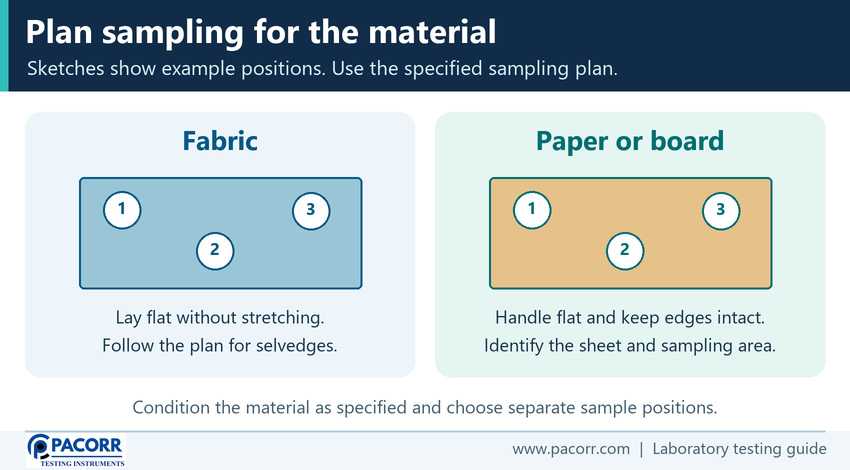
Five repeat weighings of one disc tell you how that disc reads on the balance. Five separately cut pieces provide information about sampling and specimen variation as well. If the objective is to understand a heavier edge or coated zone, keep those locations identifiable and collect corresponding regular-area controls. A single mean may hide a difference between left, centre and right positions.
Why does conditioning matter for grammage?
Paper and textiles can gain or lose moisture when moved between environments. That changes their mass and can affect dimensions, particularly with fabric that relaxes or changes shape. Compare results on a consistent basis. Record whether the method calls for conditioned material or, where provided, an oven-dry or as-taken determination. ISO 187 addresses paper and board conditioning and ISO 139 defines textile testing atmospheres. Follow the controlling method and use the prescribed sequence.
A supplier's measured value and a receiving inspection result can differ after storage or transport. Check both handling and conditioning records before treating the difference as a material or production change. When comparing finishes, record whether the material was measured before or after coating, lamination or a wash. Those steps can change the observed mass per area independently of the base material.
How do you prepare a clean fabric or paper specimen?
Lay the material flat on an approved support, free of folds and unnecessary tension. Stretching a knit while cutting can change how much material lands inside the cut circumference. On board or coated paper, incomplete cutting, chipped edges or a torn facing can change the specimen mass. Use suitable scissors or another cutter only when the method allows that preparation and geometry. For routine round cutting, follow the instrument instructions for the correct pad and blade arrangement.
Handle each piece so that loose fibres, ink transfer, dust or moisture do not enter or leave the sample. Check that the edge is complete and the specimen contains the intended layers. If the cut is visibly damaged, handle it under the method's specimen validity and retest rule. An unusually low value from a clean disc can still be a valid observation. Retain the result unless the method gives a reason to exclude it.
How do you verify the cutter area and monitor wear?
A cutter's label identifies its design area. Verify actual cuts using the laboratory's approved dimensional or area measurement procedure. Inspect specimens made on the material types under test, since stretch, crushing and edge breakup can affect the measured piece. The effective cut area can differ even when the cutter looks undamaged.
ISO 536 specifies frequent verification of the cut area and permits nominal area under its stated variation criterion. It gives a dimensions-based route when that criterion is not met or the area variation is unknown. Keep the check and any replacement or adjustment records. Verify new blades or a new pad with representative material before returning to routine work. Use the manufacturer's instructions for safe blade handling and replacement.
How do you cut, weigh and calculate GSM step by step?
This sequence is an educational workflow. Confirm the instrument procedure, applicable standard, approved specimen condition and acceptance plan before testing.
- Identify the material, lot, method edition and sampling locations. Confirm which layers, surfaces or edge regions the result will represent.
- Use the required conditioning and check that the cutter and balance are appropriate for the test area and mass range. Confirm the cut-area verification and balance status.
- Place the material on the approved cutting support. Use the cutter as instructed and check each piece for a complete boundary and an undamaged test area.
- Level or set up the balance as directed. Confirm zero, the correct mode and any tare. Centre the specimen or the tared carrier and check it touches only the weighing support, including when the draft shield is closed.
- Record the stable mass and area, or the direct reading and its approved area setting. When necessary calculate GSM using the correct denominator.
- Complete the set and review location variation, valid specimen counts, reporting precision and applicable acceptance rules. Save the underlying observations and any deviations.
How should you analyse separate specimen readings?
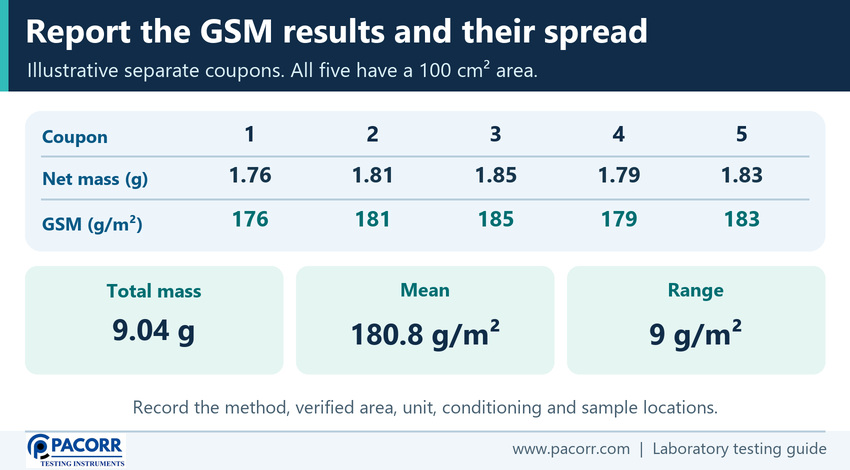
Consider five independent 100 cm² cuts from a fictional run. This is a calculation exercise. The number of specimens and locations for a real decision come from the specified procedure.
| Specimen | Net mass in grams | Calculated g/m² |
|---|---|---|
| 1 | 1.76 | 176 |
| 2 | 1.81 | 181 |
| 3 | 1.85 | 185 |
| 4 | 1.79 | 179 |
| 5 | 1.83 | 183 |
The total mass is 9.04 g. The mean of the five calculated results is 180.8 g/m², and the range is 9 g/m². These figures retain intermediate precision so the arithmetic is visible. The relevant method may require its own rounding and an additional statistic such as standard deviation. A lot average, an individual reading and the range answer different questions. If the requirement includes limits for individual pieces, retain them beside the mean.
When can you weigh specimens together?
Where the procedure permits pooling, use the sum of all specimen masses divided by their total area. The five equal-area pieces in the previous example would give 9.04 g over 500 cm², also 180.8 g/m². Weighing the pieces together would no longer tell you the individual GSM values or regional range. This arithmetic example does not establish a sufficient set of test pieces for ISO 536 or ASTM D3776/D3776M.
With unequal areas, a pooled calculation weights larger pieces more heavily. For example, two hypothetical locations measuring 182 and 150 g/m² on 100 and 64 cm² have an equal-weight mean of 166 g/m². Their pooled mass and area of 2.78 g and 164 cm² give about 169.5 g/m². Decide in advance whether the procedure needs individual results, an unweighted mean or a combined-area determination. Archive the area and mass for every test piece or bundle.
How do you diagnose an unexpected GSM result?
| Observation | First assessment |
|---|---|
| A 100-fold difference | Check whether the balance already converted the reading or whether the worksheet expects grams. |
| Mass changes as the sample settles | Check for moving air, static, contact with the draft shield, unstable zero, or moisture change. |
| Balance rechecks agree but new cuts differ | Inspect edges and cutter settings, then assess where the pieces came from. |
| A whole set shifts after a blade or pad change | Check the cut area and completeness and compare with the last traceable cutter verification. |
| Only one side of a web reads high | Repeat planned positions under consistent conditions and look for a material or coating pattern. |
A useful investigation separates the weighing process from specimen preparation. Reweigh a stable control or reference, then reweigh a valid disc in different placements. If those checks agree, compare independently cut specimens from matched locations so cut variation can be distinguished from an actual cross-web pattern. Record suspected causes as hypotheses until a repeatable check supports one.
How do you check a GSM spreadsheet or direct-reading setup?
Put specimen ID, mass value, mass unit and area value with its unit in separate fields. Add a field for measurement mode so raw grams and direct g/m² readings take the correct calculation route. Constrain the formula to positive areas in recognised units. Retain invalid entries for review rather than replacing a missing area with a default factor. Make each summary identify the included specimens and combine only observations that belong to the stated group.
To check the sheet, enter 1.82 g with 100 cm², 10,000 mm² and 0.0100 m² on separate trial rows. They should all return 182 g/m². Enter 0.96 g with 64 cm² to verify the general calculation and a blank area to test error handling. If a direct reading is imported, check that 182 g/m² stays 182. Repeat the checks when a cutter, export field or formula changes.
What belongs in a GSM test report?
Record the method and edition, material construction, lot, specimen location, conditioning or sample state, cut area and weighing mode. Keep masses and conversion factors traceable. If reported data include an average, state which observations were summarised and include the required spread or separate positional results. ISO 536 calls for the mean and standard deviation of results, with information on relevant deviations. Follow the method and purchasing requirement for reported precision.
| Report entry | What makes it reviewable |
|---|---|
| Material and sampling | Roll, reel, sheet or lot identity, and the sampling position or group. |
| Equipment and setup | Cutter size and verification, balance identity, weighing mode and applicable tare. |
| Original measurements | Net mass and area, or a permitted direct GSM indication with the associated area. |
| Calculations and disposition | Individual results or test-piece groups, required summary and any deviations. |
If an agreed limit lies close to the result, check which figures the decision rule uses and whether measurement uncertainty affects the decision. Record your basis for acceptance or retesting. Extra decimals in a spreadsheet cannot justify a narrower tolerance than the measuring process can support.
What other properties should you test alongside GSM?
Use GSM for mass per area and select other tests when the specification requires thickness, resistance to rupture or water uptake. A thicker fabric can share GSM with a thinner construction. A high-grammage paper can absorb water differently from an equally heavy material with a different surface treatment. A fabric thickness gauge and a water absorbency test for paper and board address different properties.
If using grammage in a derived result such as a burst factor or burst index, ensure the grammage and burst reading represent the same material construction and agreed basis. Combined corrugated board and a component paper have different identities in the test record. Pacorr's burst factor calculation guide.
What does Pacorr publish for the PCGSMRC-1 kit?
The Pacorr GSM Round Cutter with Weighing Balance listing identifies model PCGSMRC-1 and lists the following cutter and balance details. Treat them as published specifications and verify the actual supplied configuration.
| Published item | Catalogue value |
|---|---|
| Sample area and diameter | Nominal 100 cm² and 112.8 mm. |
| Cutter handle movement | A quarter turn as described in the listing. Follow the instrument instructions. |
| Balance capacity and least count | 300 g capacity and a listed 0.01 g least count. |
| Weighing pan and draft shield | 110 mm pan diameter, with an included draft shield stated. |
| Calibration entry | External calibration. Ask what documentation and weights are included. |
The product FAQ describes a direct GSM reading. Confirm the available unit modes and area settings for the particular balance. The published pan is narrower than the nominal cut diameter. Check clearance for the actual specimen and any tared carrier without touching the shield or housing. A different cutting mechanism may make sense for some constructions. Discuss representative samples when comparing the manual kit with the Pacorr hydraulic GSM round cutter.
How do you select a setup and request a price?
The product page provides a quotation route and no fixed price was verified. Ask for a written quote that states whether the cutter, balance, shield, pad, blades and calibration documentation are included. Share the applicable method, specimen size and materials, expected low and high specimen masses, and tolerance. A laboratory that handles small, lightweight fabric pieces and larger paper test pieces may need different weighing arrangements.
A useful demonstration starts with representative material and continues through sample cutting, a balance check and a complete result record. Ask how you can verify the actual cut area, which measurement range is supported by calibration, and whether direct GSM readings can be independently checked from grams. Those details determine how the kit will fit your current quality-control process.
Frequently asked questions
What is the GSM formula when I know the area in cm²?
Multiply the net mass in grams by 10,000 and divide by the sample area in cm². The result is in g/m².
What is the GSM of a 100 cm² specimen weighing 1.82 g?
Multiply 1.82 by 100 to get 182 g/m². The shortcut applies to a 100 cm² test area and an input in grams.
Can I multiply by 100 for any round specimen?
Only use that factor for 100 cm². Use the actual or method-prescribed area in the general formula for a different size.
Is a cutter with a 100 mm diameter the same as a 100 cm² cutter?
A 100 mm diameter circle has an area of about 78.54 cm². A circular 100 cm² area corresponds to a diameter of about 112.84 mm.
Should I multiply a direct GSM reading by 100?
A direct reading already in g/m² needs no second multiplier when the selected area is correct and the method allows that reading mode.
Does a 0.01 g balance guarantee one-GSM accuracy?
The 0.01 g step corresponds to a 1 g/m² calculation increment for 100 cm². Actual measurement capability also depends on balance verification, the cutter, handling and sampling conditions.
Can I use one 100 cm² paper disc for an ISO 536 result?
ISO 536 normally uses 500 to 1,000 cm² test pieces. Its limited-material exception can allow 100 cm² under specified conditions and requires reporting the departure. The standard's direct sheet-weighing balance option has separate area and performance requirements.
Can I weigh several pieces together and divide by the area of one?
Use the total area for a permitted combined weighing. Retain separate masses if the method or investigation needs individual or regional variation.
Is one cut enough to represent a fabric roll or paper reel?
A cut reflects its own location and condition. For lot or reel acceptance, follow the approved sampling, conditioning and decision rules.
How can Pacorr help with your GSM testing requirement?
Send the material, applicable standard and option, specimen area, expected mass range and desired report format. Include any issues with stretch, thick layers, curl or low specimen mass so the cutting and weighing arrangement can be checked. Contact Pacorr for a configuration and quotation.