Burst factor = bursting strength in kgf/cm² × 1,000 ÷ grammage in g/m². For a paper sample with a bursting strength of 3.00 kgf/cm² and a grammage of 150 g/m², the conventional burst factor is 20.0. For the same sample, convert the pressure to kPa and divide by grammage to obtain the burst index of 1.96 kPa·m²/g. These example inputs illustrate the calculation.
A bursting strength tester supplies the rupture pressure. A separate grammage test supplies the mass per unit area. The reliability of the calculated factor depends on both measurements, as well as the test method and specimen construction. Keep the original pressure and its unit on the report so another laboratory can reproduce the calculation.
What does a bursting strength tester measure?
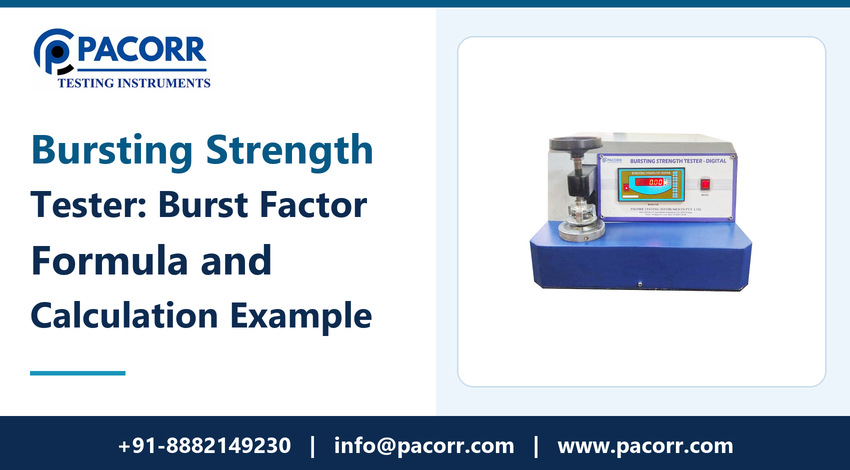
A hydraulic diaphragm bursting strength tester measures the pressure at which a clamped specimen ruptures. An elastic diaphragm bulges under increasing fluid pressure and pushes against a defined area of the specimen. The instrument records the pressure at the rupture event according to the selected method. The recorded value describes the behaviour of that specimen under that test configuration.
The result is a pressure, usually expressed in kPa or in the instrument's selected pressure unit. You already have pressure when the tester reports a valid peak, so dividing it by the area of the opening would give the wrong quantity. You need grammage only when the customer or laboratory asks for a mass-normalised result. Pacorr's bursting strength tester working principle and procedure guide.
What is the burst factor formula?
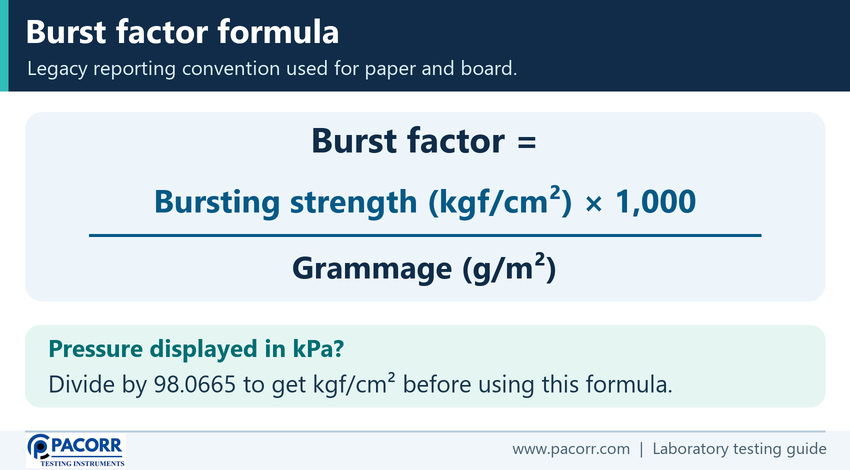
The convention used here takes the numerical pressure in kilogram-force per square centimetre (kgf/cm²) and grammage in grams per square metre (g/m²).
Conventional burst factor = [bursting strength (kgf/cm²) × 1,000] ÷ grammage (g/m²).
In this convention, multiplying the pressure number by 1,000 expresses the numerator in gram-force per square centimetre. If the pressure is already expressed in gf/cm², divide its numerical value by grammage without multiplying again. This formula is used in Indian paper and packaging practice. Put the calculation convention on the report, especially when a customer or supplier uses a spreadsheet with a differently labelled column. MANAGE technical training material on packaging tests.
The abbreviation GSM is commonly used for g/m². Enter the actual grammage number on the basis agreed for the specimen or lot. A sample that weighs 1.50 g may have a grammage of 150 g/m² depending on the area cut for weighing. The numerator measures a different property, so retain the burst pressure and the grammage separately.
How do you calculate burst factor step by step?
Consider a fictional paper sample with a measured grammage of 150 g/m². Use 3.00 kgf/cm² as an illustrative rupture pressure. The steps show the arithmetic independently of any instrument's display increment.
| Step | Calculation |
|---|---|
| Check the inputs | Pressure 3.00 kgf/cm² and grammage 150 g/m². |
| Convert the pressure numerator | 3.00 × 1,000 = 3,000 gf/cm². |
| Divide by grammage | 3,000 ÷ 150 = 20.0, using the conventional BF calculation. |
| Keep the result traceable | Report BF 20.0 with the original pressure, grammage and calculation convention. |
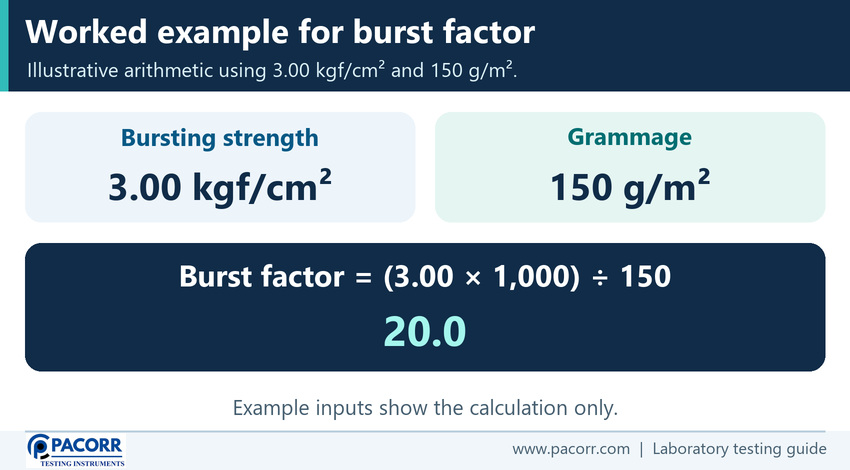
The displayed decimal places in this calculation demonstrate arithmetic. An actual report must follow the method's rounding and the instrument's resolution. The example sets no pass limit and represents no measured result from a particular Pacorr model.
You can also rearrange the formula for planning. If a purchase specification calls for a conventional burst factor of 20 on paper measured at 160 g/m², the arithmetic pressure corresponding to that factor is 20 × 160 ÷ 1,000 = 3.20 kgf/cm². Read the contract before treating this calculated value as a test limit. The contract can specify separate minimum pressure, grammage tolerance, sample count and decision rules.
How do you calculate burst index from the same reading?
Burst index is bursting strength in kPa ÷ grammage in g/m², expressed in kPa·m²/g. The definition appears in ISO 2758 for paper bursting strength. The test pressure unit changes the arithmetic. For the same material and test result, conventional burst factor and burst index give different numerical values.
One kgf/cm² equals 98.0665 kPa. Multiplying 3.00 by 98.0665 gives the example's unrounded conversion of 294.1995 kPa, approximately 294 kPa at three significant figures. To calculate the index, carry the unrounded value forward and divide by 150 g/m². The result is 1.96133 kPa·m²/g, or 1.96 kPa·m²/g to two decimal places. ISO 2758 definitions and NIST pressure conversions.
| Reported quantity | Example result |
|---|---|
| Bursting strength | 3.00 kgf/cm², approximately 294 kPa. |
| Conventional burst factor | 20.0 under the stated kgf/cm² and g/m² convention. |
| Burst index | 1.96 kPa·m²/g with the same pressure and grammage. |
Using the same data and conventional calculation, the numerical burst index is the BF number multiplied by 0.0980665, when the index unit is kPa·m²/g. This relationship changes the reporting basis. It cannot make results from different burst methods or different materials equivalent.
What if the tester gives kPa, psi or bar?
Identify the selected unit on the gauge, export or certificate first. Convert the pressure once into the unit required by the calculation. If you need burst index, convert to kPa. If you need conventional burst factor, convert to kgf/cm².
| Pressure source | Conversion to kPa |
|---|---|
| kPa | Use the pressure directly. |
| kgf/cm² | Multiply by 98.0665. |
| gf/cm² | Multiply by 0.0980665. |
| psi, or lbf/in² | Multiply by approximately 6.894757. |
| bar | Multiply by 100. |
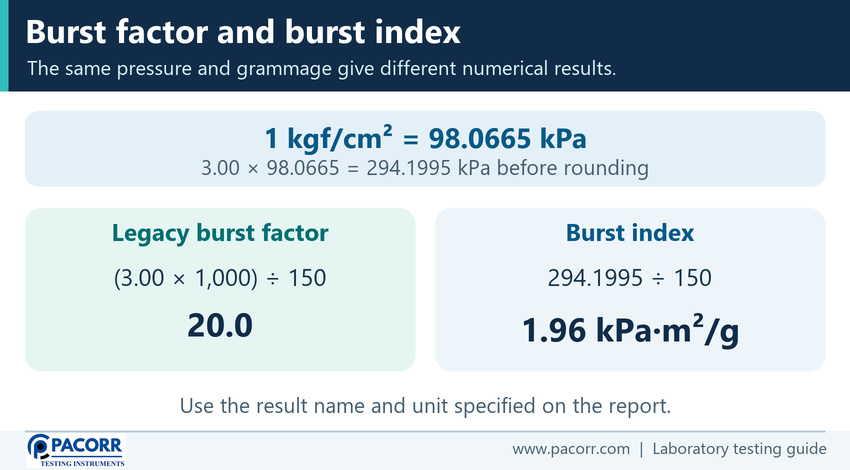
For example, start with 294.1995 kPa and divide by 98.0665 to recover 3.00 kgf/cm². Then apply the BF formula. Putting 294.1995 directly into the kgf/cm² formula gives about 1,961 instead of 20.0. The large discrepancy comes from the pressure unit, so repeat testing would leave the spreadsheet error in place.
Some older forms print “kg/cm²” as shorthand. Confirm from the instrument documentation or certificate that the displayed pressure unit is kgf/cm² before using the factor. A kilogram is a mass unit, while a kilogram-force refers to force. Keep an original unit column and a converted unit column when combining reports from different gauges.
How do you verify the grammage used in the calculation?
Grammage is the specimen's mass divided by its area. An illustrative 100 cm² sample has an area of 0.0100 m². If it weighs 1.50 g, its grammage is 1.50 ÷ 0.0100 = 150 g/m². The shortcut of multiplying the mass in grams by 100 applies to this area. For formal paper and board testing, use the specimen size, sampling and calculation specified by the applicable method. ISO 536 paper and board grammage.
A calibrated balance, verified sample area and appropriate conditioning support a useful denominator. A cutter defines an area and the balance measures mass. Confirm whether a direct-reading balance shows grams or calculated g/m². For a burst factor report, identify how the grammage sample represents the lot or material used in the pressure test. Pacorr's GSM formula and worked examples and GSM Round Cutter and Weighing Balance.
Nominal grammage and measured grammage can produce different factors. At 3.00 kgf/cm² the factor is 20.0 using a nominal 150 g/m², but approximately 19.35 using a measured 155 g/m². State which value you used and follow the agreed calculation basis. An acceptance report should not substitute nominal data without the customer's method or agreement.
Which specimen should you use for paper or board?
Identify whether the requirement applies to loose paper, a specific liner or medium, or a specimen cut from combined board. Keep the pressure reading and grammage on the same authorised material basis. If asked for a normalised value on combined board, confirm that calculation and its denominator with the specification owner. A single liner's grammage cannot represent combined board in that calculation.
Corrugated board contains flat liners and a fluted medium. The medium follows a longer path than its projected area, and the board can also contain adhesive and other additions. Simply adding the nominal grammage of flat constituent materials may therefore differ from the measured mass per unit area of the combined board. Use the construction, sampling and calculation basis required by the specification. A pressure measurement on combined board cannot establish the burst factor of an individual liner.
Cut and identify specimens from the relevant lot, grade and locations. Avoid creases, damage and irregular areas where the method requires intact areas. If the requirement specifically concerns a converted feature or a damaged area, make that purpose and sampling location explicit. Conditions can affect both mass and rupture behaviour, so record the conditioning before weighing or testing. ISO 187 conditioning and test atmosphere.
Which standard applies to paper or corrugated board?
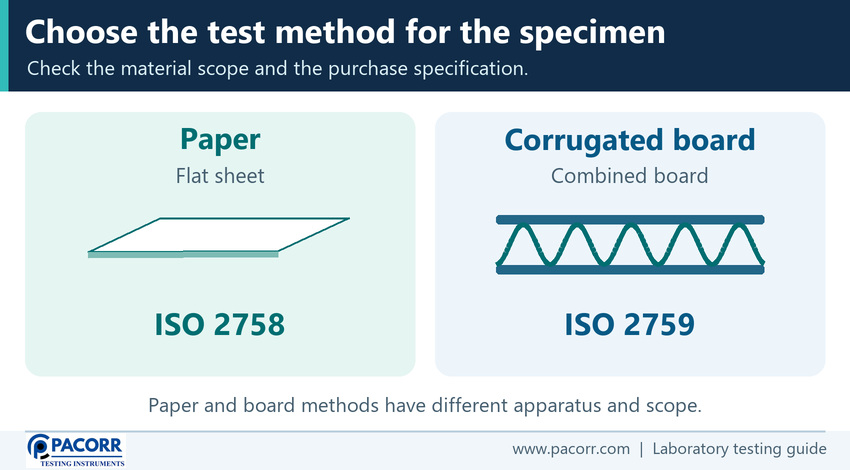
The purchase specification and specimen type determine the method. Use the named edition and confirm the complete apparatus before testing. A tester's maximum pressure alone cannot establish suitability.
| Reference | Published scope and selection point |
|---|---|
| ISO 2758:2014 | Paper with bursting strength from 70 to 1,400 kPa. It is unsuitable as the default for components of combined board, for which ISO 2759 is more appropriate. |
| ISO 2759:2014 | Board, including corrugated and solid fibreboard, from 350 to 5,500 kPa. Its scope also allows certain component papers or boards down to 250 kPa, with a precision qualification. |
The ranges overlap, and test results can depend on the apparatus. For example, a packaging supplier testing a liner intended for corrugated board should look at the component provisions even if the expected pressure lies inside the paper range. Match clamping conditions, diaphragm and its requirements, fluid delivery, measurement range and calibration to the full method. ISO 2759 board bursting strength.
Some specifications name TAPPI methods for particular material categories. Follow that named method and edition. If the material is a textile or the requirement concerns pressure inside a sealed pouch, select a method specifically written for that specimen and loading arrangement.
How does the hydraulic diaphragm test work?
The upper and lower clamps hold the specimen around the test opening. A hydraulic drive displaces fluid beneath the elastic diaphragm. The diaphragm rises into the opening and deforms the exposed specimen until it ruptures. The measuring system records the relevant peak according to the method. In ISO 2758 the indicated pressure includes the pressure needed to extend the diaphragm during the test. Use the selected method's instructions before applying any correction.
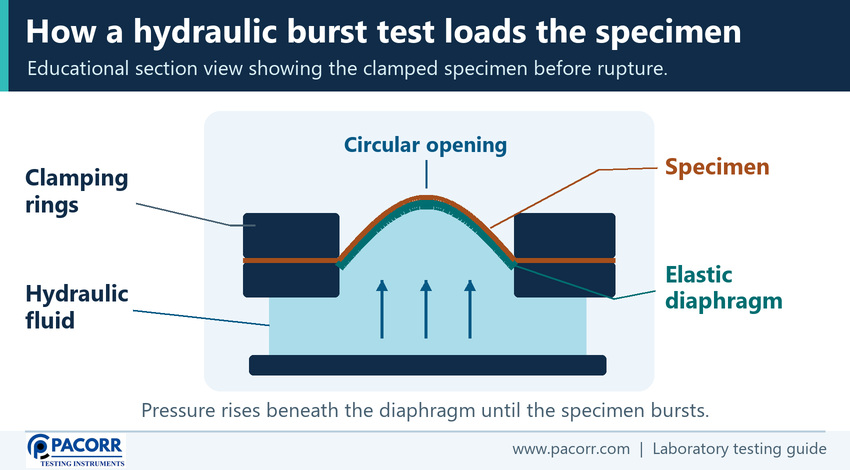
The clamp has to hold the specimen securely while preserving the test area. If the sheet slips, the opening no longer defines the intended stressed area. If the clamp damages the specimen, the rupture may start prematurely. The diaphragm also has specified properties. A worn, damaged or unsuitable diaphragm can change the pressure response.
Hydraulic loading and clamp actuation are separate functions. A pneumatic clamp uses air to secure the specimen on a pneumatic model. Check the product details for how the diaphragm itself is loaded. Pacorr's pneumatic clamping models described on its product page continue to use hydraulic fluid for the diaphragm test.
How do you run a burst test and calculate the reported result?
This sequence connects the measurements to the calculation. Use the selected test standard and the machine's instructions for detailed settings and operation.
- Identify the material and required method, the lot to be sampled and whether the report needs pressure, BF, burst index or several of these.
- Condition the samples as specified. Prepare enough suitable specimens for the required sides, locations and number of valid tests. Identify the matching grammage basis.
- Confirm the instrument setup and verification status. Inspect the clamps and diaphragm and confirm the displayed pressure unit, range and data capture.
- Seat and clamp the specimen as directed. Start the test and capture the method-defined rupture pressure.
- Check each result for a valid rupture. Record slips, clamp damage or other deviations and follow the required retest procedure using suitable fresh areas.
- Measure or confirm the authorised grammage. Apply the method's summary rule for pressure, convert units if necessary and calculate the required metric.
- Retain the original observations and report the method, units, grammage, calculation and applicable acceptance decision.
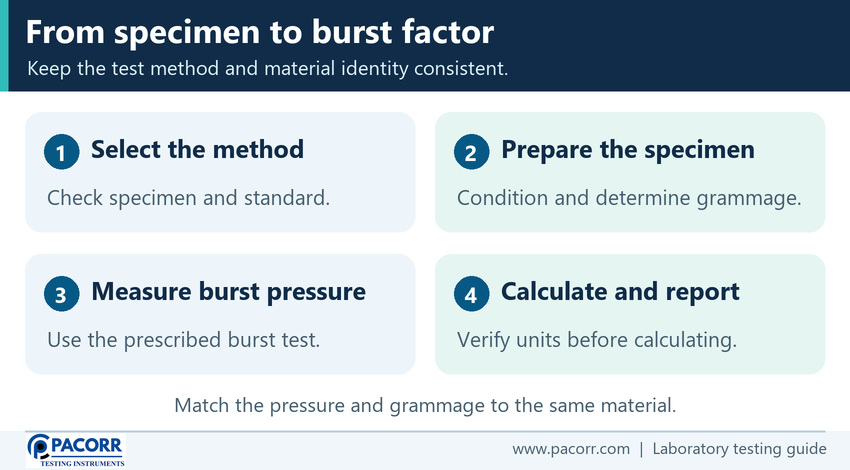
The order of averaging and dividing can matter. When the method requires a reported burst statistic and a separately determined sample grammage, use those two prescribed inputs. If a separate procedure calls for individually paired pressure and grammage observations, the mean of the individual ratios can differ from the ratio of means. Document the rule before comparing lots. Keep sufficient digits through intermediate steps, then round the final reported result according to the agreed procedure.
What should you record for purchasing or quality control?
Report enough detail for another person to reproduce the calculation. Identify the lot and specimen construction, reference method and edition, conditioning, valid rupture readings, disclosed exclusions and any repeat tests. Identify the measured or permitted nominal grammage and specify exactly which material it represents. Record the pressure unit before conversion.
| Report field | Illustrative paper example |
|---|---|
| Original pressure | 3.00 kgf/cm², with the method and reported statistic identified. |
| Grammage input | 150 g/m², with sample and calculation basis identified. |
| Calculated results | Conventional BF 20.0 and burst index 1.96 kPa·m²/g. |
| Acceptance rule | Use the purchase requirement and applicable decision rule. |
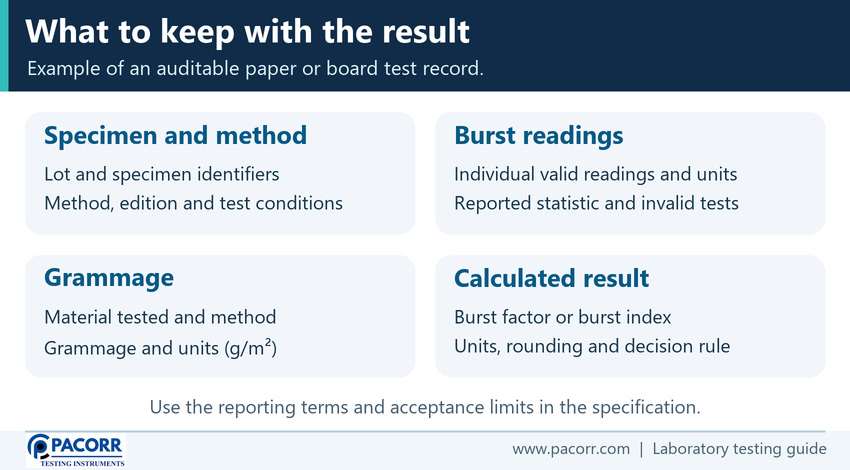
Add the instrument identity and verification record where required. If a supplier certificate reports “BF 20” without the input unit, ask for the original pressure and grammage before deciding whether the certificate is comparable. An apparently borderline calculation should be assessed against the agreed measurement and decision rules, including any rule on rounding, excluded tests or uncertainty.
How do you interpret a higher or lower burst factor?
A higher factor means more measured burst pressure per unit grammage under the same reporting convention. It can support a comparison of similar grades, provided that the method, specimen, condition and calculation basis are comparable. It does not make one paper suitable for every converting or shipping requirement.
Consider two hypothetical papers. Paper A measures 3.00 kgf/cm² at 150 g/m², giving a BF of 20.0. Paper B measures 3.30 kgf/cm² at 180 g/m², giving approximately 18.33. Paper B withstood a higher test pressure, while paper A had a higher factor. A purchase specification that limits pressure can therefore lead to a different decision from one that explicitly limits burst factor. Compare both inputs if the relative result changes unexpectedly.
Finished box stacking, board edgewise compression and water absorption each answer a different question. Select tests linked to the expected failure. A burst factor cannot determine the compression strength of a finished carton or the board's behaviour in moisture by itself. Pacorr's box compression guide, Edge Crush Tester and Cobb Sizing Tester.
What causes unexpected or inconsistent results?
Start by checking the data trail. Verify that each burst result is paired with the correct sample or lot, unit and grammage. Check for double conversion, use of nominal GSM when measured grammage is required, pressure recorded from an invalid rupture, or erroneous averaging. A consistent calculation mistake can shift an entire report while leaving the original readings stable.
Next look at the physical test. Uneven clamping, worn diaphragm, leakage, air in a hydraulic system, conditioning differences or unsuitable specimen locations can affect the reading. Follow the equipment manual for checks and maintenance. Confirm that the service or calibration covers the working pressure region and the aspects required by the test method. A successful pressure indication check does not establish the condition of the clamp or diaphragm.
If two laboratories disagree, exchange the original data, material identity, sampling locations, method, conditioning and equipment configuration before comparing factors. Then test representative portions of the same material under agreed conditions. Preserve the first results and log the differences you find.
How can you check a burst factor spreadsheet before using it?
Give each row a specimen or sample-set identifier, a pressure value, a pressure unit and a grammage value labelled g/m². Keep the unit conversion in a separate column and show which pressure value feeds each formula. Use kPa for the burst index column and kgf/cm² for the conventional BF column. Require a recognised unit and a positive grammage before calculating either result. If the grammage or original unit is missing, flag the row for review.
Test the sheet with two entries for the known example. Enter 3.00 kgf/cm² on one row and 294.1995 kPa on the other, both with grammage of 150 g/m². Both rows should return the same 20.0 BF and 1.96 kPa·m²/g at the example's report precision. Test a blank grammage and a wrong unit as well to confirm that the sheet flags them. Independently check a second example before releasing the sheet for routine work, and repeat these checks after changing any unit handling or calculation.
Keep the raw readings even when you report a summary. Suppose the approved calculation uses a mean of 3.10, 3.00 and 2.90 kgf/cm², and the associated sample grammage is 150 g/m². The mean pressure is 3.00 kgf/cm² and gives BF 20.0. The individual readings tell the reviewer how much the results varied. Three observations are used here only for a worked calculation. Follow the method and sampling plan for the number of valid bursts and whether separate sides or specimen groups must be reported.
Before comparing the calculated result with a purchase limit, confirm whether the decision rule uses the unrounded or rounded figure. For example, 19.96 shown as 20.0 to one decimal place and a requirement of at least 20 can produce different decisions under different agreed rounding rules. Record the rule and preserve the value used for acceptance.
What does Pacorr publish for the digital PCBSTD?
Pacorr lists the PCBSTD as a digital hydraulic Bursting Strength Tester with operating-wheel clamping and a peak-hold function. These are the published catalogue figures for that model. Confirm the actual supplied configuration against your method.
| Published attribute | Digital PCBSTD |
|---|---|
| Display and peak capture | Backlit digital LCD and peak hold. |
| Listed maximum pressure | 40 kgf/cm². |
| Listed display resolution | 0.1 kgf/cm². |
| Listed accuracy | ±1% within 10%–90% of the measurement range. Confirm the percentage basis. |
| Clamp openings | Upper 35.5 mm diameter and lower 38.1 mm diameter. |
| Fluid and displacement rate | Glycerin and 95 cm³/min. |
With a 150 g/m² denominator, a change of one 0.1 kgf/cm² display step corresponds arithmetically to about 0.67 in conventional BF, before considering other sources of uncertainty. This explains why additional decimal places in calculated results cannot improve the original reading. Confirm the usable calibrated range and pressure performance for your material. The 3.00 kgf/cm² worked calculation represents neither this model's display precision nor a verified reading in its qualified working range.
For higher throughput or computer reporting, Pacorr lists separate pneumatic and computerized configurations. Request confirmation of the pressure range, clamp and diaphragm, reporting options, calibration documentation, external air supply and software or computer requirements for the specific model. Pacorr Bursting Strength Tester specifications and configurations.
Frequently asked questions
What is the formula for burst factor?
For the conventional paper calculation, multiply bursting strength in kgf/cm² by 1,000 and divide by grammage in g/m². Keep the convention and both inputs on the report.
How do I calculate burst factor when the tester shows kPa?
Divide the kPa reading by 98.0665 to obtain kgf/cm². Then multiply by 1,000 and divide by grammage in g/m².
What is the burst factor of 150 GSM paper that bursts at 3.00 kgf/cm²?
Under the conventional calculation, 3.00 × 1,000 ÷ 150 gives BF 20.0. Using the same readings, the burst index is approximately 1.96 kPa·m²/g.
Are burst factor and burst index the same number?
No. Both normalise pressure by grammage, but they use different pressure conventions. Burst index uses kPa and is reported in kPa·m²/g. Conventional burst factor as defined here uses kgf/cm² and the multiplier of 1,000.
Does a bursting strength tester automatically give burst factor?
The instrument measures rupture pressure. Calculating the factor also requires a grammage value and the correct unit convention. Check whether your specific model or reporting software includes that calculation.
Can I calculate the liner's BF from a combined-board burst result?
No. Combined-board pressure describes the tested board construction. Measure the liner separately using the agreed method and use the matching liner grammage.
Does the same method apply to paper and corrugated board?
ISO 2758 covers paper and ISO 2759 covers board and certain qualifying component materials. Select the required standard, edition and instrument configuration for the specimen.
Is there a universal minimum BF for packaging?
The required value depends on the material specification, grade, end use and purchase agreement. Confirm whether the requirement is based on burst pressure, burst factor, burst index or a separate packaging performance test.
How can Pacorr help you select a test configuration?
Share your material construction, required standard and edition, expected pressure range, daily sample count, preferred clamping method and reporting requirements. If your customer needs burst factor or burst index, send the exact calculation convention and tell Pacorr how you obtain the grammage. This information supports a configuration-specific discussion and quotation. Contact Pacorr.