
What is GSM in fabric and paper?
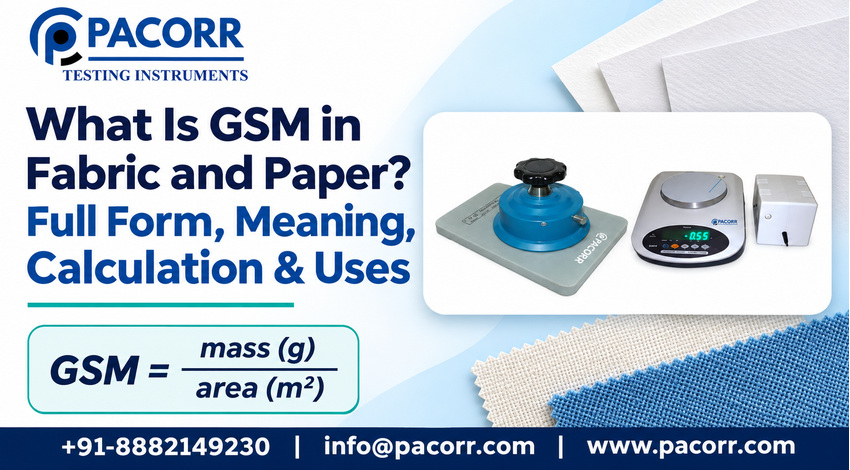
GSM stands for grams per square metre. It expresses the mass of a material per unit area, written as g/m². A fabric rated at 180 GSM has a mass of 180 grams for one square metre under the stated measurement conditions. The same unit applies to paper: 80 GSM means 80 grams per square metre, not 80 grams per sheet.
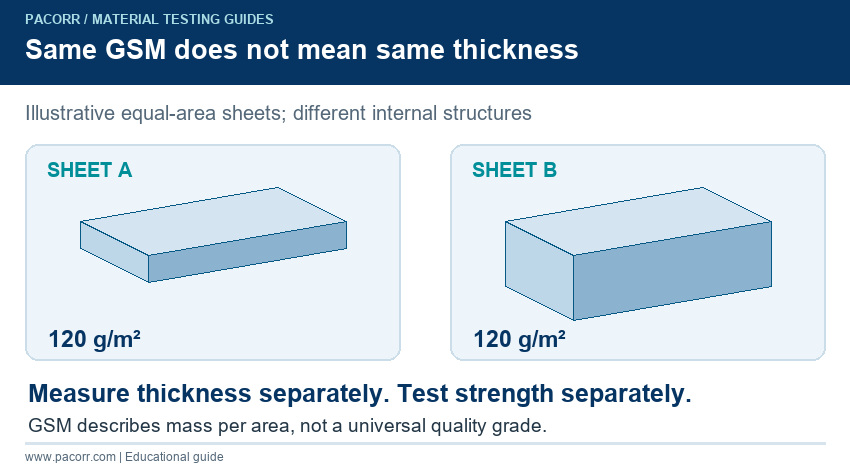
GSM gives buyers, production teams and laboratories a common way to compare sheet materials of different sizes. It is useful when checking incoming rolls, specifying a paper grade, controlling a fabric finish or estimating material consumption. However, GSM alone does not establish thickness, strength, softness, absorbency or overall quality. Those properties need their own measurements and an application-specific specification.
This guide explains the calculation from first principles, shows how a cutter and balance work together, and gives practical examples for fabric and paper. The examples are educational. For acceptance testing, use the sampling plan, conditioning requirements and procedure in the applicable standard and your approved laboratory method.
GSM full form, grammage and units explained
The full form is commonly written as grams per square metre or grams per square meter. Both spellings describe the same quantity. Grammage is the usual paper-industry term for mass per unit area; fabric specifications often call it fabric weight. Although everyday language uses the word weight, the laboratory calculation uses mass in grams.
Area is essential to the definition. A large sheet can weigh more than a small sheet while having exactly the same GSM. For example, two square metres of an illustrative 150 GSM material have a theoretical mass of 300 grams. Half a square metre of that same material has a theoretical mass of 75 grams, assuming uniform material and comparable conditions.
| Quantity | Meaning and unit |
|---|---|
| GSM or grammage | Mass divided by area; expressed as g/m². |
| Sample mass | Mass of the actual piece on the balance; expressed as g. |
| Thickness or caliper | Distance between the material surfaces under specified measuring conditions; often mm or µm. |
| Mass per running metre | Mass of one metre of roll length; expressed as g/m and dependent on width. |
Do not interchange GSM and grams per running metre. A 200 GSM fabric that is 1.5 metres wide has a theoretical mass of 300 grams per running metre. Width must be known before converting a roll-length figure into an area-based figure.
How do you calculate GSM?
GSM = sample mass in grams ÷ sample area in square metres. Measure the mass and the area of the same specimen. If a container is used, subtract its mass by taring the balance correctly. Use the area of the material being weighed, not the size of the cutting pad, weighing pan or original sheet.
When the area is measured in square centimetres, the equivalent formula is GSM = mass in grams × 10,000 ÷ area in cm². The factor 10,000 comes from the number of square centimetres in one square metre. For a rectangle, multiply length by width using the same length unit before converting the area.
For a circular specimen, area is π × diameter² ÷ 4. Be careful with diameter units: a diameter in millimetres produces an area in square millimetres. Dividing that area by 1,000,000 converts it to square metres. Do not calculate with the radius as though it were the diameter, or round an area so heavily that it changes the result.
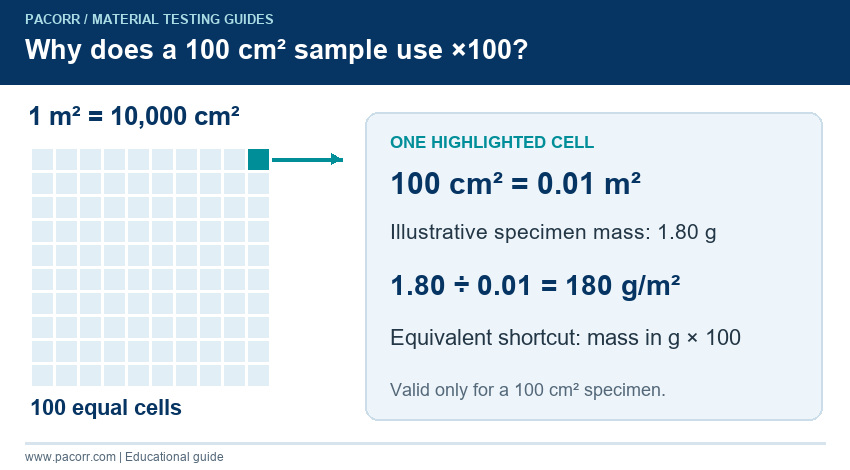
Why does a 100 cm² specimen use a multiplier of 100?
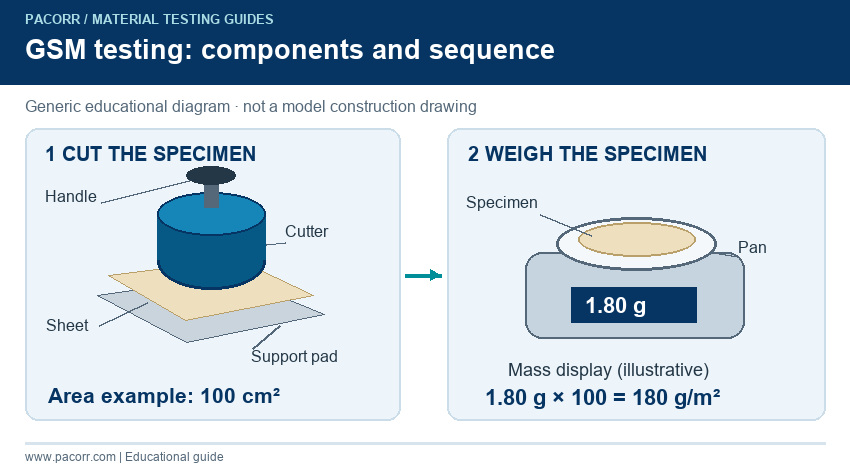
One hundred square centimetres equals 0.01 square metre. Dividing the measured mass by 0.01 is the same as multiplying it by 100. Therefore, a correctly cut 100 cm² specimen weighing 1.80 g gives 180 g/m². This shortcut applies only to that area; a 50 cm² specimen needs a multiplier of 200.
If the balance already displays a calculated result in g/m², check its selected specimen area and measurement mode. Multiplying a direct GSM reading by 100 again introduces a serious error. Record the displayed unit with every reading rather than assuming that a number on the screen represents grams.
Worked GSM calculations for fabric and paper
The following numbers are illustrative calculations, not recommended grades, product specifications or acceptance limits. They demonstrate how specimen size changes the multiplier while leaving the underlying mass-per-area relationship unchanged.
| Example | Calculation and result |
|---|---|
| Fabric circle, 100 cm², mass 1.85 g | 1.85 × 100 = 185 g/m². |
| Paper rectangle, 20 cm × 25 cm, mass 4.00 g | Area = 500 cm²; 4.00 × 10,000 ÷ 500 = 80 g/m². |
| Small specimen, 50 cm², mass 0.90 g | 0.90 × 10,000 ÷ 50 = 180 g/m². |
| Sheet, 0.5 m × 1.0 m, mass 75 g | Area = 0.5 m²; 75 ÷ 0.5 = 150 g/m². |
For an A4 sheet with nominal dimensions of 0.210 m × 0.297 m, the area is 0.06237 m². At an illustrative 80 g/m², its theoretical mass is 4.9896 g, approximately 4.99 g. This is a useful arithmetic check, not proof that every sheet sold as 80 GSM must give precisely that reading. Dimensions, moisture, uniformity and measurement uncertainty affect an actual test.
For several specimens, keep the sample count and area visible. Five 100 cm² specimens with a combined mass of 9.25 g represent 500 cm² in total. The result is 9.25 × 10,000 ÷ 500 = 185 g/m². Applying the single-specimen multiplier to their combined mass would incorrectly give 925 g/m². Only combine specimens when the chosen method permits it; individual results reveal variation that a combined weighing hides.
How is GSM used differently in fabric and paper?
The mathematical definition stays the same, but the purchasing decisions differ. In fabric, GSM describes how much mass is present over a known area of cloth. Yarn size, construction, finishing and the material's relaxed dimensions can all influence the result. Two fabrics with the same GSM may have different drape, stretch, opacity and comfort because their fibres and structures differ.
In paper and board, grammage helps define a grade and compare material consumption. A coated sheet and an uncoated sheet can share the same grammage while behaving differently in printing, folding or bonding. Thickness and surface finish remain separate specifications. Never convert a GSM figure directly into microns without a justified density or an independently measured thickness relationship for that material.
| Material decision | What to assess alongside GSM |
|---|---|
| Clothing and textile products | Fibre composition, construction, dimensional change, handle and relevant strength or performance tests. |
| Printed paper products | Caliper, opacity, surface finish, print compatibility and folding behaviour. |
| Paper packaging | Board construction, moisture sensitivity and the strength tests relevant to the finished package. |
| Coated or laminated sheets | Whether the result includes all layers; coating or adhesive contribution and intended functional performance. |
Avoid using a universal GSM chart as a pass-or-fail specification. A material suitable for one garment, printing system or package may be unsuitable for another despite an identical number. Start with the end use and an approved reference sample, then establish the required grade and its tolerance through a documented purchasing specification.
How do a GSM cutter and weighing balance work?
A GSM test separates two jobs: defining specimen area and measuring specimen mass. A round cutter prepares a circular piece with a known nominal area. A weighing balance measures its mass. The calculation converts that mass into the equivalent mass for one square metre. The cutter itself does not measure GSM, and a balance without a known specimen area cannot determine it from mass alone.
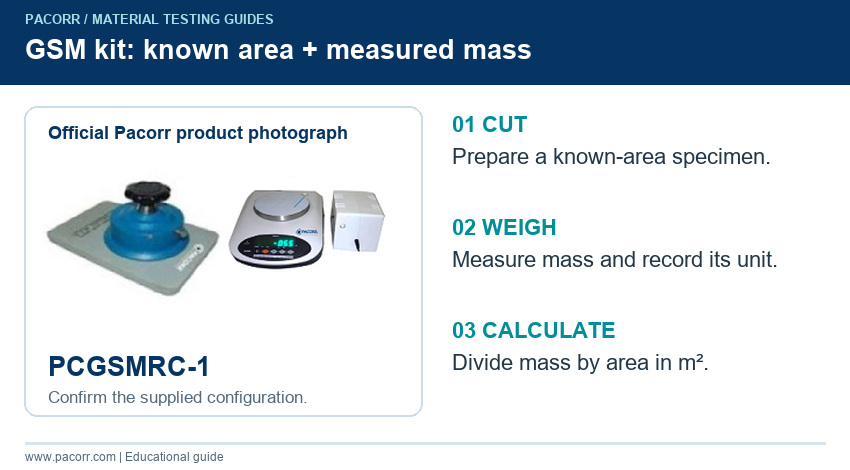
The Pacorr GSM Round Cutter with Weighing Balance product page identifies model PCGSMRC-1 and lists a 100 cm² cutting area with a nominal specimen diameter of 112.8 mm. These are rounded catalogue dimensions; assess cutting-area verification according to the method rather than treating the quoted diameter as an exact calibration certificate.
The kit photograph below is from Pacorr's official product page. Supplied accessories and the balance configuration should be confirmed in the quotation. A dedicated GSM display can automate the conversion, but the operator must still select the correct area, prepare a valid specimen and use the right reporting unit. Automation of arithmetic does not remove sampling errors.
GSM testing diagram and component functions
The diagram shows a generic educational cutter-and-balance arrangement. It explains the measurement sequence and does not depict an internal construction drawing of a specific Pacorr model. The cutter, specimen and balance are separate stages; material is cut on a suitable support surface, then transferred for weighing.
The handle provides the controlled manual movement required by the cutter design. The cutting assembly defines the circular boundary. A suitable support pad protects the working surface and supports a clean cut. The balance pan receives the specimen, while the display shows the selected mass or GSM unit. Where supplied and appropriate, a draft shield reduces disturbance from air movement during weighing.
Do not assume that all cutters have the same blade arrangement or operating motion. Use the supplied model manual for blade engagement, permitted materials and safe handling. Keep hands away from cutting edges, secure the instrument as instructed and avoid using the weighing pan as a cutting surface. A blade that drags fibres or leaves an incomplete edge can change the effective specimen area.
Which equipment specifications matter?
Pacorr's published product page and official technical data sheet list the following selected specifications. Confirm the current supplied configuration before ordering, especially where your method requires a particular balance performance or specimen size.
| Published item | Listed value |
|---|---|
| Round-cutter specimen area | 100 cm² |
| Nominal specimen diameter | 112.8 mm |
| Balance weighing capacity | 300 g |
| Balance least count | 0.01 g |
| Balance pan diameter | 110 mm |
| Calibration arrangement | External |
| Draft shield | Listed as included |
Least count is not the same as measurement accuracy or uncertainty. With a 100 cm² specimen, a 0.01 g display increment corresponds arithmetically to 1 g/m². That calculation does not establish ±1 GSM accuracy: area error, calibration, repeatability, environmental effects and specimen handling also contribute. Select the balance and specimen size to meet the measurement method and the decision you need to make.
Also check how a flexible circular specimen will sit on the pan without touching surrounding surfaces. Pan diameter and specimen diameter need not match, but the full specimen mass must be supported by the balance. Any folding, container or support arrangement must be permitted by the method and correctly accounted for. Confirm suitability with the actual material rather than assuming that every paper, board or fabric can be cut and weighed identically.
How should samples be selected and prepared?
Sampling decides what your result can represent. A specimen taken from one convenient corner describes that location; it cannot automatically represent a full roll, shipment or production batch. Identify the lot, roll or sheet source and use a sampling plan appropriate to the acceptance decision. Record specimen positions so that repeated tests can investigate differences across width or along length.
For fabric, define whether the sample is woven, knitted, nonwoven, coated or laminated. Clarify its finishing and washing history. Avoid stretching the material during marking or cutting, because a stretched area can produce a different mass-per-area result after relaxation. Decide how edges and selvages are treated according to the method. Do not quietly remove a visibly unusual area if it belongs within the required sampling plan.
For paper, identify the grade, batch and whether coatings or additional layers are included. Handle specimens with clean, dry hands or suitable handling tools. Keep loose dust, labels and packaging away from the weighed material. Define whether the test concerns a single layer or a complete composite: the grammage of a multilayer construction is not automatically the grammage of each constituent sheet.
Condition specimens as required by the applicable standard and laboratory procedure. Moisture can change measured mass, and fabrics may also change dimensions as they relax. Use the prescribed atmosphere and criterion for equilibrium rather than an invented universal waiting period. Record conditioning conditions and any departure from them. Comparing conditioned and freshly received material without identifying the difference can create an apparent supplier discrepancy.
What is the GSM testing procedure?
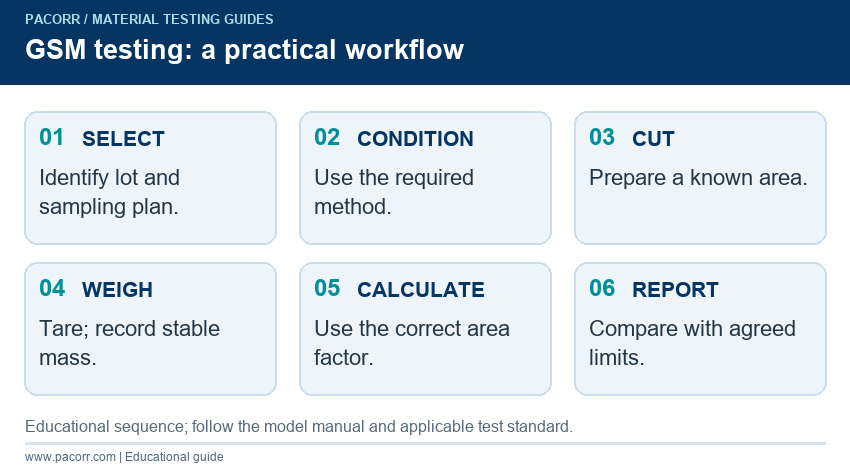
This educational procedure describes the measurement logic. It does not replace the equipment manual or a complete standard test method, which determines specimen count, size, conditioning, calculation details and reporting. Establish those requirements before starting acceptance work.
- Identify the material and test purpose. Record the batch, roll, grade, construction and relevant finish. Confirm the required method and whether the result is intended to represent a local sample or a wider lot. Agree the target and tolerance separately from the measurement procedure.
- Select and condition the samples. Follow the sampling plan and conditioning method. Preserve sample identity throughout preparation. Keep fabric relaxed and paper protected from contamination or moisture changes that would make the test inconsistent with the agreed condition.
- Check the cutter and balance. Inspect the cutting edge and support pad. Confirm balance level, stability, calibration status and routine verification results. Select the correct unit and allow the equipment to stabilise as required by its manual before recording measurements.
- Prepare specimens of known area. Cut complete specimens using the approved technique. Do not stretch, crush or leave attached material. Check the cut perimeter and reject preparation defects according to the method, documenting the reason instead of silently replacing inconvenient results.
- Zero or tare correctly. Confirm the unloaded balance reading. If an approved container or support is needed, tare it before adding the specimen. Ensure the specimen rests freely without contact with a draft shield, bench or another surface that could support part of its mass.
- Weigh and record the unit. Wait for the stable indication specified by the instrument. Record each mass and corresponding specimen area, or record the direct GSM result with the selected area setting. Avoid touching the balance or creating drafts while the reading is taken.
- Calculate and review. Apply the correct area conversion. For repeated specimens, retain individual results and calculate the required summary. Check that combined specimen mass has not been multiplied by a single-specimen factor. Investigate outliers under the documented procedure.
- Report the conclusion and limitations. Include method, condition, sample identity, observations and required statistics. Compare against the agreed acceptance rule, considering uncertainty where relevant. Retain the original readings so the calculation can be reviewed independently.
How do you interpret GSM results and variation?
For specimens of equal area, the arithmetic mean of their GSM values summarises the tested sample. In an illustrative set of 178, 181, 180, 179 and 182 g/m², the mean is 180 g/m² and the observed range is 4 g/m². These results describe the specimens tested; they do not establish a universal tolerance or a guarantee that every location on the roll is identical.
For unequal specimen areas, dividing total mass by total area gives an area-weighted result. A simple average of the individual GSM values gives equal weight to each specimen, which may answer a different question. Use the calculation required by the test method and do not switch between these approaches without explanation.
Percentage deviation from a specified target can be calculated as (measured value − target) ÷ target × 100. If an illustrative target is 200 g/m² and the measured mean is 194 g/m², the deviation is −3%. Whether that passes depends on the agreed tolerance, sampling plan and decision rule. Do not invent a default ±5% limit or assume that a satisfactory average cancels unacceptable individual results.
When results differ between laboratories, first compare sample identity, conditioning, specimen area, balance mode and calculation. Then examine preparation technique and instrument verification. Repeating measurements until a preferred result appears is not an investigation. Keep the original data, document the suspected cause and use a defined retest process.
Which standards apply to fabric and paper GSM?
Choose the standard for the material and measurement scope. A familiar standard number on a product page does not by itself show that every specimen size or laboratory workflow meets all its requirements. The public catalogue descriptions below establish scope; obtain the full current method for a conformity test.
| Standard | Scope and selection point |
|---|---|
| ASTM D3776/D3776M-20(2025) | Fabric mass per unit area; provides options for full pieces, full-width samples, small swatches and narrow fabrics. Select the appropriate option. |
| ISO 3801:1977 | Mass per unit length and mass per unit area of woven fabrics; the woven-fabric scope matters when selecting a method. |
| ISO 536:2019 | Grammage determination for paper and board. Use its specimen preparation, area, conditioning and reporting requirements. |
ASTM's small-swatch option describes the submitted sample and does not automatically establish the properties of the original lot. Likewise, buying a 100 cm² cutter does not automatically make a paper test compliant with ISO 536. Check the required test area and sampling arrangements in the selected method rather than assuming one cutter procedure is interchangeable across every standard.
Record the standard edition and any approved deviations in the report. If a customer specifies a different national or industry method, check that method directly. Avoid claiming that a kit is certified to a standard merely because it can support one part of the measurement process.
Where is GSM useful in manufacturing and purchasing?
GSM is useful wherever material is bought, processed or compared on an area basis. For textile purchasing, it helps define the supplied fabric and monitor changes between lots. In production, a shift may prompt investigation of yarn delivery, fabric construction, relaxation or finishing. It is a diagnostic measurement, not a complete explanation of why a change occurred.
For paper converting and printing, grammage helps estimate sheet mass and compare material consumption. A theoretically uniform 1,000 m² order at 120 g/m² contains 120 kg of material, before allowances for waste and changes in condition. For a fabric roll of known usable width and length, the same relationship supports a planning estimate: mass in kg = GSM × width in m × length in m ÷ 1,000.
These calculations are estimates based on area and grammage; they do not replace weighing a shipment or verifying usable dimensions. Exclude cores and packaging from comparisons where appropriate, and distinguish gross roll mass from net material mass. Allow for cutting waste and process losses when converting an estimate into a production purchase quantity.
For packaging, use grammage alongside structural performance. A heavier sheet is not proof of a stronger finished carton. Pacorr's guide to bursting strength testing explains a separate material-strength measurement. The GSM cutter and balance quality-testing overview provides related background on the equipment used to prepare and weigh samples.
Common GSM testing errors and how to prevent them
The most useful troubleshooting starts with the complete measurement chain: sample selection, area preparation, weighing, calculation and interpretation. A balance that passes a routine mass check cannot correct an incorrectly cut area. Similarly, a precise cutter cannot correct a wrong unit conversion.
| Common error | Practical prevention |
|---|---|
| Confusing cm² with m² | Write the area unit beside the number and check the conversion before calculating. |
| Multiplying a direct GSM display again | Confirm whether the screen shows g or g/m² and verify the selected sample area. |
| Weighing several specimens but using one specimen's area | Record specimen count and total area, or weigh and calculate each separately. |
| Stretching fabric or leaving a ragged cut | Follow the preparation method and inspect specimen edges before weighing. |
| Comparing different moisture conditions | Apply and record the required conditioning procedure for both sample sets. |
| Treating GSM as proof of strength | Use the additional performance tests required by the product specification. |
An apparently stable reading is not enough if the specimen touches another surface, the tare is wrong or the wrong sample is on the pan. Use clear sample labels and a simple data sheet that connects each specimen to its area and mass. A second-person calculation check is valuable when establishing a new method or investigating a disputed lot.
How should you select and maintain a GSM testing kit?
Start with the material family, expected grammage, available specimen size and acceptance method. Tell the supplier whether you test thin paper, extensible fabric, coated material or a layered construction. Confirm that the cutter produces clean specimens of the required area without stretching or damaging that material. Ask for a demonstration using representative samples when suitability is uncertain.
Match balance readability and verified performance to the expected sample mass and required decision. Check capacity, pan arrangement, environmental needs, calibration options and available units. A smaller specimen can save material but produces a smaller mass, making a given display increment more significant relative to the result. A larger specimen may be appropriate only when permitted by the method and supported by the equipment.
Keep the weighing area clean, stable and protected from avoidable drafts and vibration. Inspect the cutter's cutting elements and support surface according to the manual. Replace worn components through the recommended process. Verify the balance using suitable reference masses and maintain traceable calibration records appropriate to your quality system. Verify the cutter's effective area separately; a balance calibration does not calibrate the cutter.
Set verification and calibration intervals according to usage, risk, previous performance and your laboratory system. Do not invent a universal interval for every installation. When a check fails, assess which results may have been affected, correct the cause and document the return to service before relying on new acceptance measurements.
What affects GSM cutter and balance pricing?
A current, fixed selling price for the specified Pacorr kit was not verified, so a quotation is required. A useful quotation should identify the cutter model, specimen area, balance configuration, supplied accessories, calibration documents, installation or training scope, taxes, freight and warranty terms. Compare the complete scope rather than an isolated headline amount.
Price can change with the balance specification, cutter construction, material suitability, replacement consumables and support requirements. State your test method and measurement needs so the supplier can recommend a suitable configuration. Ask whether the quoted balance displays mass only or also calculates GSM, and confirm any required specimen-area settings. Do not purchase solely on the assumption that a higher price or more display digits guarantees better results for your material.
Frequently asked questions about GSM
What is the full form of GSM in fabric and paper?
GSM stands for grams per square metre, written as g/m². It is the mass of a material divided by its area. The definition is the same for fabric and paper; paper specifications often call it grammage.
Does higher GSM always mean better quality?
No. Higher GSM means greater mass per unit area. Quality depends on the intended use and other properties, such as fabric construction, paper surface characteristics and relevant performance tests. GSM alone does not establish thickness, strength or suitability.
Why is a 100 cm² sample mass multiplied by 100?
One hundred square centimetres equals 0.01 square metre. Dividing mass in grams by 0.01 converts it to grams per square metre, which is equivalent to multiplying by 100. Use this shortcut only for a verified 100 cm² specimen.
Can GSM be calculated without a round cutter?
Yes. A specimen of accurately known area can be weighed and its mass divided by that area. A suitable cutter helps make repeatable specimens, but the applicable test method determines acceptable preparation, specimen area and equipment requirements.
Is GSM the same as fabric thickness or paper caliper?
No. GSM measures mass per area, while thickness or caliper measures a distance under specified conditions. Materials with the same GSM can have different thicknesses. A universal conversion from GSM to microns is not valid without additional material information.
Can a GSM balance reading be multiplied by 100?
Only multiply by 100 when the reading is mass in grams for one 100 cm² specimen. If the instrument already displays g/m² using the correct area setting, that result is already GSM and must not be multiplied again.
Is one small specimen enough to accept an entire roll?
Not automatically. A small specimen represents its sampled location. Acceptance of a roll or lot requires an appropriate sampling plan, the specified test method and agreed decision criteria. Keep individual readings and specimen locations when assessing variation.
Does a 0.01 g least count guarantee one-GSM accuracy?
No. For a 100 cm² specimen, 0.01 g corresponds to a 1 g/m² display increment. Accuracy and uncertainty also depend on calibration, repeatability, specimen area, environmental conditions and handling. Display resolution alone is not an accuracy guarantee.
Discuss your GSM testing requirement with Pacorr
To select a suitable setup, share the material type, expected GSM, sample dimensions, applicable standard and the decision the measurement must support. Include details of coatings, layers, fabric stretch or any difficulty cutting a clean sample. These details help define the cutter and balance requirements more clearly than a GSM value alone.
Explore the GSM Round Cutter with Weighing Balance or contact Pacorr for a configuration-specific quotation. Call +91-8882149230 or email info@pacorr.com with your material and test requirements. Confirm the supplied configuration and method suitability before placing an order.