What is a Bursting Strength Tester?
A Bursting Strength Tester measures the pressure required to rupture a specimen under a defined bursting test. In the hydraulic diaphragm arrangement discussed here, a sheet is clamped over an elastic diaphragm. Increasing fluid pressure expands the diaphragm against the specimen until rupture, and the instrument records the relevant maximum pressure.
The result is a pressure, not simply a force. It helps paper and packaging teams evaluate resistance to a particular kind of multidirectional loading. It is useful for comparing suitable materials under equivalent conditions, checking incoming supply and investigating production variation. It does not, by itself, establish the stacking strength of a finished carton or its resistance to every transport hazard.
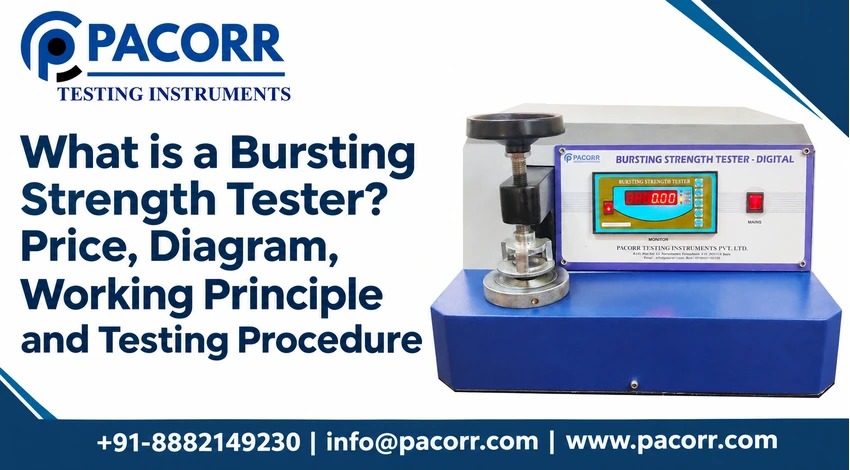
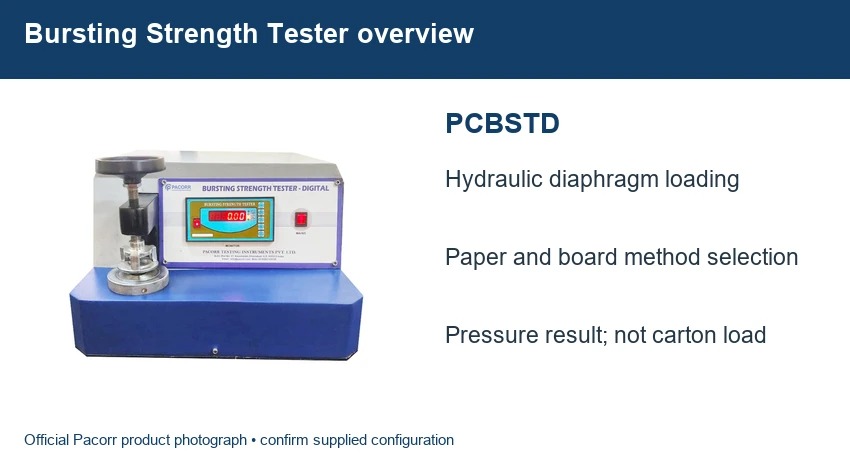
Pacorr's digital Bursting Strength Tester, identified as PCBSTD, provides a documented product example. This article focuses on paper and board testing while explaining why other materials can require different apparatus. The procedure is educational: specimen preparation, conditioning, clamping and reporting must follow the selected standard and the instructions for the actual machine.
What is the hydraulic bursting-strength working principle?
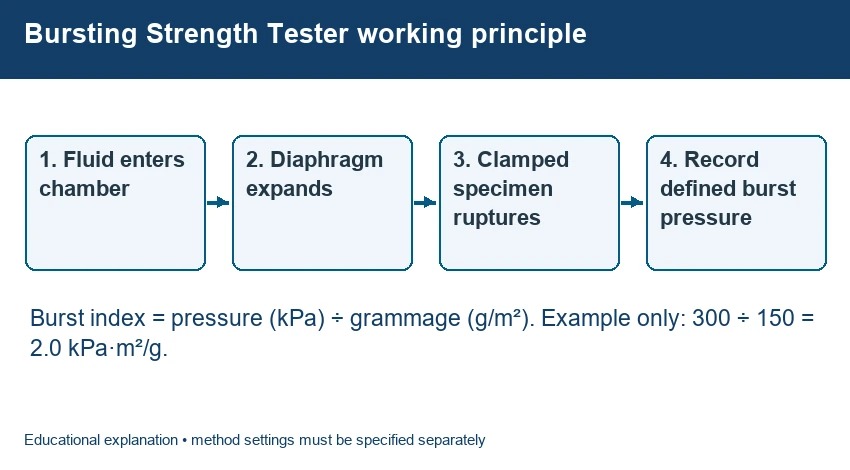
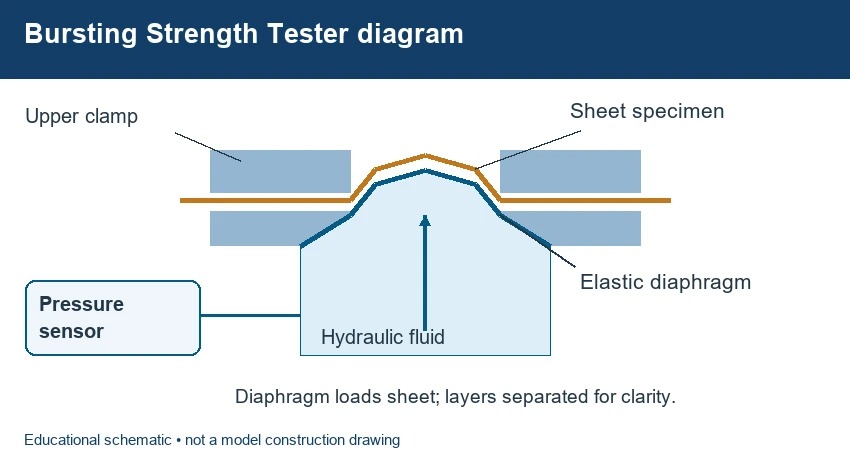
The test assembly contains a fluid chamber beneath an elastic diaphragm. The specimen is held between annular clamping surfaces so that a defined circular region is exposed. As fluid is displaced into the chamber, the diaphragm bulges and loads the specimen. The test continues to the method-defined rupture event, while the pressure-measuring system captures the relevant reading.
The diaphragm transfers the hydraulic loading to the specimen and forms part of the test system. Its condition and specified properties matter. A worn, damaged or unsuitable diaphragm can change the response. The clamp assembly also matters because the specimen must be held as required without slipping or being damaged by excessive or uneven clamping.
Pressure measured in the hydraulic system must be interpreted according to the method. Do not divide it by another area merely because a tensile-test calculation uses force divided by area. Bursting strength is already reported as pressure under the prescribed geometry. Likewise, do not apply an improvised diaphragm correction taken from a different material-test method.
The distinction from pneumatic package testing is important. A pouch burst tester introduces air into a package. A hydraulic sheet tester expands a diaphragm against a clamped sheet. Although both may report pressure, the specimens, loading arrangements and interpretation differ. A pouch result is not a substitute for a paper bursting-strength result, and neither directly gives a carton compression value.
What does the Bursting Strength Tester diagram show?
The labelled diagram is a generic educational cross-section. It shows the upper clamp, sheet specimen, lower support, elastic diaphragm, hydraulic chamber and pressure-measuring connection. It explains the loading path without claiming to reproduce the hidden construction of the PCBSTD model. The product overview image separately shows the authentic Pacorr machine.
| Component | Role in the test |
|---|---|
| Upper and lower clamps | Hold the sheet around the specified test opening. |
| Specimen | Presents the selected paper or board area to diaphragm loading. |
| Elastic diaphragm | Expands under hydraulic pressure and loads the specimen. |
| Hydraulic chamber and drive | Provide controlled fluid displacement beneath the diaphragm. |
| Pressure-measuring system | Records the pressure response and the defined rupture result. |
| Display and controls | Support the available operating sequence and result indication. |
The upper and lower openings need not have the same stated diameter. Use the dimensions required by the relevant apparatus specification instead of modifying a clamp to make the openings look symmetrical. Keep clamping surfaces clean and inspect them for wear or damage using the manufacturer's procedure. Their role is functional, not merely cosmetic.
An external photograph cannot verify every internal feature. During procurement, ask for the relevant specification sheet, operating instructions and calibration documentation. Confirm which material and standard the supplied diaphragm, clamp and pressure range are intended to support. A broad list of materials on a webpage is not a substitute for this configuration review.
How do paper, board and textile configurations differ?
Paper and board methods use related hydraulic principles, but their apparatus requirements and applicable ranges differ. Selecting a method solely because it contains the word bursting can therefore lead to inappropriate comparisons. Identify the specimen and required standard first, then choose the pressure range, diaphragm and clamping arrangement.
Manual or pneumatic clamping describes how the specimen is held. It does not necessarily describe the medium that generates the bursting load. A tester with pneumatic clamps can still use hydraulic pressure beneath the diaphragm. Similarly, digital indication and computer reporting describe data functions rather than a different fundamental material property.
Textile bursting tests can involve different requirements, including how diaphragm effects are handled. A paper or board configuration should not be advertised as suitable for a particular fabric method without checking the complete requirements. If a laboratory needs both packaging and textile testing, ask the supplier to identify the necessary configurations and any changes between them.
Computerised reporting may be useful for result storage and traceability, but it does not make invalid specimen preparation valid. A basic display with a controlled procedure can provide useful measurements; a sophisticated report can still contain misleading results if the wrong standard, specimen condition or units were used. Evaluate the whole test system rather than the screen alone.
What materials and decisions suit this test?
Paper mills, board converters and packaging laboratories use bursting measurements as one part of material evaluation. Candidate specimens can include appropriate papers, solid board and corrugated board, provided the chosen method and apparatus are suitable. The test can support incoming inspection, comparison of production lots and investigation of changes in material construction.
The location of a specimen within a converted product matters. Creases, printing, adhesive regions and previous damage may affect a result. Decide whether the test is intended to characterise the base material or a particular converted area. Do not alternate between these objectives without identifying them in the sampling and reporting procedure.
For corrugated packaging, bursting resistance is not the same as edgewise compression resistance or box compression performance. A finished package also depends on geometry, joints, contents, humidity and how it is supported. If the purchasing question is stacking performance, use the appropriate package tests in addition to the relevant material tests.
When comparing suppliers, agree on the method, conditioning, specimen selection and units. Otherwise one supplier's result may be technically valid but not comparable with another's. Retaining a sample and its production identity can be valuable when a disagreement needs to be investigated later.
Which technical specifications are published for PCBSTD?
The following selected details are listed on Pacorr's digital product page, checked on 10 November 2026. They should be confirmed in the quotation and delivered documentation. They are not universal values for every bursting tester or every material standard.
| Listed specification | PCBSTD value |
|---|---|
| Maximum pressure range | 40 kgf/cm² |
| Display resolution | 0.1 kgf/cm² |
| Upper clamp opening | 35.5 mm diameter |
| Lower clamp opening | 38.1 mm diameter |
| Fluid displacement rate | 95 cm³/min |
| Hydraulic fluid | Glycerin |
Source: Pacorr digital Bursting Strength Tester specifications. One kgf/cm² is approximately 98.0665 kPa, so a 0.1 kgf/cm² display increment corresponds to about 9.81 kPa. The conversion does not imply that all digits are significant or that the instrument's uncertainty equals its display increment.
Check that the apparatus suits both the expected pressure and the selected standard. A catalogue maximum does not establish good performance at every lower value. Ask for calibration coverage in the actual working region and clarify how any accuracy statement is defined. Verify the fluid, diaphragm and displacement requirements rather than choosing only on maximum capacity.
How should specimens be selected and conditioned?
Start with the required property and the material specification. Identify whether the test concerns paper, board or a converted construction. Select the method and edition required by the contract or quality system. Define specimen locations, conditioning, the number of valid tests and the rules for handling invalid results before beginning.
Prepare samples without introducing unintended folds, dents or damage. Use the specimen dimensions and preparation requirements in the method. Keep the tested area representative of the intended material. If a deliberately damaged, creased or printed area is part of the study, identify it explicitly so that it is not mistaken for a base-material result.
Conditioning is particularly important for paper-based materials because moisture can influence their behaviour. Follow the specified atmosphere and duration rather than relying on an informal period on the laboratory bench. Record the relevant conditions and protect conditioned samples from uncontrolled exposure during handling.
If grammage is needed for a burst index, determine it using the appropriate procedure and keep the units consistent. Do not use an unverified nominal catalogue grammage when the study requires a measured value. Identify whether the grammage corresponds to the material actually tested, especially for multilayer or corrugated constructions.
How is a bursting-strength test performed?
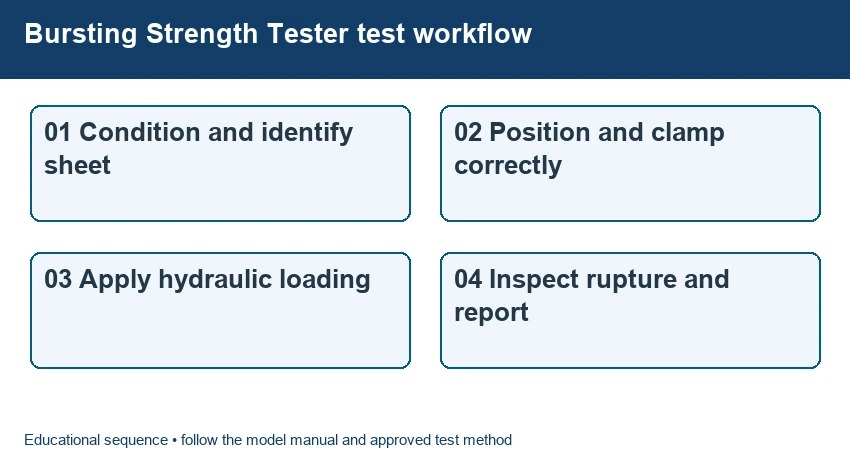
The steps below describe the workflow, not model-specific operating instructions. Obtain the complete method for exact apparatus requirements, clamping settings, specimen numbers and result treatment. Follow the machine manual for startup, protective measures, fluid handling and stopping the test.
- Confirm the configuration. Check that the installed clamps, diaphragm, pressure range and fluid system match the selected material method. Resolve any uncertainty before testing production acceptance samples.
- Inspect the equipment. Look for diaphragm damage, contamination, hydraulic leakage and worn clamping surfaces. Review calibration status and any recent repairs. Do not continue with a damaged diaphragm or a suspect measuring system.
- Identify each specimen. Record its source, material construction, conditioning and test location. Maintain the required distinctions between faces or orientations if the method calls for them.
- Position the sheet. Place the intended test area over the opening without folds or unintended pre-stress. Keep previously tested or damaged areas away from the new test region according to the method.
- Clamp as specified. Use the authorised clamping procedure to prevent slipping without introducing unacceptable damage. Pneumatic clamping still requires the correct setting and a suitable specimen arrangement.
- Prepare the indication. Select the correct units and clear the previous result as instructed. Complete the prescribed reference or zero checks without substituting them for calibration.
- Apply the hydraulic loading. Start the authorised test sequence and keep clear of the test area. The machine expands the diaphragm beneath the specimen until the defined rupture event.
- Stop and release safely. Follow the unloading and unclamping instructions. Confirm that pressure has been released before accessing the specimen or undertaking any adjustment.
- Inspect the outcome. Check for slipping, unusual rupture or damage associated with the clamp. Classify validity using the standard and record the reason for any exclusion.
- Repeat and calculate. Obtain the required number of valid results using the approved sampling procedure. Retain individual readings, calculate the required summary and report conditions alongside the values.
Do not stack sheets or change specimen layers unless the selected method explicitly permits and defines that arrangement. Multiple layers can change the test response. Similarly, do not repeat a test over an already stressed area and treat it as an independent result. The specimen history must remain consistent with the property being reported.
How do you interpret bursting strength, burst index and burst factor?
Bursting strength is reported as pressure under the specified method. Higher pressure indicates greater resistance to that particular bursting challenge when materials are tested comparably. It does not automatically mean a better package in every application. Consider other required properties and the way the finished product will be handled.
For paper, burst index expresses bursting strength relative to grammage. Using pressure in kPa and grammage in g/m² gives burst index in kPa·m²/g. ISO 2758's terminology defines this relationship. Keep the mass unit explicit; changing g/m² to kg/m² changes the numerical scale.
| Educational calculation | Result |
|---|---|
| Hypothetical bursting strength | 300 kPa |
| Hypothetical grammage | 150 g/m² |
| Burst index: 300 ÷ 150 | 2.0 kPa·m²/g |
This example illustrates arithmetic only. It is not a Pacorr performance result, a specimen prescription or an acceptance threshold. Record the test method and the grammage determination with the calculation. Rounding should reflect the underlying measurements rather than the number of digits a calculator displays.
The term burst factor is also used in commercial specifications, but it must be accompanied by its formula and unit convention. Do not silently substitute burst factor for burst index. If a customer specifies burst factor using a different pressure unit, obtain the agreed definition and verify the conversion before issuing a conformity statement.
Review variation as well as the average. Unusual scatter may arise from material variability, preparation, clamping or instrument condition. Investigate these possibilities with controlled checks instead of assuming that every low value is a defective material. Preserve invalid results with the documented reason for exclusion so that the review remains traceable.
Which bursting-strength standards apply?
ISO 2758:2014 addresses paper bursting strength using hydraulic pressure. ISO 2759:2014 addresses board, including corrugated and solid fibreboard within its scope. Their apparatus and application distinctions mean that results are not automatically interchangeable.
The published ISO 2758 information identifies an applicable paper range of 70–1,400 kPa. ISO 2759 describes a board range of 350–5,500 kPa, with additional scope conditions. These ranges describe the standards' application, not the capacity of every Pacorr model. Review the complete documents to resolve overlap and material-specific choices.
Do not treat all standard numbers found on product pages as current or universally applicable. ASTM D774 appears in legacy paper-burst literature; verify its status and the required contractual method before specifying it. Textile diaphragm bursting methods, such as ASTM D3786/D3786M, concern a different material application and require a separate apparatus review.
The standard defines the method; the buyer's material specification defines the relevant acceptance requirement. A machine described as compliant with a standard does not supply a universal pass limit for every grade. Ask the supplier to demonstrate the configured apparatus against the actual method and expected specimen range.
What is the Bursting Strength Tester price in India?
Pacorr's digital product page publishes an indicative range of ₹50,000–₹2,50,000, checked on 10 November 2026. Treat it as a guide to the listed category, not a fixed price for every machine. Obtain a current, itemised quotation identifying the pressure range, clamping system, reporting functions and accessories.
Cost can change with the required configuration, pneumatic clamping, computer reporting, calibration documentation and service scope. A paper-testing laboratory and a board-converting plant may not require the same apparatus. Compare quotations only after confirming that the proposed configurations support the same test method and specimen range.
Clarify GST, delivery, installation and training. Ask which consumables and spare diaphragms are included, what fluid is supplied, and how replacement parts are obtained. Consider the cost of keeping the test system in service rather than judging the purchase solely by the initial instrument price.
How should a laboratory select and validate a tester?
Prepare a requirement sheet listing material types, thickness or construction, expected bursting range, applicable methods and required outputs. Include any need for grammage measurement or automated reporting, but keep those requirements distinct from the burst measurement itself. State the expected daily workload and available laboratory services.
Request a demonstration on representative specimens across the intended range. Observe sample handling, clamping, rupture detection and result recording. If several operators will use the machine, include practical training and a consistent procedure in the implementation plan. A machine demonstration is most useful when it exposes difficult specimens and realistic workflow constraints.
Before routine release testing, verify that operators obtain consistent results under the approved procedure. Investigate differences in conditioning, test location and clamping. Where a new instrument replaces an old one, plan a comparison using controlled samples and matched methods. Do not assume that matching model names guarantee equivalent historical data.
Define what happens when a result is close to a specification limit. The quality system should establish the relevant decision rule and treatment of uncertainty. Repeating only borderline or failing tests without a documented rule can bias the result. A clear review procedure protects the usefulness of the measurement for both supplier and customer.
When planning a wider corrugated-packaging assessment, Pacorr's guide to the Edge Crush Test in corrugated packaging introduces edgewise compression. The compression test machine guide explains another loading mode relevant to packaging evaluation. Keep the results separate: hydraulic bursting measures sheet rupture pressure, edge crush measures edgewise strength per unit length, and a box-compression test evaluates the assembled box under the selected compression conditions.
What maintenance and calibration practices matter?
Inspect the diaphragm, clamp surfaces and hydraulic circuit according to the manufacturer's maintenance schedule. Keep the apparatus clean and use only the specified fluid and replacement parts. Air trapped in the hydraulic system, leakage or mechanical wear should be addressed through the authorised service procedure, not improvised adjustments during acceptance testing.
A damaged diaphragm should be replaced before further measurements. After replacement, complete the checks required by the method and machine instructions. Do not assume that any rubber sheet with a similar appearance is a suitable substitute. Diaphragm dimensions and response are part of the defined apparatus.
Calibration and verification should cover the pressure measurement over the working range, together with other apparatus checks required by the method. Display resolution is not evidence of calibration. Keep certificates, service records and instrument identification available with the laboratory procedure. Investigate unexplained shifts, overloads and repairs before relying on subsequent results.
The calibration interval depends on the quality system, instrument use, stability and manufacturer guidance. A single universal annual interval should not be invented for every laboratory. Routine checks may help reveal changes between calibrations, but they should be documented with their scope and limitations. A passing zero check does not validate the complete pressure response.
Frequently asked questions
Does bursting strength measure force or pressure?
The hydraulic diaphragm method reports a pressure under a defined test arrangement. It should not be described simply as a force reading or converted using an unrelated tensile-test formula.
Is a higher bursting value enough to prove carton stacking strength?
No. Bursting resistance is one material property. Finished-carton compression and stacking performance also depend on construction, geometry, conditions and the applicable package tests.
Is pneumatic clamping the same as pneumatic bursting?
No. Pneumatic clamping describes how the specimen is held. A pneumatically clamped sheet tester can still generate the bursting load hydraulically through an elastic diaphragm.
What is burst index?
For paper, burst index is bursting strength in kPa divided by grammage in g/m², giving kPa·m²/g. Use the applicable method and keep the pressure and mass units explicit.
Can the same setup test every paper, board and fabric?
No. Material methods can require different diaphragms, clamps, ranges and reporting procedures. Confirm the configuration against each intended standard rather than relying on the instrument name.
What should I do when the diaphragm is damaged?
Stop using the instrument for measurements, replace the diaphragm through the approved procedure, and complete the required checks before testing resumes. Do not substitute an unspecified rubber sheet.
Request a suitable bursting-strength configuration
The right tester matches the material, method and required pressure range. Reliable results also depend on conditioning, specimen selection, clamping and correct units. Keep these requirements together when writing a purchase specification or reviewing supplier data.
Share your materials, expected values and test standards through Pacorr's enquiry page. Call +91-8882149230 or email info@pacorr.com for a written configuration proposal and quotation, including fixtures, calibration documentation and service requirements.