
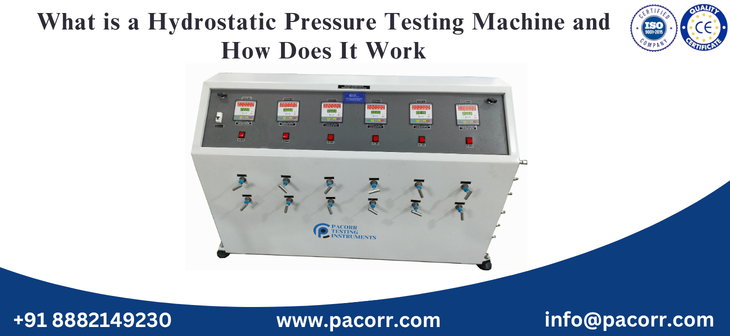
Pacorr brings deep expertise to the field of quality assurance and industrial testing, and one of the most critical instruments in this space is the Hydrostatic Pressure Testing Machine. Designed to evaluate the pressure resistance, leak integrity, and structural durability of products, this machine plays a vital role in ensuring safety and compliance across industries. From pipelines and pressure vessels to automotive parts and plumbing components, hydrostatic testing helps manufacturers verify that their products can withstand demanding operating conditions without failure.
Introduction
In modern manufacturing, product safety is not optional. Components that carry fluids under pressure must perform reliably throughout their service life, even under extreme conditions. This is where a Hydrostatic Pressure Testing Machine becomes essential. It is used to test the strength and leak resistance of materials or finished components by filling them with liquid, usually water, and then subjecting them to pressure higher than their normal working limit.
This testing method is widely used in industries where pressure-bearing products are common, such as oil and gas, automotive, aerospace, construction, water management, and industrial equipment manufacturing. By simulating real-life stress conditions in a controlled environment, hydrostatic testing equipment helps detect weaknesses before products reach the market.
What is a Hydrostatic Pressure Testing Machine?
A Hydrostatic Pressure Testing Machine is a specialized instrument used to assess the ability of a product, pipe, vessel, or component to withstand internal pressure without leaking, deforming, or rupturing. It is considered one of the most effective forms of non-destructive testing, because the tested specimen can often remain usable after the test if it passes successfully.
The machine works by filling the test specimen with a liquid and applying pressure beyond normal operating limits to identify structural flaws, leakage points, or material weaknesses. Because liquids are nearly incompressible, they provide a safer and more stable testing medium than gases. This makes hydrostatic testing especially valuable when accuracy, repeatability, and safety are top priorities.
In practical terms, the machine helps manufacturers answer several critical questions:
- Can the product withstand its intended service pressure?
- Are there any hidden leaks, cracks, or weak joints?
- Will the component maintain integrity over time?
- Does it meet regulatory and quality standards?
By answering these questions before the product is installed or shipped, a hydrostatic test procedure reduces field failures, improves customer trust, and supports long-term reliability.
Working Principle of Hydrostatic Pressure Testing Machine
The pressure testing machine working principle is based on a simple but powerful scientific concept: Pascal’s Law. According to this law, when pressure is applied to a confined fluid, that pressure is transmitted equally in all directions throughout the fluid. This principle makes it possible to apply uniform internal pressure to the specimen being tested.
Understanding Hydrostatic Pressure
Hydrostatic pressure refers to the pressure exerted by a fluid at rest within a confined system. In hydrostatic testing, the liquid acts as a medium to transfer force evenly to the internal walls of the test object. Because water does not compress significantly, even small increases in volume from the pump can create measurable and controlled pressure changes.
This behavior offers two major advantages:
- It allows precise control over test pressure.
- It reduces the risk associated with stored energy compared to compressed gases.
Basic Working Sequence
A typical Hydrostatic Pressure Testing Machine follows these stages:
- Preparation
The specimen is secured in the machine and connected to the testing circuit. - Filling with liquid
The specimen is filled with water or another suitable test fluid. - Pressurization
A hydraulic or pressure generation system raises the internal pressure above standard operating conditions. - Holding and monitoring
The machine maintains pressure for a specified duration while sensors and gauges track any pressure drop. - Leak detection and evaluation
The operator checks for leakage, deformation, bulging, or failure.
This method ensures that even minor defects can be detected under controlled and measurable conditions.
Step-by-Step Working Process
To understand the hydrostatic test procedure more clearly, it helps to break the process into detailed operational steps.
1. Cleaning and Setup
Before testing begins, the specimen must be cleaned thoroughly. Dirt, oil, debris, or trapped contaminants can interfere with sealing and affect results. The specimen is then mounted and connected to the machine using appropriate fixtures, valves, and adapters.
A proper setup is critical because poor clamping or loose connections can create false leakage readings.
2. Removing Air from the System
Air must be purged from the specimen and the connecting lines before pressure is applied. This is a crucial step because trapped air is compressible and can lead to unstable readings, inaccurate results, and increased safety risk.
By removing air completely, the operator ensures that pressure is transmitted uniformly through the liquid.
3. Filling with Water
The specimen is filled with water, which is the most commonly used test medium. Water is preferred because it is:
- Safe compared to compressed gases
- Readily available and cost-effective
- Nearly incompressible
- Easy to handle and dispose of in many settings
In some specialized cases, other liquids may be used depending on the application, material compatibility, or industry standard.
4. Applying Pressure Above Normal Operating Levels
Once the specimen is full, the machine gradually raises the internal pressure to a predetermined test value. This pressure is typically higher than the product’s normal working pressure to verify a suitable safety margin.
The increase must be controlled and steady. Sudden pressure spikes can distort results or damage the specimen in a non-representative way.
5. Monitoring for Leaks or Deformation
The pressure is then held for a specified time. During this holding period, the machine monitors:
- Pressure stability
- Visible leakage
- Material expansion
- Joint weakness
- Permanent deformation
A drop in pressure may indicate a leak, while visible distortion may suggest structural weakness. If the specimen maintains pressure without signs of failure, it passes the test.
Key Components of the Machine
The performance of a Hydrostatic Pressure Testing Machine depends on the coordination of several core components.
Fluid Reservoir
This stores the testing liquid before it is transferred into the specimen. A reliable reservoir ensures continuous fluid supply and stable operation.
Hydraulic Pump
The hydraulic pump is responsible for moving the liquid and generating the required pressure. It is one of the most important elements in the system because it directly influences pressure accuracy and test efficiency.
Pressure Generation System
This system increases and regulates internal pressure according to the required test parameters. In advanced machines, it may include boosters, regulators, and automated control valves.
Pressure Gauges and Sensors
These instruments measure and display the applied pressure in real time. High-quality sensors are essential for precise monitoring, repeatable performance, and reliable test reports.
Control Panel
The control panel allows the operator to manage the entire testing sequence. In fully automatic machines, it may include digital displays, programmable logic controls, alarms, and data logging functions.
Each component contributes to the accuracy, safety, and consistency of the test. Well-designed hydrostatic testing equipment reduces operator error and improves overall productivity.
Types of Hydrostatic Pressure Testing Machines
Different production environments require different levels of automation. That is why hydrostatic testing machines are generally available in three main types.
Manual Machines
Manual machines require the operator to control most of the testing steps, including filling, pressurizing, and observation.
Best suited for:
- Small-scale operations
- Basic testing applications
- Low production volumes
Advantages:
- Lower initial cost
- Simple operation
- Easy maintenance
Semi-Automatic Machines
Semi-automatic machines automate some parts of the process while still requiring operator involvement for setup and supervision.
Best suited for:
- Medium-scale manufacturing
- Repetitive but flexible testing needs
- Companies seeking a balance between cost and efficiency
Advantages:
- Better consistency than manual systems
- Improved speed
- Reduced operator dependence
Fully Automatic Machines
Fully automatic machines handle filling, pressurization, holding, monitoring, and data collection with minimal manual intervention.
Best suited for:
- High-volume production
- Precision-critical applications
- Strict quality documentation requirements
Advantages:
- High accuracy
- Faster testing cycles
- Excellent repeatability
- Integrated reporting and traceability
Applications Across Industries
The Hydrostatic Pressure Testing Machine is used in many sectors where pressure-bearing components must meet strict safety standards.
Oil and Gas Pipelines
Pipelines transport fluids under high pressure over long distances. Hydrostatic testing verifies that pipes, joints, and welds can operate safely without leaks.
Automotive Components
Fuel lines, radiators, brake components, and hydraulic assemblies must be tested for pressure resistance and sealing integrity before use.
Aerospace Systems
Aircraft hydraulic systems and pressure-sensitive components require highly accurate testing because even minor failures can have severe consequences.
Plumbing and Construction Materials
Pipes, fittings, valves, and tanks used in buildings and infrastructure must be tested to ensure long-term reliability.
Pressure Vessels and Cylinders
Industrial vessels, storage cylinders, and compressed fluid containers are tested to confirm compliance with safety and regulatory requirements.
In all of these industries, hydrostatic testing is not just about quality control. It is about preventing catastrophic failures, protecting users, and meeting compliance standards.
Advantages of Hydrostatic Pressure Testing
There are several reasons why hydrostatic testing remains one of the most trusted quality assurance methods.
Non-Destructive Testing Method
When conducted correctly, the product remains usable after testing, making it ideal for production environments.
High Accuracy in Leak Detection
Even small leaks or pressure losses can be identified with precision.
Ensures Product Safety and Compliance
Testing confirms that components can withstand required pressure levels and meet industry regulations.
Cost-Effective Quality Assurance
Detecting defects before installation or shipment prevents expensive recalls, downtime, and field repairs.
Reliable and Repeatable Results
With the right equipment and procedure, results can be repeated consistently across multiple test cycles.
Safety Considerations
Although water-based testing is safer than gas-based pressure testing, it still involves high forces and must be handled carefully.
Important safety measures include:
- Ensuring proper fixture alignment and secure sealing
- Using protective shields and personal protective equipment
- Calibrating gauges and sensors regularly
- Preventing pressure overshoot
- Training operators thoroughly in machine operation and emergency procedures
High-pressure testing should never be treated casually. Proper machine design, standard operating procedures, and trained personnel are essential for safe operation.
Why Choose Pacorr Hydrostatic Pressure Testing Machines
Pacorr has earned a strong reputation in the testing equipment industry by delivering machines that combine precision, durability, and application-focused engineering. For manufacturers looking for reliable hydrostatic testing equipment, Pacorr offers solutions designed to meet real production challenges.
Precision and Reliability
Pacorr machines are built for accurate pressure control, dependable leak detection, and repeatable test performance.
Industry Expertise
With experience in quality testing instruments, Pacorr understands the compliance, operational, and technical requirements of modern manufacturing industries.
Advanced Design
From robust construction to user-friendly controls, Pacorr focuses on practical innovation that supports both accuracy and efficiency.
Customization and Support
Every industry has unique testing needs. Pacorr provides support and tailored solutions to help customers select the right machine configuration for their products and production environment.
When businesses invest in a pressure testing solution, they need more than just equipment. They need confidence, consistency, and technical support. That is exactly where Pacorr stands out.
Conclusion
A Hydrostatic Pressure Testing Machine is an essential tool for verifying the strength, durability, and leak resistance of pressure-bearing products. By using liquid to apply controlled internal pressure, this testing method provides a safe, accurate, and non-destructive way to identify flaws before products enter service. From understanding Pascal’s Law to following the correct hydrostatic test procedure, every step of the process contributes to better quality control and stronger industrial safety.
For industries such as oil and gas, automotive, aerospace, plumbing, and pressure vessel manufacturing, hydrostatic testing is a critical part of product validation and compliance. Choosing the right machine can directly improve testing accuracy, reduce risk, and enhance long-term product performance.
Pacorr delivers dependable and high-performance hydrostatic pressure testing solutions designed to help manufacturers maintain the highest standards of quality and safety.
For more information about Pacorr’s testing equipment, contact:
Email: info@pacorr.com
Phone: +91 8882149230
Recent Blogs
Enhance your understanding of testing and precise quality control indistinct applications with our
knowledge based articles coming from top editors of industry leaders.
Our USP's
Demonstration of Machine
- Try Before You Decide
- Experience Before You Invest
- See It in Action – Free Demo
Global Reach
- Delivering Excellence Worldwide
- Serving Across Borders
- Your Global Supply Partner
On-Site Support
- Support That Comes to You
- On-Ground Assistance, Anywhere
- We Reach Where You Are
Team Strength
- Powered by Expert Minds
- Driven by Skilled Professionals
- Engineering Excellence Team
Manufacturing
- Precision-Driven Manufacturing
- Smart & Automated Production
- Engineered In-House Excellence
