
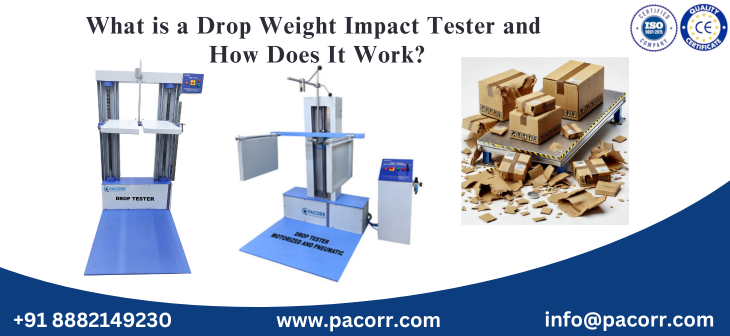
Pacorr offers advanced testing solutions for industries that need reliable, repeatable, and technically accurate material evaluation. For companies involved in packaging, plastics, automotive components, construction materials, films, sheets, and product safety testing, a Drop Weight Impact Tester is one of the most important instruments used to measure how a material performs under sudden impact. To learn more about suitable testing solutions, businesses can contact Pacorr at info@pacorr.com or 8882149230.
What is a Drop Weight Impact Tester?
A Drop Weight Impact Tester is a precision impact testing equipment used to determine the impact resistance, toughness, puncture strength, and energy absorption capacity of materials. It works by dropping a known weight from a controlled height onto a test specimen and observing how the material responds.
The purpose of the test is simple but highly valuable: it helps manufacturers understand whether a material can withstand sudden force, shock, dropping, puncture, or collision during real-life use.
In industrial quality control, materials are rarely tested only for appearance or dimensions. They must also be tested for strength, durability, and failure resistance. This is where material strength testing becomes essential. A Drop Tester helps evaluate whether a product or raw material can survive handling, transportation, stacking, accidental drops, packaging stress, or end-use impact.
For example, plastic films used in packaging may look strong, but they can fail when a pointed object strikes them. Automotive plastic parts may appear rigid, but they must resist sudden impact during service. Construction sheets, laminated films, and molded components must also maintain performance under dynamic force.
Why Drop Weight Impact Testing is Important
Impact failure can lead to product damage, customer complaints, safety risks, and financial losses. A Drop Weight Impact Tester helps manufacturers identify weak materials before they reach the market.
This test is important because it helps:
- Measure resistance to sudden impact
- Compare different material grades
- Improve packaging durability
- Validate supplier material quality
- Reduce product failure during shipping
- Support compliance with industry standards
- Improve research and product development
- Maintain consistent production quality
Unlike static testing, where force is applied slowly, drop weight testing simulates sudden loading. This makes it especially useful for applications where materials experience shock, falling objects, accidental drops, or puncture forces.
Working Principle of a Drop Weight Impact Tester
The basic working principle of a Drop Weight Impact Tester is based on the conversion of potential energy into impact energy. A weight is raised to a selected height and then released. As it falls, gravitational potential energy converts into kinetic energy. When the falling weight strikes the specimen, that energy is transferred to the material.
The impact energy is commonly associated with the formula:
Impact Energy = mass × gravity × height
This means the severity of the test depends mainly on the weight of the impactor and the drop height. By adjusting these parameters, laboratories can test materials under different impact conditions.
Drop weight testing is widely used for films, thermoplastics, composites, metals, and finished components. Lower-energy systems may be suitable for films and plastics, while high-energy systems are used for demanding applications such as metals and pipeline-related specimens.
Main Components of a Drop Weight Impact Tester
A standard Drop Weight Impact Tester consists of several important components that work together to deliver accurate and repeatable results.
1. Drop Tower or Vertical Column
The drop tower provides a guided vertical path for the falling weight. It ensures that the impactor falls in a straight line and strikes the specimen at the correct location.
2. Falling Weight or Dart
The falling weight, also called a dart, tup, or impactor, is the main loading element. It is selected according to the required impact energy and test standard.
3. Specimen Holder or Clamp
The specimen holder keeps the sample firmly positioned during the test. Proper clamping is essential because movement during impact can affect results.
4. Release Mechanism
The release system holds the weight at a selected height and releases it without unwanted vibration or manual interference.
5. Impact Head
The impact head may be hemispherical, flat, conical, or specially designed depending on the material and test method.
6. Height Adjustment System
The operator can adjust the drop height to control the energy delivered during the test.
7. Measurement and Display System
Modern machines may include digital displays, sensors, energy calculation systems, and data recording features for better accuracy and documentation.
8. Safety Guard
Because the equipment uses falling mass and impact force, safety guarding protects the operator during testing.
Step-by-Step Testing Process
The working process of a Drop Weight Impact Tester typically follows these steps:
Step 1: Sample Preparation
The material specimen is prepared according to the required test method. For films, sheets, laminates, or molded parts, the sample size and conditioning must be controlled.
Step 2: Test Standard Selection
The operator selects the relevant standard or internal quality control method. For plastic film impact testing, standards such as ASTM D1709 and ISO 7765-1 are commonly referenced. These methods are used to evaluate plastic film impact strength using a free-falling dart approach.
Step 3: Specimen Placement
The sample is fixed securely in the specimen clamp or support fixture. The impact point must be properly aligned.
Step 4: Weight and Height Selection
The correct dart weight and drop height are selected depending on the material type and expected impact resistance.
Step 5: Release of Falling Weight
The weight is released from the selected height. It falls freely through the guide path and impacts the specimen.
Step 6: Observation of Failure
The material is examined for rupture, crack, puncture, deformation, or complete failure.
Step 7: Result Recording
The result may be recorded as pass/fail, energy absorbed, puncture resistance, failure weight, or impact strength, depending on the test method.
Step 8: Data Analysis
Multiple specimens are tested to obtain reliable results. The data helps determine material consistency and suitability for application.
Standards Related to Drop Weight Impact Testing
Different industries use different standards depending on the material and application. Some commonly referenced standards include:
- ASTM D1709 – Falling dart impact resistance of plastic film
- ISO 7765-1 – Impact resistance of plastic film and sheeting by free-falling dart method
- ASTM D3763 – High-speed puncture properties of plastics
- ISO 6603 – Puncture impact behavior of rigid plastics
- ASTM D7136 – Drop-weight impact damage resistance of composite materials
Drop weight impact testing is also used for puncture resistance, compression-after-impact, tensile impact, three-point bending, wedge peel, and finished component testing depending on the equipment configuration and standard followed.
Applications Across Industries
A Drop Weight Impact Tester is widely used across multiple sectors where impact resistance and product reliability are critical.
Packaging Industry
Packaging films, flexible laminates, plastic bags, pouches, and wrapping materials are tested to ensure they can withstand handling, filling, transportation, and stacking stress.
Plastics Industry
Plastic sheets, molded parts, thermoplastics, and polymer components are tested for toughness, crack resistance, and puncture behavior.
Automotive Industry
Automotive interior and exterior components must resist impact during use. Drop weight testing helps evaluate dashboards, panels, bumpers, trims, and polymer-based parts.
Construction Industry
Construction sheets, panels, membranes, and protective materials are tested for durability against falling objects and site impact conditions.
Consumer Goods
Products such as containers, casings, protective covers, toys, and household plastic items may be tested for sudden impact resistance.
Research and Development
R&D teams use impact testing to compare new formulations, improve material design, and validate product performance before mass production.
Key Features of a Good Drop Weight Impact Tester
A reliable Drop Weight Impact Tester should include features that support accuracy, safety, and repeatability.
Important features include:
- Rigid vertical structure
- Adjustable drop height
- Interchangeable weights
- Accurate release mechanism
- Strong specimen clamping system
- Digital result display
- Easy sample loading
- Operator safety enclosure
- Repeatable impact positioning
- Compliance with relevant standards
- Low-maintenance design
These features help laboratories perform consistent material strength testing and make data-driven quality decisions.
Benefits of Using Drop Weight Impact Testing Equipment
Using professional impact testing equipment offers several benefits to manufacturers and testing laboratories.
Improved Product Quality
Manufacturers can identify weak materials and improve formulations before products enter the market.
Reduced Failure Risk
Testing helps reduce damage during transportation, storage, and end use.
Better Material Selection
Engineers can compare different materials and choose the best one for strength, cost, and application performance.
Compliance Support
Standardized testing supports quality documentation and customer requirements.
Cost Savings
Early detection of material weakness reduces rejection, returns, warranty claims, and production losses.
Stronger Customer Confidence
Consistent testing proves that products meet performance expectations.
How to Choose the Right Drop Weight Impact Tester
Selecting the right Drop Weight Impact Tester depends on the material, testing standard, accuracy requirement, and production environment.
Before purchasing, consider the following factors:
- Type of material to be tested
- Required impact energy range
- Applicable ASTM, ISO, or industry standard
- Sample size and thickness
- Type of impact head required
- Manual or digital operation
- Data recording requirements
- Safety features
- Calibration support
- After-sales service and technical guidance
For packaging films, a falling dart-type tester may be suitable. For rigid plastics, composites, or automotive parts, a more advanced drop weight system with higher energy and data acquisition may be required.
Why Pacorr is a Trusted Brand for Impact Testing Solutions
Pacorr is recognized for delivering reliable, industry-focused testing instruments designed for quality control, research, and production environments. The company understands the practical challenges faced by manufacturers and laboratories that need accurate, repeatable, and easy-to-operate testing equipment.
Pacorr’s testing solutions are developed with attention to durability, user convenience, testing consistency, and compliance needs. For businesses looking for a dependable Drop Tester, Pacorr provides technical support and equipment guidance to help users select the right model for their application.
The brand serves industries such as packaging, plastics, automotive, paper, polymers, and manufacturing, where quality assurance plays a critical role in product success.
Conclusion
A Drop Weight Impact Tester is an essential instrument for evaluating how materials behave under sudden impact. It helps manufacturers measure toughness, puncture resistance, energy absorption, and failure behavior. From packaging films and plastic sheets to automotive components and industrial materials, drop weight impact testing plays a vital role in quality control, product development, and performance validation.
By using reliable impact testing equipment, companies can improve product durability, reduce failures, meet testing standards, and build stronger customer confidence. For businesses seeking dependable solutions for material strength testing, Pacorr offers professional testing instruments backed by industry knowledge and customer support.
To learn more about Pacorr’s Drop Weight Impact Tester and other quality testing equipment, contact Pacorr at info@pacorr.com or call 8882149230 today.
Recent Blogs
Enhance your understanding of testing and precise quality control indistinct applications with our
knowledge based articles coming from top editors of industry leaders.
Our USP's
Demonstration of Machine
- Try Before You Decide
- Experience Before You Invest
- See It in Action – Free Demo
Global Reach
- Delivering Excellence Worldwide
- Serving Across Borders
- Your Global Supply Partner
On-Site Support
- Support That Comes to You
- On-Ground Assistance, Anywhere
- We Reach Where You Are
Team Strength
- Powered by Expert Minds
- Driven by Skilled Professionals
- Engineering Excellence Team
Manufacturing
- Precision-Driven Manufacturing
- Smart & Automated Production
- Engineered In-House Excellence
