
Products travel through warehouses, distribution centers, highways, and shipping networks before reaching customers. During these journeys, continuous vibration can cause products to shift, cushioning materials to compress, closures to loosen, and shipping cartons to deteriorate. Even packaging that appears strong during visual inspection may develop problems after prolonged transportation.
An ASTM D999 Vibration Table is associated with laboratory testing methods used to evaluate how filled shipping containers and their contents respond to vibration. Such testing helps packaging engineers identify weaknesses and improve package designs before commercial distribution.
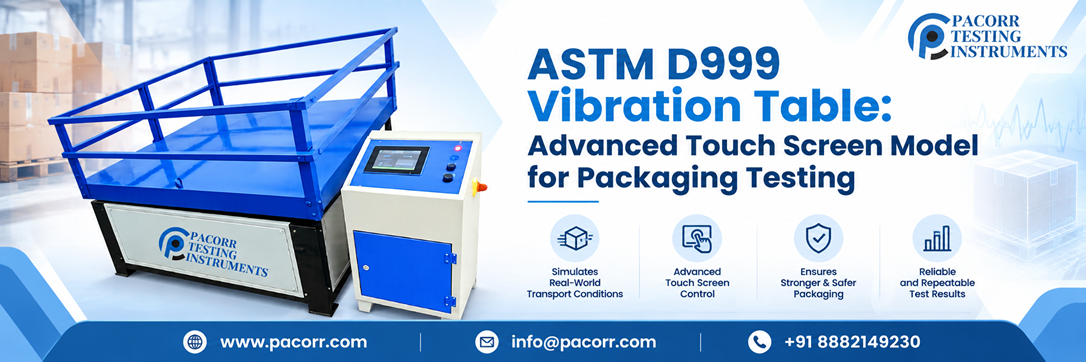
The Pacorr Vibration Table - Touch Screen, model PC-VT-TouchPro, offers touchscreen operation, adjustable vibration settings, and a heavy-duty testing platform for packaging evaluation. Its digital controls are intended to make test setup and monitoring more convenient.
Understanding the machine's capabilities and the requirements of ASTM D999 helps manufacturers select appropriate equipment for packaging quality control.
What Is an ASTM D999 Vibration Table?
An ASTM D999 Vibration Table is a laboratory vibration testing machine used with applicable ASTM D999 methods to evaluate the performance of filled shipping containers under controlled vibration. It helps engineers assess packaging strength, product protection, internal movement, and potential damage associated with transportation. The equipment must support the specific test method selected.
Packaging vibration testing examines the complete packaging arrangement, including the outer carton, protective cushioning, internal partitions, closures, and packaged contents.
During vibration exposure, engineers may observe product displacement, abrasion, carton deformation, or deterioration of protective materials. The results can guide packaging design improvements.
It is important to distinguish between an instrument marketed for packaging vibration testing and a machine verified to perform a specific ASTM D999 procedure.
What Is ASTM D999 and Why Is It Important for Packaging Testing?
ASTM D999-08(2023) is titled Standard Test Methods for Vibration Testing of Shipping Containers. It describes laboratory methods for evaluating how filled shipping containers and their packaging systems respond to vibration. These methods help investigate package strength, protective performance, and vibration-related weaknesses that may occur during transportation.
The standard covers several different testing approaches:
- Method A1: Repetitive shock testing using vertical motion.
- Method A2: Repetitive shock testing using rotary motion.
- Method B: Single-container resonance testing.
- Method C: Resonance testing of palletized loads, unitized loads, or vertical stacks.
Each method addresses a different testing condition. Therefore, a vibration table should be evaluated against the mechanical motion, operating capabilities, fixtures, and control requirements of the specific method.
Why does ASTM D999 matter to packaging manufacturers?
Shipping containers can experience repeated dynamic forces while transported by road, rail, or other distribution systems. These forces may expose weaknesses that are not apparent during static testing.
Appropriate laboratory vibration tests can help manufacturers:
- Investigate carton and cushioning performance.
- Examine product movement within shipping packages.
- Identify vibration-sensitive packaging arrangements.
- Compare alternative packaging designs.
- Develop more informed packaging quality-control procedures.
ASTM D999 does not automatically establish a universal pass-or-fail requirement for every product. Test selection and acceptance criteria must be appropriate to the packaging application.
How Does the Pacorr Touch Screen Vibration Table Work?
A touchscreen vibration table operates by generating controlled movement through a test platform. A packaged sample is placed on the platform, and the operator configures the available test parameters through a digital interface. The vibration exposure is then used to investigate how the packaging and its contents respond.
Pacorr identifies the PC-VT-TouchPro as a touchscreen-controlled machine with vertical/reciprocating motion, adjustable frequency and amplitude, and a programmable test timer.
General packaging vibration testing workflow
- Prepare the sample: Use a representative shipping package containing the product, cushioning, closures, and internal supports.
- Record initial conditions: Document package weight, dimensions, condition, orientation, and relevant product details.
- Position the sample: Place the package on the testing platform and use only the positioning or restraint arrangements permitted by the selected procedure.
- Configure test parameters: Use the touchscreen to set the applicable available vibration settings and test duration.
- Perform the test: Start the equipment and monitor the exposure from a safe operating position.
- Inspect the package: Examine the carton, seals, cushioning, internal components, and product after the test.
- Document observations: Record any damage, displacement, leakage, or functional changes against predefined evaluation criteria.
This is a general laboratory workflow, not a substitute for the prescribed procedure in ASTM D999.
Why does a touchscreen interface matter?
Touchscreen operation can make test setup more convenient by presenting controls and operating information through a digital interface.
According to Pacorr's product information, the touchscreen system allows users to configure test settings, monitor parameters, and store or repeat test cycles. These functions may support consistent setup when laboratories conduct repeated packaging evaluations.
The accuracy of a test still depends on machine performance, calibration, correct test conditions, and operator practices.
Key Features of Pacorr's Advanced Touch Screen Vibration Table
The Pacorr PC-VT-TouchPro combines an operator-friendly control interface with an industrial testing platform. Its published features focus on controlled vibration exposure and convenient laboratory operation.
1. Digital touchscreen control
The touchscreen interface allows operators to interact with the vibration testing system without relying entirely on conventional switches or manual control arrangements.
This is particularly useful for laboratories performing multiple tests with different settings.
2. Adjustable frequency and amplitude
Pacorr lists adjustable frequency and amplitude as product features.
These adjustments may help laboratories configure different vibration exposures within the machine's operating range. However, the exact frequency and amplitude limits should be confirmed from the manufacturer before selecting a testing procedure.
3. Vertical and reciprocating vibration motion
The manufacturer's technical sheet identifies vertical/reciprocating vibration as the machine's operating mode.
Motion type is an important consideration because packaging testing standards can require particular vibration characteristics.
4. Programmable test duration
A programmable timer allows users to set the required operating period within the machine's available limits.
Controlled test duration can help maintain consistent exposure when comparing packaging samples.
5. Heavy-duty testing platform
Pacorr describes the equipment as having a heavy-duty platform designed for industrial and laboratory use.
The platform dimensions, permissible sample mass, and sample-restraint configuration should be confirmed for the intended packaging size.
6. Equipment safety features
The manufacturer lists an emergency-stop function and overload protection.
Laboratories should also establish safe sample positioning, operator clearances, and inspection procedures appropriate to their testing environment.
Technical Specifications of Pacorr Touch Screen Vibration Table
The following information is based on Pacorr's published PC-VT-TouchPro product page and specification sheet.
| Specification | PC-VT-TouchPro |
| Brand | Pacorr |
| Product name | Vibration Table - Touch Screen |
| Control system | Digital touchscreen interface |
| Vibration motion | Vertical / reciprocating |
| Frequency | Adjustable; numerical range to be confirmed |
| Amplitude | Adjustable; numerical range to be confirmed |
| Load capacity | Customizable; rated capacity to be confirmed |
| Testing platform | Heavy-duty platform |
| Platform dimensions | To be confirmed by Pacorr |
| Test duration | Programmable timer |
| Timer range | To be confirmed by Pacorr |
| Power supply | Industrial power; voltage and phase to be confirmed |
| Safety features | Emergency stop and overload protection |
| ASTM D999 compatibility | Specific methods to be confirmed by Pacorr |
Technical note: Pacorr publishes additional specifications for its separate PCVT-1 vibration table. Those values should not be assumed to apply to the touchscreen PC-VT-TouchPro model.
For the current product configuration and complete specifications, visit Pacorr's Vibration Table – Touch Screen product page.
Benefits of Using a Touch Screen Vibration Table for Packaging Testing
Improved operating convenience
A digital control interface can simplify the process of entering available test settings and monitoring equipment operation. This can be useful in laboratories where different packaging samples require different test configurations.
Early identification of packaging weaknesses
Vibration testing can reveal packaging problems such as product movement, damaged partitions, compressed cushioning, loose closures, and abrasion.
Identifying such weaknesses during product development provides an opportunity to improve the packaging system.
Better comparison of package designs
Engineers can use appropriately controlled vibration tests to compare packaging alternatives.
For example, two cushioning arrangements may be evaluated under the same specified exposure to investigate differences in package performance.
Support for packaging quality-control programs
A documented vibration test can contribute to a broader quality-assurance process.
When test conditions and evaluation criteria are clearly defined, results can help teams investigate packaging changes, supplier variations, or reported transportation damage.
Potential reduction of transportation losses
Packaging improvements informed by laboratory testing may help lower the risk of transit-related product damage, returns, and replacements.
However, vibration testing alone cannot guarantee that products will arrive undamaged under every distribution condition.
Applications of ASTM D999 Vibration Testing
Packaging vibration testing is relevant to many industries in which packed products may experience repeated movement during transportation.
Corrugated boxes and shipping cartons
Corrugated shipping cartons can be examined for structural changes, closure failure, and internal product movement. Testing may also help assess the performance of partitions and cushioning arrangements.
Electronics and electrical products
Packaged electronics may be vulnerable to impact between components, movement within cartons, and deterioration of cushioning materials. Vibration evaluation can help investigate the protection provided by the shipping package.
Pharmaceutical and medical product packaging
Packaging teams may use vibration testing to examine secondary and tertiary shipping cartons, bottle positioning, and package integrity. This does not replace any required product-specific pharmaceutical or medical-device validation.
Automotive components
Spare parts, mechanical assemblies, and packaged automotive components may experience vibration during distribution. Appropriate testing can help evaluate protective packaging arrangements and component restraint.
E-commerce and consumer goods
Parcel networks expose packages to multiple handling and transportation conditions. Vibration testing can help identify potential packaging weaknesses, although complete distribution testing may require additional drop, compression, and environmental tests.
Export and industrial packaging
Industrial products transported over extended routes may require robust shipping containers and suitable internal support systems. Vibration evaluation can form one part of a broader transport-packaging qualification program.
The suitability of PC-VT-TouchPro for any particular sample depends on its configured platform size, load capacity, motion characteristics, and applicable testing requirements.
ASTM D999 vs ASTM D4728
ASTM D999 includes several defined vibration-testing methods, including repetitive shock and resonance testing.
ASTM D4728 focuses on random vibration testing of shipping containers. Random vibration and other types of vibration exposure cannot automatically be treated as equivalent.
A machine suitable for one approach may not possess the equipment or control capabilities required for another.
ASTM D999 vs ISTA procedures
ISTA procedures may combine vibration with other exposures, such as shock, compression, or atmospheric conditioning, depending on the chosen procedure.
Therefore, buyers should select the relevant test procedure first and then confirm whether the laboratory equipment can perform its required elements.
How to Choose the Right Vibration Table for Packaging Testing
Selecting an appropriate vibration table requires more than comparing machine appearance or digital control features.
Before purchasing, consider the following:
- Testing standard: Identify the ASTM, ISO, or ISTA procedure required for the packaging application.
- Vibration characteristics: Confirm the required motion type, frequency, amplitude, and control capability.
- Package dimensions: Ensure the testing platform accommodates the representative shipping sample.
- Load capacity: Check the machine's permitted sample weight and any operating restrictions.
- Control system: Evaluate the available touchscreen settings, monitoring functions, and test repeatability.
- Fixture requirements: Confirm that sample restraints and positioning arrangements are compatible with the chosen method.
- Calibration and safety: Review calibration documentation, emergency controls, maintenance needs, and operator safety requirements.
- Technical support: Request operating documentation, available configurations, and assistance with method selection.
For ASTM D999 testing, the most important purchasing question is whether the specific machine configuration can execute the selected test method.
Why Choose Pacorr's Touch Screen Vibration Table?
Pacorr offers the PC-VT-TouchPro as a touchscreen-controlled vibration testing system intended for packaging and product durability evaluation.
The published product information identifies several useful characteristics, including digital controls, adjustable vibration settings, programmable test duration, heavy-duty construction, and configurable load capacity.
For packaging laboratories, these features may support convenient testing workflows and controlled evaluation of packaged products.
Pacorr also presents customization options for vibration frequency, equipment size, and load capacity. Buyers should request written specifications for the exact configuration being quoted.
Before purchasing equipment for a defined ASTM method, ask Pacorr to confirm the applicable method, machine capability, calibration documentation, and required accessories.
Explore the Pacorr Touch Screen Vibration Table or contact Pacorr for technical information and a quotation.
Frequently Asked Questions About ASTM D999 Vibration Tables
1. What is an ASTM D999 vibration table?
An ASTM D999 vibration table is equipment used to perform applicable vibration tests on filled shipping containers. Such tests help evaluate the package's strength and its ability to protect contents under controlled vibration exposure. The selected equipment must meet the operating requirements of the specific ASTM D999 method.
2. What is the purpose of ASTM D999 vibration testing?
ASTM D999 vibration testing helps evaluate how shipping containers, interior packing, closures, and contents respond to vibration. The tests may reveal package weaknesses, resonance-related effects, or damage mechanisms. Results help packaging professionals investigate designs and assess protection against transportation-related vibration.
3. How does a touch screen vibration table work?
A touchscreen vibration table uses a digital control interface to configure machine operation. A sample is positioned on the testing platform, and the equipment generates the selected vibration exposure. Operators monitor the test and inspect the sample afterward. Available adjustments depend on the machine model and configuration.
4. What types of packaging can be tested using a vibration table?
Depending on the equipment's size, load capacity, and test method, vibration testing may be used for corrugated cartons, consumer-goods packages, packaged electronics, pharmaceutical shipping cartons, and industrial shipping containers. The intended package and test requirements must be compatible with the specific machine.
5. What is the difference between ASTM D999 and ASTM D4728?
ASTM D999 contains defined shipping-container vibration test methods that include repetitive shock and resonance testing. ASTM D4728 addresses random vibration testing of filled shipping units. The approaches use different vibration characteristics and are not automatically interchangeable. Equipment suitability must be checked separately for each procedure.
6. How do you select a vibration table for packaging testing?
Start by identifying the required test standard and method. Then evaluate the equipment's motion type, frequency and amplitude capabilities, permissible sample weight, platform dimensions, control functions, and calibration documentation. Manufacturer confirmation is particularly important when testing must follow a specified ASTM or ISTA procedure.
7. What are the advantages of touchscreen vibration testing equipment?
A touchscreen interface can simplify machine setup by providing digital access to available controls and operating information. Depending on the model, it may also help operators monitor parameters or repeat stored test configurations. Actual testing performance still depends on equipment design, calibration, and correct laboratory procedures.
8. Does every vibration table comply with ASTM D999?
No. ASTM D999 includes multiple vibration test methods with different mechanical and operating requirements. A machine described as a vibration table is not automatically suitable for every method. Buyers should request written confirmation that their particular equipment configuration supports the procedure they intend to perform.
9. Where can I get details about Pacorr's Touch Screen Vibration Table?
Pacorr provides information about the PC-VT-TouchPro on its official website. Buyers can review published features and contact the manufacturer to request numerical specifications, available configurations, pricing, and confirmation of supported test standards.
Conclusion
Vibration testing provides valuable insight into the ability of shipping containers and packaging systems to withstand selected transportation-related exposures. It can help identify product movement, cushioning deterioration, closure problems, and other weaknesses before a packaging design is finalized.
The Pacorr Vibration Table - Touch Screen, PC-VT-TouchPro, combines touchscreen operation with adjustable vibration settings and an industrial testing platform for laboratory packaging evaluation.
When selecting equipment for ASTM D999 testing, manufacturers should confirm that the required test method is supported by the specific machine configuration.
Looking for a touchscreen vibration table for your packaging testing laboratory? Contact Pacorr to request complete specifications, configuration options, ASTM method compatibility details, and a quotation.
Recent Blogs
Enhance your understanding of testing and precise quality control indistinct applications with our
knowledge based articles coming from top editors of industry leaders.
Our USP's
Demonstration of Machine
- Try Before You Decide
- Experience Before You Invest
- See It in Action – Free Demo
Global Reach
- Delivering Excellence Worldwide
- Serving Across Borders
- Your Global Supply Partner
On-Site Support
- Support That Comes to You
- On-Ground Assistance, Anywhere
- We Reach Where You Are
Team Strength
- Powered by Expert Minds
- Driven by Skilled Professionals
- Engineering Excellence Team
Manufacturing
- Precision-Driven Manufacturing
- Smart & Automated Production
- Engineered In-House Excellence
