
Last updated: 27 October 2026
Verified by: Kishore Gupta - Technical Expert
ASTM standards are technical documents developed through ASTM International’s consensus process. They establish shared methods, requirements, classifications, and terminology for materials, products, systems, and services. Manufacturers and laboratories use them to measure properties, specify purchases, compare results, and document quality against an identified requirement.
For a quality-control team, the practical question is more specific than “Does this product follow ASTM?” It is: Which standard, which edition, which test conditions, and which acceptance criteria apply? Answering those questions turns a general standards claim into a testing requirement that a supplier, laboratory, and buyer can understand.
What is the full form of ASTM?
ASTM historically stands for American Society for Testing and Materials. The organization adopted the name ASTM International in 2001. The historical expansion remains useful when explaining the abbreviation, but ASTM International is its current name, as recorded in its organizational overview.
ASTM International is the standards developer. An ASTM standard is an individual document it publishes. A designation such as ASTM D638 identifies a particular document; it does not represent a universal approval of a material, machine, or manufacturer.
The organization’s standards are used internationally. Their relevance to a particular purchase depends on the material, application, customer specification, and applicable requirements—not simply the country where the supplier operates.
What does an ASTM standard tell a manufacturer?
Different standards answer different questions. A test method explains how to obtain a result. A specification establishes requirements that a material or product must meet. Other documents organize terminology, describe procedures, or help readers assess available approaches.
Consider this hypothetical purchasing situation: a buyer orders plastic components and asks for tensile-test evidence. The testing instruction identifies the method and conditions. The purchasing specification identifies the acceptable property limits. The supplier needs both to demonstrate that the delivery meets the buyer’s requirements.
A result without its method can be difficult to interpret. A method without an acceptance requirement may produce useful measurements but does not, by itself, establish that a product passes.
For procurement and laboratory planning, separate these four items:
- Material identity: What is being evaluated?
- Test method: How will the property be measured?
- Acceptance requirement: What result is acceptable?
- Evidence: What records must accompany the result?
ASTM’s introduction to its standards explains their use in contracts, codes, laws, and regulations. The obligation comes from the relevant document or requirement, rather than from the ASTM designation alone.
What are the six types of ASTM standards?
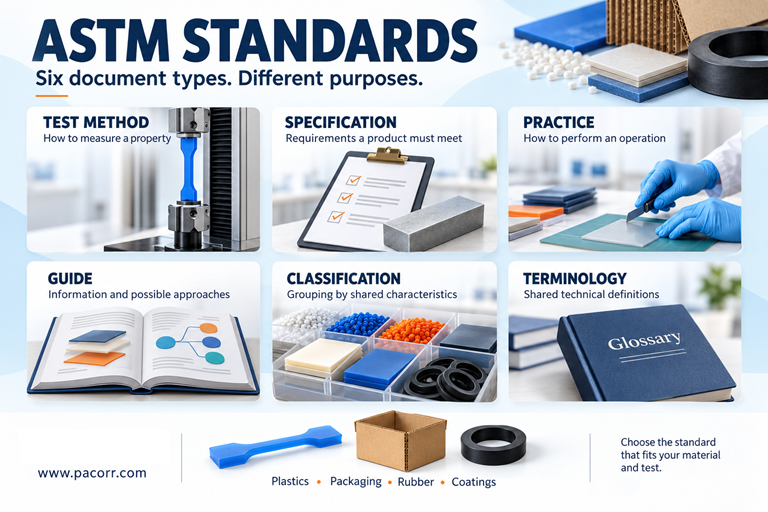
ASTM’s technical committee handbook identifies six principal standard types: test methods, specifications, practices, guides, classifications, and terminology. The type indicates the document’s purpose. Knowing that purpose helps prevent mistakes such as expecting an equipment-operating practice to provide a product’s minimum acceptable performance.
The following explanations reflect ASTM’s guidance on standard types. Examples are illustrative, not references to particular published standards.
| Standard type | Main purpose | Question it answers | Illustrative use |
| Test method | Defines how to obtain a test result | How do we measure this property? | Measuring a specimen’s response to tension |
| Specification | Sets requirements to be satisfied | What must this product meet? | Establishing acceptable material properties for a purchase |
| Practice | Describes operations without itself producing a test result | How should this operation be performed? | Preparing samples before evaluation |
| Guide | Presents information and possible approaches | What options should we consider? | Assessing alternative evaluation approaches |
| Classification | Groups items by shared characteristics | Which category describes this material? | Organizing materials by composition or use |
| Terminology | Establishes meanings for technical terms | What does this term mean here? | Using consistent property definitions in reports |
A guide should not be read as though it mandates one particular approach. Likewise, a terminology document clarifies language; it does not replace a testing procedure.
Six ASTM standards used in industrial testing
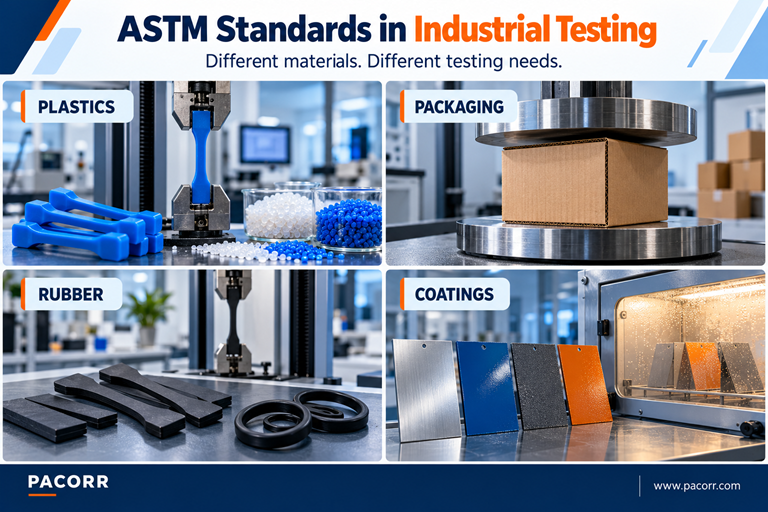
The examples below cover plastics, rubber, packaging, and coatings. They illustrate different applications rather than a ranking of the “most important” standards.
The equipment categories are starting points for selection. Actual suitability depends on the chosen method, specimen, measurement range, fixtures, controls, and reporting requirements.
| Standard | Material or application | What it evaluates or specifies | Equipment category | Important scope consideration |
| ASTM D638 | Reinforced and unreinforced plastics | Tensile properties using specified dumbbell-shaped specimens | Tensile or universal testing machine | ASTM identifies D882 as the preferred method for thin sheeting and film below 1.0 mm |
| ASTM D882 | Thin plastic sheeting and films Tensile behaviour | Tensile behaviour | Tensile tester with suitable film grips and extension measurement | Its scope covers material below 1.0 mm thickness |
| ASTM D412 | Vulcanized rubber and thermoplastic elastomers | Properties under tension | Tensile tester with appropriate specimens and fixtures | It excludes ebonite and similar hard materials with low elongation; its alternative methods do not give identical results |
| ASTM D642 | Shipping containers, components, and unit loads | Resistance to externally applied compression | Container or box compression tester | Loading direction and platen configuration matter; different configurations should not be treated as equivalent |
| ASTM B117 | Salt-fog exposure of test specimens | Operation and control of the salt-spray environment | Salt spray chamber | It does not set product-specific exposure periods or explain how every product’s result should be judged |
| ASTM D1238 | Thermoplastic resins | Melt extrusion rate under specified conditions | Extrusion plastometer or melt flow index tester | Results depend on test conditions; the designation alone is insufficient for comparing reported values |
Why the scope matters
A laboratory testing thin packaging film should not automatically select the same procedure used for a moulded plastic specimen. Both involve tension, but specimen form changes the applicable method. ASTM D638 explicitly points readers toward D882 for thin film and sheeting below the stated thickness boundary.
Similarly, specifying “salt spray testing to ASTM B117” leaves important questions unanswered. The purchaser still needs to identify the exposure duration and evaluation requirements through the applicable product specification or agreement.
For more application-specific reading, see Pacorr’s articles on ASTM D638 and ISO 527 tensile testing and ASTM standards for box compression testing. Use the applicable official standard as the controlling technical reference.
How do you read an ASTM standard designation?
A standard’s designation identifies the document and, when written in full, its edition information. The year is important because a revised edition may contain changes affecting the laboratory’s procedure or the customer’s requirements.
For example, ASTM’s catalogue lists D412-16(2021):
- D412 is the standard’s fixed identification. Its letter belongs to ASTM’s subject classification system; it does not mean “test method.”
- 16 identifies the 2016 revision.
- (2021) identifies reapproval in 2021, rather than a new revision dated 2021.
Other designations can include a letter following the year or an epsilon notation. ASTM’s Form and Style guidance explains these conventions, including the distinction between revision, reapproval, and editorial changes.
Record the full edition required by the job. If a contract names an older edition, clarify the requirement before substituting a newer one. A general blog article or an undated equipment brochure cannot resolve that contractual choice.
ASTM versus ISO: what is the difference?
ASTM International and the International Organization for Standardization both publish standards used across countries and industries. Their structures and standards portfolios differ, but neither can be reduced to a simple geographic rule. ISO also publishes detailed material-testing standards, while ASTM’s documents extend beyond test methods.
| Comparison | ASTM International | ISO |
| Organization | Develops voluntary consensus standards through technical committees | Brings together national standards bodies to develop international standards |
| Relevant content | Test methods, specifications, practices, guides, classifications, and terminology | Standards covering products, testing, processes, services, and management systems |
| Plastics-testing example | ASTM D638 addresses tensile properties of plastics | ISO 527 includes general principles and parts addressing particular material forms |
| Selection basis | Applicable specification, customer requirement, material, and test objective | The same practical considerations apply |
| Interchangeability | Must be checked for the specific documents | A related subject does not establish technical equivalence |
ISO’s organizational overview describes its structure and scope. Its ISO 527-1 catalogue entry explains how general tensile-testing principles relate to other parts of the series.
ASTM D638 itself states that it and ISO 527-1 address the same subject but differ technically. A laboratory should therefore compare the required editions and obtain agreement before substituting methods. A shared property name, such as tensile strength, is not sufficient evidence of equivalence.
Are ASTM standards applicable in India?
An Indian manufacturer may use an ASTM standard when it is appropriate to the test and required by a customer, purchasing specification, project, or relevant regulatory provision. However, an ASTM test report should not be assumed to satisfy every Indian product-compliance requirement.
Keep commercial requirements and statutory requirements visible as separate checks. A customer may request an ASTM method for supplier evaluation while the product is also subject to Indian requirements.
The Bureau of Indian Standards explains that certain products fall under compulsory certification through Quality Control Orders. For a regulated product, check the applicable order, Indian Standard, effective date, and certification route. Do not assume that an ASTM-based result replaces a required BIS licence, registration, or other applicable conformity-assessment requirement.
Before agreeing to supply, document both the buyer’s testing expectations and the requirements governing the product’s intended market.
How to choose the right ASTM standard and equipment
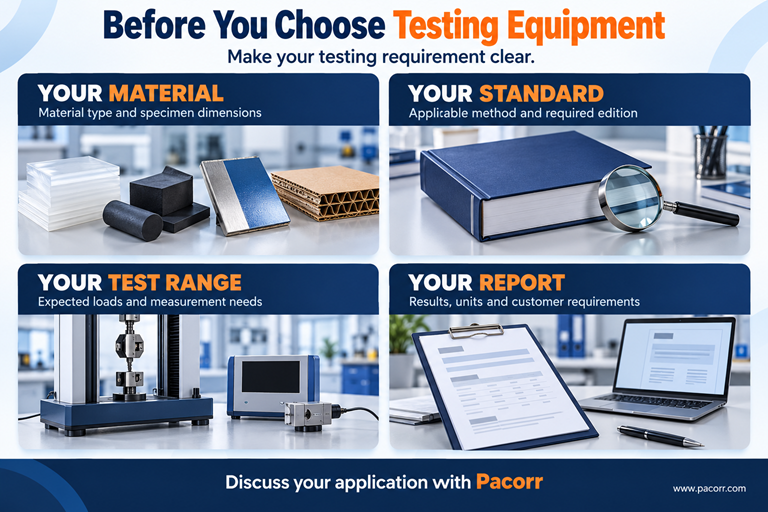
Start with the testing requirement, then select the equipment configuration. The following planning sequence helps make an enquiry specific enough for a useful technical discussion.
1. Define the material and decision
Identify the material, product form, dimensions, and property of interest. Also state what the result will decide: incoming-material acceptance, supplier comparison, process monitoring, or product development. “Plastic testing” is too broad to establish a method.
2. Obtain the governing requirement
Request the customer specification, drawing, purchase-order clause, or applicable product requirement. Confirm whether it names a standard, edition, procedure option, and acceptance limit. Resolve missing information before preparing specimens.
3. Review the official scope and edition
Check the publisher’s current catalogue and obtain the complete required document. Read its exclusions and referenced documents. An online summary can help identify the right standard, but it does not contain everything needed to perform the work.
4. Plan specimen preparation and conditioning
Identify preparation tools, specimen geometry, orientation, conditioning, and any environmental controls required by the method. Include these needs in the laboratory budget. A suitable testing machine cannot compensate for an unsuitable specimen.
5. Match the complete equipment configuration
Ask the supplier to assess capacity, usable measurement range, grips or platens, speed control, displacement or strain measurement, chamber conditions, and software outputs as relevant. Specify the actual specimen and method option rather than requesting generic “ASTM compliance.”
6. Establish measurement checks and reporting
Plan calibration or verification appropriate to the method and measurement system. Define how operators will record specimen identity, edition, conditions, results, units, and deviations. Agree how results will be evaluated against acceptance limits.
7. Confirm the setup before routine testing
Use a documented commissioning or method-implementation review appropriate to the application. Make sure operators understand the procedure and that the report contains the information the customer needs. Record any unresolved limitations before issuing conformity statements.
Common mistakes when using ASTM testing standards
Using an old edition without checking the requirement. Review both the publisher’s status and the edition named by the customer. Updating a document and changing an agreed method are separate decisions.
Choosing by keyword instead of scope. “Tensile,” “compression,” or “corrosion” describes a broad testing area. Material form, loading conditions, and the intended property determine which document is relevant.
Treating the method as a pass/fail specification. Ask where the acceptance limit comes from. Avoid inventing one because the instrument produces a numerical result.
Assuming that related methods are equivalent. Compare the documents and secure customer acceptance before changing the method used for a reported result.
Making an unsupported “ASTM certified” claim. Testing to a standard, declaring conformity, and holding third-party certification are different statements. Identify the actual standard, evidence, certification body, and scope where applicable. ASTM does have specific certification activities, including programs through its affiliate SEI, so a blanket claim that ASTM has no certification programs would also be inaccurate. See its certification-program overview.
Frequently asked questions
Q1. Does buying an ASTM-compatible machine make my laboratory compliant?
No. Equipment capability is one part of the setup. The selected method also determines specimen preparation, conditions, measurement requirements, operation, and reporting. Ask the supplier to identify the configuration and limitations relevant to your application, then document how the laboratory will implement the method.
Q2. Does an ASTM test report prove that a product is safe?
It provides evidence about the tested characteristics under the stated conditions. It should not be expanded into a claim about every hazard, application, or operating environment. Product acceptance may require additional tests and requirements beyond the reported method.
Q3. Can I use an older ASTM edition?
First check the governing requirement. An older edition may be specifically referenced in a contract or specification. Document that reference, check its status, and obtain clarification before changing editions. Do not silently describe an older-edition test as meeting the latest revision.
Q4. Why can two laboratories obtain different results?
Different specimens, conditions, method options, or measurement systems can affect comparability. Begin by comparing the complete test records. ASTM D412, for example, notes the influence of test conditions and cautions that its alternative methods do not produce identical results.
Q5. Where should I obtain the complete standard?
Use ASTM International’s official catalogue or an authorized source. Confirm that the purchased edition matches the job. Public summaries, equipment brochures, and articles help explain applications but are not substitutes for the complete procedure and its referenced requirements.
Q6. Can one machine perform several ASTM tests?
Possibly, if its configuration meets each method’s requirements. Different tests may need different fixtures, measurement ranges, sensors, or control functions. Request a method-by-method capability assessment rather than relying on a long list of standards in a quotation.
Q7. Does a tensile test cover every rubber-performance requirement?
No. It evaluates behaviour under tension within the method’s scope. If the application also requires resistance to environmental exposure, identify that requirement separately. Pacorr’s overview of ozone-chamber testing standards introduces another testing area relevant to rubber products.
Discussing an ASTM testing requirement with Pacorr
Pacorr supplies testing instruments for areas including packaging, plastics, rubber, and coatings. Its ASTM standards directory provides a starting point for exploring standards associated with its equipment.
For a focused equipment discussion, share your material and specimen dimensions, applicable standard and edition, expected test range, required fixtures, and reporting needs. Include any customer-specific acceptance requirements so the proposed configuration can be assessed against the actual work.
Contact Pacorr to discuss your testing application and the equipment specifications it requires.
Recent Blogs
Enhance your understanding of testing and precise quality control indistinct applications with our
knowledge based articles coming from top editors of industry leaders.

Our USP's
Demonstration of Machine
- Try Before You Decide
- Experience Before You Invest
- See It in Action – Free Demo
Global Reach
- Delivering Excellence Worldwide
- Serving Across Borders
- Your Global Supply Partner
On-Site Support
- Support That Comes to You
- On-Ground Assistance, Anywhere
- We Reach Where You Are
Team Strength
- Powered by Expert Minds
- Driven by Skilled Professionals
- Engineering Excellence Team
Manufacturing
- Precision-Driven Manufacturing
- Smart & Automated Production
- Engineered In-House Excellence
