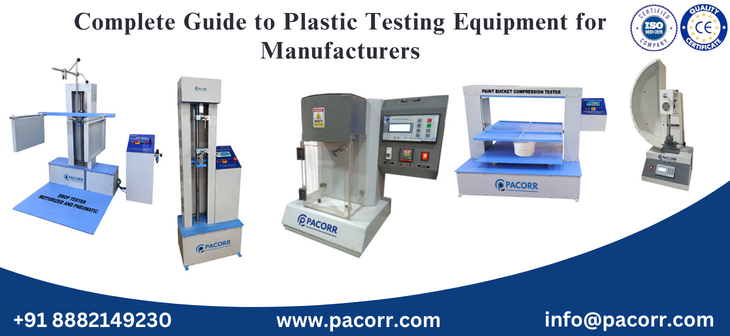
Pacorr understands that in today’s competitive manufacturing environment, product consistency is no longer optional. Whether you produce rigid containers, flexible packaging, molded components, films, sheets, or industrial plastic parts, the quality of your raw material and finished products directly affects performance, compliance, and customer trust. This is where Plastic Testing Instruments, Polymer Testing Instruments, and advanced Plastic Testing Equipment become essential.
Plastic materials are widely used because they are versatile, lightweight, and cost-effective. However, their performance can vary significantly based on resin grade, additives, processing conditions, and environmental exposure. Even a minor variation in strength, melt behavior, thickness, or sealing performance can lead to product failure, rejection, or costly recalls.
Manufacturers therefore rely on Polymer Testing Equipment and Plastic Material Testing Instruments to measure physical, mechanical, thermal, and performance-related properties. With the right testing setup, companies can maintain quality standards, improve process control, reduce waste, and ensure that products meet application-specific requirements.
What is Plastic Testing Equipment
Plastic Testing Equipment refers to a range of instruments used to evaluate the quality, strength, flexibility, durability, and processing behavior of plastic and polymer materials. These instruments help manufacturers test raw materials, semi-finished samples, and finished products under controlled laboratory conditions.
In practical terms, Polymer Testing Instruments are designed to answer important production questions:
- Is the material strong enough for its intended use?
- Will the polymer flow properly during molding or extrusion?
- Can the packaging material withstand pressure, load, or impact?
- Does the product maintain performance under heat, humidity, or stress?
- Is the finished part compliant with industry and customer standards?
Common plastic quality testing methods include:
- Tensile strength testing
- Melt flow rate analysis
- Compression and bursting tests
- Impact resistance testing
- Thickness and dimensional evaluation
- Environmental testing of plastics
- Seal and packaging integrity tests
These laboratory testing instruments help transform quality control from guesswork into measurable, repeatable data.
Plastic Testing Instruments for Raw Material Validation
Before production begins, manufacturers use Plastic Testing Instruments to verify resin properties, consistency between batches, and process suitability.
Polymer Testing Equipment for Finished Product Analysis
After conversion or molding, Polymer Testing Equipment is used to validate performance in real-world applications such as bottles, films, caps, containers, and industrial components.
Importance of Plastic Testing Equipment in Quality Testing
The importance of Plastic Testing Equipment lies in its ability to prevent defects before products reach the market. In plastic and packaging manufacturing, failures often originate from poor material selection, inconsistent processing, or inadequate quality checks. Testing helps identify those issues early.
Key reasons why testing matters include:
- Maintaining product consistency: Standardized testing ensures uniform quality across production lots.
- Reducing rejection and waste: Early detection of poor material properties helps avoid large-scale production losses.
- Improving process efficiency: Accurate data supports better control of extrusion, injection molding, thermoforming, and blow molding processes.
- Meeting compliance requirements: Many industries require proof of material performance through validated test results.
- Enhancing product safety: Packaging, automotive, medical, and electrical applications demand reliable performance under stress.
- Supporting R&D and innovation: Testing allows teams to compare formulations, optimize designs, and improve product life.
For example, packaging material testing is crucial in flexible packaging and plastic containers where sealing, puncture resistance, and load-bearing performance directly affect storage and transport. Similarly, tensile strength testing is critical when evaluating films, straps, sheets, and molded products.
Why Polymer Testing Instruments Matter for Packaging Material Testing
In packaging applications, poor polymer quality can result in leakage, deformation, breakage, or reduced shelf life. Reliable Polymer Testing Instruments help manufacturers protect both the product and the brand.
Need the right testing solution for your production line? Contact Pacorr for expert guidance on plastic and polymer testing instruments.
Email: info@pacorr.com
Phone: +91 8882149230
Key Features of Plastic Testing Equipment
Modern Plastic Testing Equipment is built to deliver accuracy, repeatability, and user-friendly operation. While features vary by instrument type, high-quality systems generally include the following capabilities:
- Precise measurement systems for dependable testing results
- Robust construction for long service life in industrial labs
- Digital control panels for easy setup and operation
- User-friendly interfaces that simplify testing workflows
- Standard-compliant designs aligned with common quality protocols
- Data recording and reporting options for traceability
- Repeatable test conditions for better comparison across batches
- Low maintenance requirements for uninterrupted lab performance
When selecting Plastic Material Testing Instruments, manufacturers should look for instruments that support both process control and product validation. A good testing platform should not only provide readings but also help teams interpret material behavior.
Essential Plastic Material Testing Instruments in a Modern Lab
A well-equipped plastic testing laboratory may include:
- Melt Flow Index Tester for resin flow analysis
- Universal Testing Machine for tensile and compression properties
- Environmental chambers for environmental testing of plastics
- Bursting or compression testers for packaging evaluation
- Thickness gauges for dimensional consistency
- Impact testers for product toughness assessment
These polymer testing machines support quality assurance at every stage of production.
Working Principle of Plastic Testing Equipment
The working principle of Plastic Testing Equipment depends on the property being measured, but the core concept is the same: apply a controlled force, heat, load, or environmental condition to a sample and observe how the material responds.
For example:
- In tensile strength testing, a sample is pulled from both ends until it stretches or breaks. The instrument records force, elongation, and breaking strength.
- A melt flow index tester measures how easily molten polymer flows through a die under a specified temperature and load. This helps assess processability.
- In compression testing, the sample is subjected to increasing force to determine its resistance to crushing or deformation.
- During environmental testing of plastics, samples are exposed to temperature, humidity, or aging conditions to evaluate long-term stability.
The testing cycle usually follows these steps:
- Prepare the sample according to standard dimensions.
- Mount or place the sample in the instrument.
- Set required test parameters such as force, temperature, or time.
- Start the test and monitor sample behavior.
- Record data and compare results against specifications.
How Polymer Testing Instruments Generate Actionable Data
The value of Polymer Testing Instruments is not just in measurement, but in decision-making. The data generated helps manufacturers:
- approve or reject incoming raw material
- fine-tune process settings
- compare suppliers
- validate product performance
- document quality for audits and customer approvals
Applications of Plastic Testing Equipment in Different Industries
The use of Plastic Testing Equipment extends across multiple sectors because plastics are used in so many demanding applications.
Plastic Testing Instruments in Packaging Industry
In packaging, testing helps evaluate films, bottles, caps, pouches, containers, and laminates. Packaging material testing is important for ensuring strength, sealing performance, durability, and transport safety.
Polymer Testing Equipment in Automotive Industry
Automotive components made from polymers must withstand mechanical load, heat, vibration, and environmental exposure. Testing ensures parts are durable and dimensionally stable.
Plastic Material Testing Instruments in Consumer Goods
Products such as household items, appliances, toys, and storage components require consistent strength, finish, and usability. Testing helps maintain quality and reduce returns.
Polymer Testing Machines in Medical and Pharmaceutical Packaging
Medical packaging must maintain integrity, cleanliness, and reliability. Polymer and plastic testing supports quality assurance in highly sensitive applications.
Laboratory Testing Instruments for Industrial Manufacturing
Industrial plastic parts used in electrical, construction, and engineering applications must meet strict functional requirements. Laboratory-grade testing helps verify that the product will perform as intended.
How to Choose the Right Plastic Testing Equipment
Choosing the right Plastic Testing Equipment depends on your product type, testing objectives, production process, and quality requirements. A packaging film manufacturer may prioritize tensile, puncture, and seal tests, while a molding unit may focus more on melt flow and compression properties.
Consider the following before buying:
- Material type: rigid plastic, flexible film, polymer granules, molded parts, sheets, or laminated structures
- Critical properties: strength, flow behavior, impact resistance, dimensional consistency, thermal stability
- Industry standards: ensure the instrument aligns with your required test methods
- Production scale: match lab capability with testing frequency and sample load
- Ease of use: operators should be able to run tests efficiently
- Data management: reporting and traceability are important for audits and quality control
- Service and support: reliable technical support reduces downtime
The best approach is to choose Polymer Testing Equipment that supports both present quality needs and future expansion. Investing in dependable systems helps reduce long-term operational costs.
Why Choose Pacorr for Plastic Testing Equipment
Pacorr is a trusted name for quality-driven testing solutions designed for modern manufacturing and packaging environments. With a strong focus on performance, accuracy, and user-friendly design, Pacorr offers a practical range of Plastic Testing Instruments, Polymer Testing Instruments, and related laboratory testing instruments that help manufacturers achieve better quality control.
Why manufacturers choose Pacorr:
- Reliable and accurate testing solutions
- Instruments designed for industrial and packaging applications
- Strong understanding of material testing requirements
- Support for quality improvement and process control
- Durable equipment with practical usability
- Dedicated customer assistance for selecting the right solution
Whether your goal is plastic quality testing, resin validation, packaging material testing, or performance analysis of finished components, Pacorr helps you build a stronger and more dependable quality assurance process.
Conclusion
For manufacturers working with plastics and polymers, testing is not just a laboratory activity; it is a critical part of product quality, process efficiency, and brand reliability. The right Plastic Testing Equipment helps identify variation, reduce defects, improve compliance, and ensure materials perform as expected in real applications.
From Polymer Testing Equipment for raw material evaluation to Plastic Material Testing Instruments for finished product validation, a robust testing strategy gives manufacturers the confidence to produce consistent, high-performance products. As competition and quality expectations continue to rise, investing in the right testing systems becomes a strategic advantage.
If you are looking for dependable Plastic Testing Instruments and Polymer Testing Instruments for your manufacturing or packaging needs, connect with Pacorr today.
Email: info@pacorr.com
Phone: +91 8882149230
Frequently Asked Questions (FAQ)
1. What are plastic testing equipment used for?
Plastic testing equipment is used to evaluate the physical, mechanical, thermal, and processing properties of plastic materials. It helps manufacturers check strength, flexibility, melt behavior, durability, and overall product quality.
2. What is the difference between plastic testing instruments and polymer testing instruments?
In most industrial contexts, the terms are closely related. Plastic testing instruments are commonly used for finished plastic products and packaging materials, while polymer testing instruments may also include tools for evaluating raw polymer resins and formulation behavior.
3. Why is a melt flow index tester important in polymer testing?
A melt flow index tester measures how easily molten polymer flows under specific conditions. This is important because it helps manufacturers assess processability, batch consistency, and suitability for molding or extrusion.
4. Which industries use plastic testing equipment the most?
Plastic testing equipment is widely used in packaging, automotive, consumer goods, medical packaging, electronics, and industrial manufacturing. Any industry that depends on plastic performance benefits from accurate testing.
5. How does tensile strength testing help in plastic quality testing?
Tensile strength testing measures how much pulling force a plastic sample can withstand before breaking. It helps determine strength, elongation, and material reliability for films, sheets, molded parts, and packaging materials.
6. What should manufacturers consider when choosing polymer testing equipment?
Manufacturers should consider material type, required test parameters, industry standards, instrument accuracy, ease of operation, reporting features, and supplier support before choosing polymer testing equipment.
7. How often should plastic materials be tested during production?
Testing frequency depends on the product, process, and quality requirements. Many manufacturers test incoming raw materials, first production samples, and routine batch samples to ensure consistent quality throughout production.
Recent Blogs
Enhance your understanding of testing and precise quality control indistinct applications with our
knowledge based articles coming from top editors of industry leaders.
Our USP's
Demonstration of Machine
- Try Before You Decide
- Experience Before You Invest
- See It in Action – Free Demo
Global Reach
- Delivering Excellence Worldwide
- Serving Across Borders
- Your Global Supply Partner
On-Site Support
- Support That Comes to You
- On-Ground Assistance, Anywhere
- We Reach Where You Are
Team Strength
- Powered by Expert Minds
- Driven by Skilled Professionals
- Engineering Excellence Team
Manufacturing
- Precision-Driven Manufacturing
- Smart & Automated Production
- Engineered In-House Excellence
