
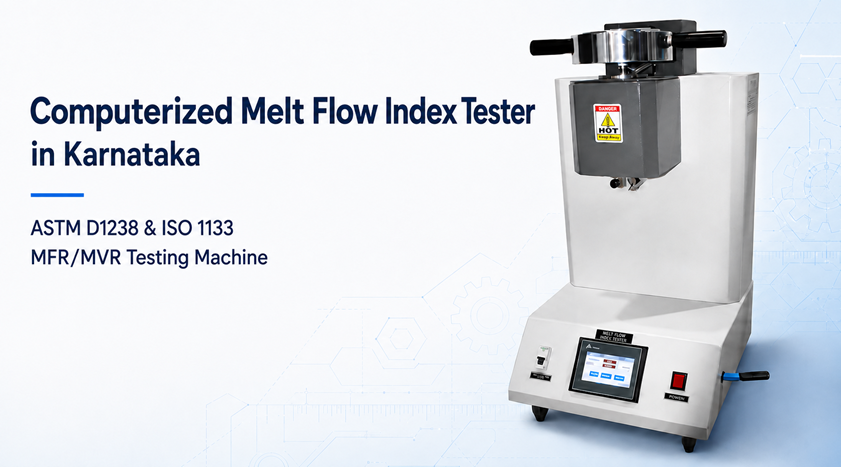
Pacorr provides a Computerized Melt Flow Index Tester in Karnataka for plastic manufacturers, polymer processors, packaging companies, compounders and quality-control laboratories that need dependable MFR and MVR measurements. Model PCAMFIC-1 is designed to evaluate how a thermoplastic material flows through a standard die under a controlled temperature and specified load. The resulting data helps a laboratory compare material batches, inspect incoming resin and identify variations that could affect extrusion, injection moulding or blow moulding. For laboratories seeking ASTM D1238 and ISO 1133 testing, the complete machine configuration should be selected according to the polymers being tested, required test method, load combinations, reporting needs and level of automation.
Why Melt Flow Testing Matters in Plastic Manufacturing
Two batches of plastic granules may look identical but behave differently when processed. Differences in molecular structure, formulation, moisture, contamination, filler content, recycling history or thermal degradation can change the way a polymer flows in its molten state.
These changes may lead to practical production problems such as:
- Incomplete filling of injection-moulded parts
- Unstable extrusion output
- Variation in film thickness
- Poor surface finish
- Longer or shorter moulding cycles
- Changes in bottle or container formation
- Excessive flashing or material leakage
- Inconsistent performance between production batches
A Melt Flow Index Tester provides a quick and standardized way to identify such variations before the material is released for production. It is commonly used as part of incoming inspection, process control, supplier evaluation and product-development work.
Melt flow testing does not replace complete rheological, mechanical or chemical analysis. However, it is an effective routine screening test when results are compared using the same material type, temperature, load and test procedure.
Understanding MFI, MFR and MVR
Although MFI, MFR and MVR are sometimes used interchangeably, they do not mean exactly the same thing.
Melt Flow Index
Melt Flow Index, commonly abbreviated as MFI, is the traditional industry term used to describe the flow behaviour of a molten thermoplastic. In standardized reporting, the result is usually stated as MFR or MVR.
Melt Mass-Flow Rate
Melt Mass-Flow Rate, or MFR, represents the mass of molten polymer passing through the standard die in ten minutes. It is normally reported in grams per 10 minutes, written as g/10 min.
In a mass-based test, the extrudate is cut at specified time intervals and weighed. The measured mass and cutting interval are then used to calculate the MFR value.
Melt Volume-Flow Rate
Melt Volume-Flow Rate, or MVR, represents the volume of molten polymer passing through the die in ten minutes. It is reported in cubic centimetres per 10 minutes, written as cm³/10 min.
MVR is generally determined by measuring piston displacement over a defined period. A machine configured for MVR therefore requires an accurate displacement-measurement system in addition to controlled heating and loading.
When MFR and MVR are measured under identical conditions, their relationship can also provide information about melt density. The exact reporting method should follow the applicable material specification and laboratory procedure.
ASTM D1238 and ISO 1133 Test Requirements
ASTM D1238 covers the determination of melt flow rates of thermoplastics using an extrusion plastometer under specified conditions of temperature, load and piston position. ISO 1133-1:2022 specifies procedures for determining both MFR and MVR. Under ISO 1133, Procedure A is based on mass measurement, while Procedure B is based on piston displacement.
A compliant test involves much more than heating plastic and recording how quickly it flows. The result can be influenced by:
- Test temperature
- Applied load
- Sample quantity
- Preheating time
- Piston position
- Cutting or measurement interval
- Sample conditioning
- Moisture level
- Barrel and die cleanliness
- Operator technique
The standard and material specification should therefore be reviewed together. A result such as “8 g/10 min” has little technical value unless the report also identifies the polymer, temperature, applied load and test procedure.
Why ±0.1°C Temperature Accuracy Is Important
Molten polymers are highly sensitive to temperature. Even a relatively small temperature variation may change melt viscosity and influence the reported MFR or MVR value. This becomes particularly important when laboratories are comparing closely matched batches or checking material against a narrow acceptance range.
For a requirement of ±0.1°C temperature accuracy, the buyer should verify:
- The temperature-control specification
- Temperature uniformity within the barrel
- Sensor type and location
- Controller resolution
- Stabilization time
- Calibration method and calibration points
- Whether the stated value refers to accuracy, resolution or display least count
These terms should not be treated as identical. A controller may display temperature in 0.1°C increments without guaranteeing an overall system accuracy of ±0.1°C. The technical datasheet and calibration certificate should clearly explain the offered performance.
Working Principle of a Computerized Melt Flow Index Tester
The test begins by heating the barrel to the temperature specified for the polymer. A prepared sample is placed inside the barrel and compacted carefully to reduce air pockets. After the prescribed preheating period, a piston and selected test weight apply pressure to the molten material.
The material is forced through a die with controlled dimensions. Depending on the selected method, the system determines flow through one of two approaches:
- MFR method: The extruded material is cut, weighed and converted into a mass-flow result in g/10 min.
- MVR method: Piston movement is measured over time and converted into a volume-flow result in cm³/10 min.
A computerized machine can simplify calculations, test-data storage and report preparation. Automation can reduce routine operator effort, but accurate results still depend on correct sample conditioning, loading, timing, cleaning and calibration.
Typical Melt Flow Test Procedure
The exact procedure depends on the standard and polymer, but a routine test generally follows these stages:
1. Identify and Condition the Sample
Record the material name, grade, batch number and supplier details. Moisture-sensitive polymers may require controlled drying before testing. PET, nylon and certain engineering plastics can produce misleading results if their moisture condition is not properly controlled.
2. Select the Correct Test Conditions
Set the temperature and load specified for the material. MFR or MVR values obtained under different test conditions should not be compared directly.
3. Inspect and Clean the Test Components
The barrel, piston and die must be free from residue left by a previous sample. Contamination or carbonized polymer can restrict flow and alter the result.
4. Stabilize the Barrel Temperature
Allow the test barrel to reach and maintain the selected temperature before introducing the sample.
5. Load and Compact the Material
Introduce the required amount of material into the barrel. Proper charging and compaction help reduce voids and improve repeatability.
6. Follow the Specified Preheating Time
The material must remain under controlled thermal conditions for the prescribed period. Excessive heating may degrade the polymer, while insufficient heating may result in incomplete melting.
7. Apply the Test Load
Place the selected weight on the piston according to the test method. The weight should be verified as part of the calibration programme.
8. Measure the Flow
For MFR, collect and weigh extrudate cuts made at controlled intervals. For MVR, measure piston travel during a defined time.
9. Review and Report the Result
Check the individual readings for unusual variation before accepting the calculated average. Record every condition necessary for another laboratory to understand or reproduce the test.
10. Clean the Machine
Remove the remaining material while the barrel is still at a safe and suitable cleaning temperature. Consistent cleaning reduces contamination between samples and helps protect the die and barrel.
What Should a Complete Test Report Include?
A useful report should contain enough information to trace the sample and understand how the result was produced. Depending on the laboratory procedure, it may include:
- Company and laboratory details
- Sample name and identification number
- Polymer grade and batch number
- Supplier or production-lot reference
- Sample-conditioning or drying information
- Test standard and procedure
- Test temperature
- Applied load
- Preheating time
- Individual readings
- Average MFR or MVR result
- Units of measurement
- Test date and time
- Operator identification
- Machine model and serial number
- Calibration status
- Acceptance limits and pass/fail status, where applicable
Before purchasing, the customer should request a sample test report and confirm whether the selected software supports PDF, Excel and CSV exports. Graph generation, result comparison, report customization, data backup and storage capacity should also be confirmed in the final technical offer.
Software and Data-Management Features to Evaluate
“Computerized” can describe different levels of automation. One system may only calculate the final result, while another may control the test, store complete records and generate customized reports. Buyers should therefore evaluate the actual workflow instead of relying only on the product description.
The software demonstration should cover:
- Creation of sample and batch records
- Selection of test temperature and load
- MFR and MVR calculation
- Display of individual and average readings
- Graph generation
- Data storage and retrieval
- PDF report generation
- Excel or CSV data export
- Reprinting of previous reports
- User-access control
- Backup and recovery options
- Entry of company and customer information
- Calibration reminders, if available
The final quotation should clearly distinguish standard features from optional software modules or accessories.
Materials That Can Be Evaluated
A suitable Melt Flow Index Tester can be used for many thermoplastic materials, provided the correct temperature, load, sample preparation and procedure are followed. Common examples include:
- Polyethylene, including LDPE and HDPE
- Polypropylene
- Polystyrene
- ABS
- PET
- Polyamide or nylon
- Polycarbonate
- Engineering thermoplastics
- Masterbatches
- Filled polymer compounds
- Reprocessed and recycled plastics
Some materials are sensitive to moisture, oxidation, thermal history or cross-linking. These materials require more controlled preparation and timing. Laboratories should refer to the relevant material specification rather than applying one common test condition to every polymer.
Applications in Karnataka’s Plastic Industry
A Computerized Melt Flow Index Tester in Karnataka can support quality laboratories serving packaging, automotive components, electrical products, consumer goods, masterbatch production and recycled-plastic processing.
Incoming Material Inspection
The test helps a manufacturer compare received resin with the approved material grade or supplier specification before it enters production.
Injection Moulding
Changes in melt flow may affect cavity filling, flashing, cycle time, surface appearance and dimensional consistency.
Film and Sheet Extrusion
MFR comparison helps identify material variations that could influence extrusion stability and film-processing behaviour.
Blow-Moulded Packaging
Manufacturers of plastic bottles, jars and containers can use melt flow data to monitor resin consistency between batches.
Polymer Compounding
Compounders can evaluate the effects of additives, fillers, pigments and processing conditions on flow behaviour.
Recycled Plastic Testing
Repeated processing, contamination and mixed feedstock can change polymer behaviour. Melt flow testing gives recyclers a practical method for sorting or comparing material batches, although additional tests may be needed for complete quality assessment.
Research and Product Development
R&D teams can use MFR and MVR data to compare formulations and study changes resulting from material modification or processing.
Common Causes of Incorrect MFR or MVR Results
A sophisticated machine cannot compensate for poor sample preparation or an uncontrolled procedure. Common causes of inconsistent results include:
- Testing a moisture-sensitive polymer without proper drying
- Using the wrong temperature or load
- Comparing values obtained under different conditions
- Incorrect preheating time
- Delayed loading or measurement
- Air pockets within the sample
- Contamination from a previous test
- Worn or damaged die
- Incorrectly verified weights
- Temperature-sensor drift
- Irregular extrudate cutting
- Inaccurate balance readings
- Polymer degradation during the test
Operators should be trained to recognize these sources of error. A repeatable method, cleaning routine and calibration schedule are as important as the machine specification.
Does a Higher MFI Mean Better Plastic?
No. A higher MFI means the polymer flows more readily under the selected test conditions. It does not automatically mean the material is stronger or of better quality.
For the same polymer family, a higher MFR may be associated with lower melt viscosity, but formulation, fillers, degradation and molecular structure can complicate the relationship. The correct value depends on the intended manufacturing process and product requirement.
A low-flow grade may be suitable for one extrusion application, while a high-flow grade may be preferred for a thin-wall injection-moulded component. The result should always be compared with the approved material specification.
Calibration Requirements
For dependable results, the calibration programme should address every measurement that can affect the test. The scope may include:
- Barrel temperature and temperature controller
- Timer
- Test weights
- Piston and barrel dimensions
- Die dimensions
- Piston-displacement system for MVR
- Balance used for MFR measurement
- Automatic cutting system, where applicable
Many quality systems use annual calibration, but the final interval should be based on usage, laboratory policy, customer requirements and applicable accreditation procedures.
Before ordering, ask for written details covering:
- Initial calibration certificate
- Calibration traceability
- Availability of NABL-accredited calibration, if required
- Annual calibration scope
- Annual calibration charges
- Calibration turnaround time
- Travel or service charges
- Recommended intermediate verification checks
Installation and Operator Training
Installation should confirm that the machine is positioned on a stable surface and connected to a suitable electrical supply. The engineer should verify temperature control, loading, software communication, cutting or displacement functions and report generation.
Operator training should cover:
- Sample preparation and drying
- Selection of temperature and load
- Machine setup
- MFR and MVR procedures
- Software operation
- Result interpretation
- Cleaning of the barrel, piston and die
- Routine verification
- Safe handling of hot components
- Troubleshooting and error identification
The customer should request confirmation of whether installation and training are included in the quoted price and how many operators can attend.
Service Support in Bangalore and Karnataka
Local support is a major consideration because melt flow equipment works at high temperatures and contains measurement components that require periodic verification. Before issuing a purchase order, the laboratory should ask for a clear service commitment covering:
- Remote technical assistance
- On-site support in Bangalore and other Karnataka locations
- Normal breakdown-response time
- Emergency-support procedure
- Engineer availability
- Warranty inclusions and exclusions
- AMC scope and annual cost
- Preventive-maintenance visits
- Software support and updates
- Availability of critical spare parts
- Typical spare-parts delivery time
A written response-time commitment is more useful than a general statement that service is available.
Important Spare Parts and Consumables
The customer should discuss the recommended spare-parts package at the quotation stage. Depending on the configuration, this may include:
- Standard die
- Piston assembly
- Barrel-cleaning tools
- Die-cleaning tools
- Extrudate cutter or cutting blade
- Temperature sensor
- Heater
- Fuses and electrical components
- Approved test weights
- Printer or reporting accessories, where offered
Keeping frequently required parts available can reduce downtime, particularly in laboratories that test production samples every day.
What to Check During the Machine Demonstration
A demonstration video is helpful, but a live test using a relevant polymer gives a clearer understanding of the complete process. Ask the supplier to demonstrate:
- Sample loading and compaction
- Temperature setting and stabilization
- Test-weight selection
- MFR and MVR operating modes
- Automatic or manual cutting
- Piston-displacement measurement
- Result calculation
- Graph generation
- Data storage and retrieval
- PDF, Excel and CSV export
- Cleaning after the test
- Reprinting of a stored report
The sample report produced during the demonstration should be reviewed by the quality and IT teams before final approval.
Buyer’s Checklist for PCAMFIC-1 or the Latest Suitable Model
A complete technical and commercial offer should confirm:
- Offered model and configuration
- Compliance with ASTM D1238 and ISO 1133
- MFR and MVR capability
- Temperature range and accuracy
- Controller resolution and uniformity
- Supplied test weights
- Standard die and piston details
- Automatic or manual cutting method
- Displacement measurement for MVR
- Computer and software scope
- Data-storage capacity
- PDF, Excel and CSV export
- Graph and report facilities
- Sample test report
- Demonstration video or YouTube link
- Calibration certificate and annual charges
- Warranty period
- AMC cost and coverage
- Installation and training charges
- Bangalore service support
- Breakdown-response time
- Spare-parts availability and lead time
- Packing, freight, taxes and delivery schedule
- Payment terms and quotation validity
This checklist helps prevent important software, service or calibration requirements from being overlooked during commercial comparison.
Commercial Quotation and Payment Terms
The price of a computerized MFI/MFR machine depends on its measurement method, level of automation, software package, accessories, test weights, calibration scope and service coverage. Comparing only the basic machine price may therefore produce an incomplete purchasing decision.
The quotation should show the cost of the complete required configuration, including software, computer, MFR/MVR accessories, calibration, installation, training, packing and delivery.
If the purchasing company does not accept 100% advance payment, it should request the best available milestone-based payment terms. Final terms can be discussed according to order value, configuration and internal commercial approval.
Why Choose Pacorr?
Pacorr manufactures testing instruments for plastic, packaging and industrial quality-control applications. The PCAMFIC-1 Melt Flow Index Tester can be evaluated for laboratories requiring controlled melt-flow testing, while the final model and accessories should be selected according to the customer’s specific MFR, MVR, software and reporting requirements.
Customers can request:
- Technical datasheet
- Complete compliance statement
- Configuration details
- Sample test report
- Machine demonstration video
- Software demonstration
- Calibration proposal
- Warranty and AMC details
- Installation and training scope
- Karnataka service-support information
- Commercial quotation with suitable payment terms
Frequently Asked Questions
What is a Computerized Melt Flow Index Tester?
It is an extrusion plastometer used to measure the flow behaviour of molten thermoplastics under a specified temperature and load. A computerized configuration can assist with calculation, data storage and report generation.
Are MFI and MFR the same?
MFI is a widely used general term. MFR is the standardized mass-based result expressed in g/10 min.
What is the difference between MFR and MVR?
MFR measures the mass of material flowing in ten minutes, while MVR measures its volume. MFR is expressed in g/10 min, and MVR is expressed in cm³/10 min.
Which standards apply to melt flow testing?
ASTM D1238 and ISO 1133 are widely used for determining the melt-flow properties of thermoplastics. The applicable method and conditions depend on the material specification.
Can different MFR results be compared directly?
Only when the material and test conditions are comparable. Results obtained at different temperatures or loads should not be treated as equivalent.
Why is temperature accuracy important?
Polymer viscosity changes with temperature. Stable and accurately calibrated temperature control is essential for producing repeatable results.
Can recycled plastic be tested?
Yes. Melt flow testing can help compare recycled-material batches and detect changes caused by degradation or mixed feedstock. Other tests may still be required for complete material qualification.
Can the machine generate PDF, Excel and CSV reports?
Reporting and export options depend on the offered software configuration. These formats should be demonstrated and confirmed in the technical quotation before purchase.
How often should the machine be calibrated?
Annual calibration is common, but the appropriate interval depends on machine usage, laboratory procedures, customer requirements and the quality-management system.
Is installation and training available in Karnataka?
Installation, operator training, Bangalore service coverage and breakdown-response time should be confirmed in the final commercial offer for the installation location.
Request a Technical and Commercial Proposal
To discuss a Computerized Melt Flow Index Tester in Karnataka with ASTM D1238 and ISO 1133 capability, contact Pacorr. Share your polymer types, required MFR/MVR methods, reporting formats, calibration expectations and service location so that the appropriate configuration can be proposed.
Email: info@pacorr.com
Contact Number: +91 8882149230
Recent Blogs
Enhance your understanding of testing and precise quality control indistinct applications with our
knowledge based articles coming from top editors of industry leaders.


Our USP's
Demonstration of Machine
- Try Before You Decide
- Experience Before You Invest
- See It in Action – Free Demo
Global Reach
- Delivering Excellence Worldwide
- Serving Across Borders
- Your Global Supply Partner
On-Site Support
- Support That Comes to You
- On-Ground Assistance, Anywhere
- We Reach Where You Are
Team Strength
- Powered by Expert Minds
- Driven by Skilled Professionals
- Engineering Excellence Team
Manufacturing
- Precision-Driven Manufacturing
- Smart & Automated Production
- Engineered In-House Excellence
