Paper core flat crush resistance = selected radial crushing force ÷ the axial length basis required by the test method. If a valid crush event occurs at 1,250 N and the applicable axial length basis is 100 mm, the result is 12.5 N/mm, equivalent to 12.5 kN/m. The machine measures force. The specimen preparation and calculation procedure determine which length and force to use.
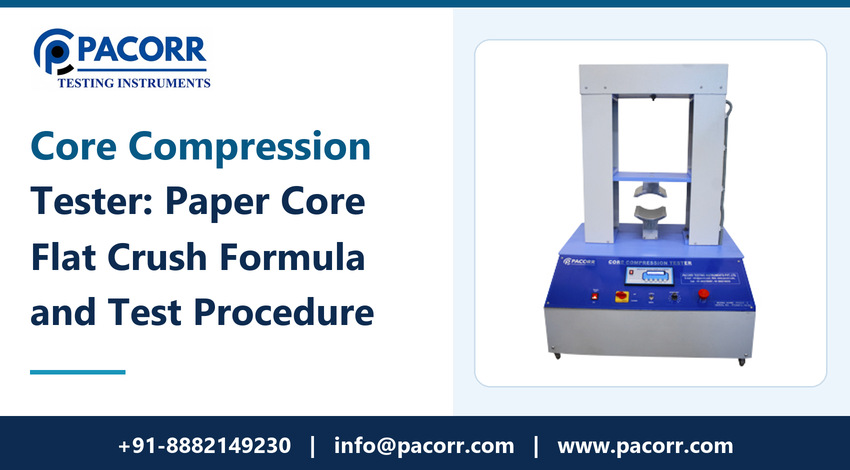
A Core Compression Tester applies compression to a wound paper or board core between platens. For a radial flat crush test, the tube lies on its side so the force acts across the diameter. ISO 11093-9:2019 defines the specimen length basis and the force event for its method. The 100 mm example demonstrates the arithmetic for one basis and does not establish a universal test-piece size or passing value.
What does a Core Compression Tester measure?
A core compression tester develops a compressive load and measures the resulting force. In the radial arrangement, the platens press against opposite sides of the tube wall. The core deforms, and the force-measuring system records the response during loading. The laboratory selects the relevant value according to the test method and converts it to the required reporting unit.
Paper cores support rolls of film, paper, foil or similar web materials. Testing a representative cut section can help compare lots or assess a change to the winding material or construction. The result describes the defined laboratory loading arrangement. An installed core also sees loads from winding, mounting and handling, so a flat crush result does not establish the safe load for the entire roll or chuck assembly.
How are radial and axial core compression different?
For radial flat crush, the core lies on its side, with its longitudinal axis parallel to the platen faces. The closing platens load the core perpendicular to that axis. Think of a horizontal tube becoming oval as it is squeezed across its diameter. The tube's axial length still matters to the calculation because it defines the length of the section being loaded.
For axial compression, the core is loaded through its ends, in the direction of the longitudinal axis. That arrangement tests a different response. A side-loading problem at a roll support and an end-loading problem during a stacking or assembly operation call for different test descriptions. Establish which loading direction the customer expects before cutting the specimen.
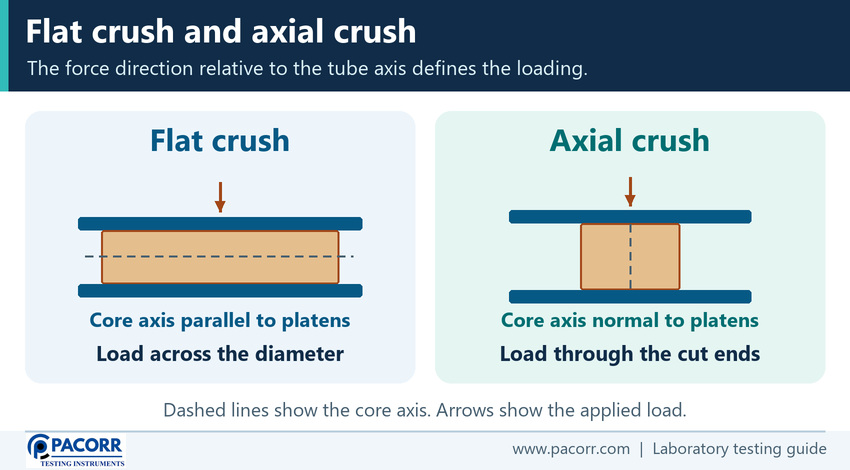
Machine travel may be vertical in both arrangements. The direction that identifies the test is the force relative to the tube axis. Specify that relationship on drawings, work instructions and reports. ISO lists a separate draft on core axial crush, ISO/FDIS 11093-10, under development when checked. Treat draft and published method status separately.
Which force belongs in the flat crush formula?
Use the force associated with the valid crushing event defined by the method. For ISO 11093-9:2019, the definition uses the first maximum or levelling of the force on the load–deformation curve. The method calls for loading past the relevant maximum unless another authorised endpoint is specified. The highest reading during the entire travel can be a different number if the already crushed material is compressed further.
For example, a tube can flatten enough for the walls to touch and then show a rising force as the collapsed material compacts. A generic peak-hold function could retain that later force. If the specified result is the first valid crush event, confirm that the controller, trace or other authorised measurement procedure actually identifies it. Record a clear first maximum or the permitted levelling event, and apply the controlled method when the trace is ambiguous.
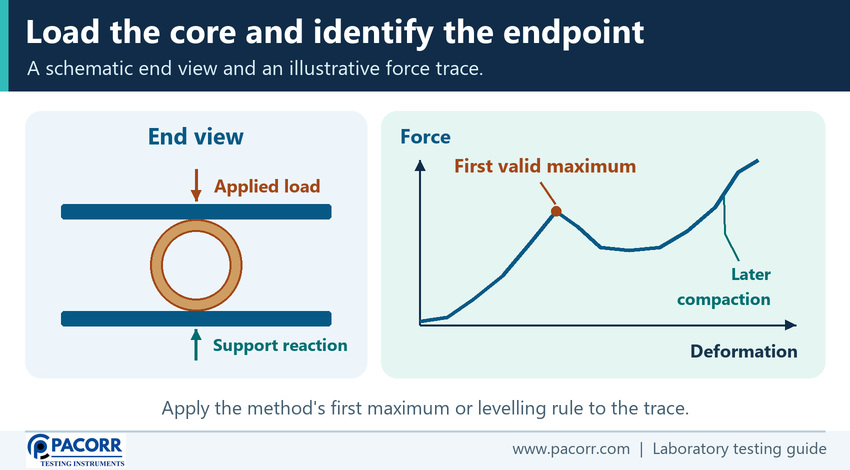
Inspect the physical result as well. A force bump created by uneven seating or by a damaged specimen end deserves review. ISO 11093-9:2019 flags the lack of a detectable breaking point in cores with walls thinner than 5 mm. For an unclear event, preserve the trace and observation and resolve method suitability with the specification owner. A late reading chosen for convenience cannot fill in a missing endpoint. ISO 11093-9 scope and publication status.
How do you calculate core flat crush resistance?
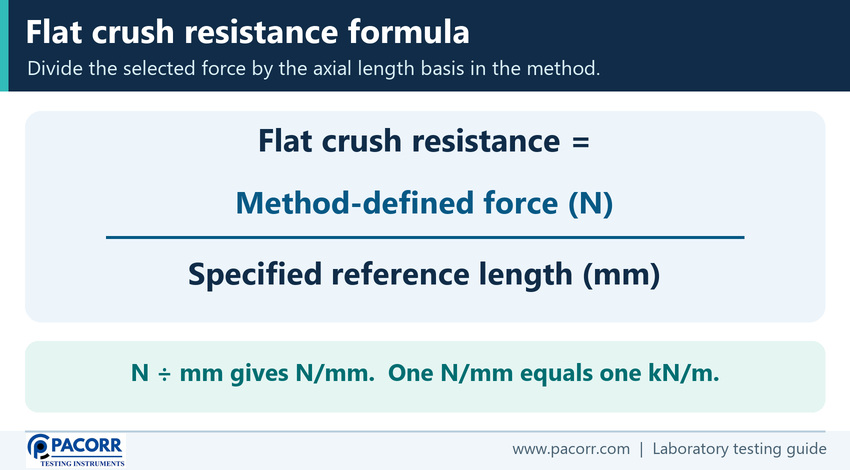
Let F be the valid radial force and L the axial length basis the method requires. Divide the force in newtons by the length in millimetres. The resulting number in N/mm is numerically equal to the number in kN/m. Converting newtons to kilonewtons and millimetres to metres divides both entries by 1,000, so the ratio keeps the same numerical value.
Core flat crush resistance (kN/m) = F (N) ÷ L (mm) when this force-per-length convention applies. Use the measured axial length if the agreed procedure defines an actual-length ratio. For an ISO 11093-9:2019 test, use its nominal calculation basis for the specified test-piece category. Measure and record the actual length to confirm the specimen meets the preparation requirements. The diameter, wall thickness and platen contact area serve different purposes.
| Quantity | What to use |
|---|---|
| Measured crushing force | The valid method-defined radial force, converted to N if needed. |
| Axial length basis | The length in mm required for the chosen calculation. |
| Normalized result | N/mm, numerically equal to kN/m. |
If the machine shows kgf, convert it as force. One kilogram-force is 9.80665 N. Confirm the display unit before export or transcription, especially when a worksheet uses “kg” as shorthand. A reading in kN already represents force on a different numerical scale. Convert the numerator to N before using a denominator in mm in the displayed formula.
How do you work through the 1,250 N example?
Assume a correctly prepared, hypothetical tube section has an axial length of exactly 100 mm and uses a 100 mm calculation basis. A valid radial crush event is observed at 1,250 N.
| Step | Worked result |
|---|---|
| Read the force | 1,250 N, or 1.250 kN. |
| Identify the length basis | 100 mm, or 0.100 m. |
| Divide | 1,250 ÷ 100 = 12.5 N/mm. |
| Check the other unit system | 1.250 ÷ 0.100 = 12.5 kN/m. |
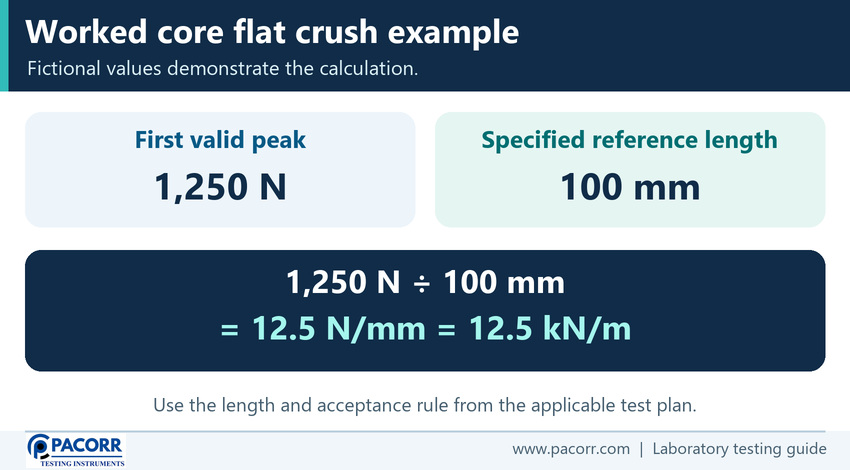
Keep the original force and length on the report. A number written as “12.5” could be mistaken for total force if its unit is omitted. When a legacy certificate shows a force per 100 mm, identify its particular convention and the associated method before comparing results. A mathematically equivalent unit conversion cannot resolve different test conditions or a different force endpoint.
For an arithmetic cross-check, suppose another example uses 3,600 N and a 300 mm reference length. This gives 12.0 kN/m. The total force is higher in the second example, while the result per axial length is lower. Both results are fictional. The arithmetic does not establish equivalence between cores of different diameter, construction or specimen category.
Does ISO 11093-9 always use a 100 mm test piece?
No. ISO 11093-9:2019 chooses the preparation category by the core's nominal inside diameter. For a nominal inside diameter of 300 mm or less, the basis is 100 mm. For a nominal inside diameter above 300 mm, it is 300 mm. The standard sets a specimen length tolerance of ±1.5 mm at all points for each category. Check the controlled document for the complete preparation and calculation requirements.
| Nominal core inside diameter | ISO 11093-9:2019 length basis |
|---|---|
| Up to and including 300 mm | 100 mm nominal test-piece length and calculation basis. |
| Greater than 300 mm | 300 mm nominal test-piece length and calculation basis. |
This distinction matters even for a small difference in measured length. For instance, 1,250 N divided directly by a measured 99.0 mm would give about 12.63 N/mm under an actual-length calculation. For the 100 mm category, the ISO calculation on a suitable piece uses 100 mm and gives 12.5 kN/m. Record the actual measurement and the method basis in separate fields. Arithmetic using the actual length cannot make an otherwise unsuitable specimen conform to the standard.
Which standards apply to wound paper cores?
The published edition checked for radial flat crush was ISO 11093-9:2019, with a replacement under development. Its scope is wound paper and board cores. Cylindrical specimens made from other materials, tapered cones, and purpose-built assemblies may require another procedure. A procurement document should name the applicable edition and any agreed departures.
ISO 11093-1 addresses representative sampling of a lot. Part 2 addresses conditioning of core test samples. Part 4 provides methods for measuring core dimensions including internal and external diameter, wall thickness and length. Check the editions the controlled procedure requires. These supporting references do not set a universal strength requirement for all core grades. ISO 11093-1 sampling, ISO 11093-2 conditioning and ISO 11093-4 dimensions.
When preparing a purchase or dispute report, verify the method and calculation basis before matching a supplier's result to a release limit. A buyer who specifies a particular force at a defined deformation needs to confirm that endpoint in the agreement. It represents a different comparison if the other lab reports the first maximum. Use the applicable reporting instructions and identify the selected event.
How does core flat crush differ from corrugated board FCT?
The words “flat crush” can describe two different tests. Core flat crush uses a cylindrical paperboard specimen loaded across its diameter and a result based on axial length. Corrugated fibreboard flat crush uses a board specimen loaded perpendicular to its faces. The corrugated board result relates the designated crushing force to specimen area, and is expressed in kPa under ISO 3035:2025. The loading geometry and denominator matter.
| Test | Property compared |
|---|---|
| Paper core flat crush | Radial force per axial length under the core method. |
| Corrugated board flat crush | Crush resistance of the fluted board through its faces, based on specimen area. |
| Corrugated board edge crush | Edgewise compression of a corrugated board test piece. |
| Finished box compression | Resistance of an assembled box under a defined compression setup. |
ISO 3035:2025 covers single-faced and single-wall board within its scope, with exclusions for double-wall and microflute because their test endpoints cannot be clearly established under that method. An edge crush result may use kN/m too, but it describes a different specimen and loading direction. Neither value can be converted to the core result merely by matching units. Compare the applicable methods before choosing a test fixture. ISO 3035 for corrugated fibreboard, Pacorr's Edge Crush Test guide and box compression test guide.
How should you prepare and condition the test piece?
Use representative cores from the lot under the approved sampling plan. Identify grade, production lot and sampling location before cutting. Follow the method for the distance from the original ends and for the number of cores and pieces. An end crushed during storage may be relevant to an investigation, but the result must identify that departure rather than using it as a routine test piece without disclosure.
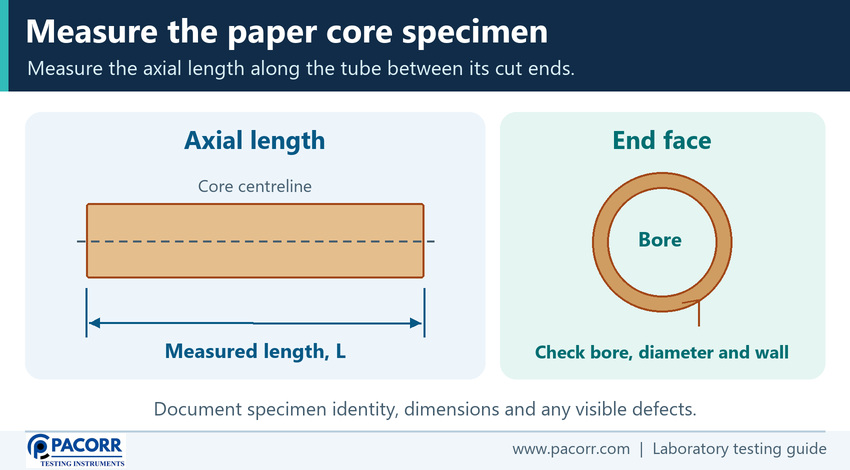
Use a suitable cutting arrangement that keeps the ends square to the tube axis and avoids crushing, tearing, fraying or changing the wall shape. Check the actual axial length at the points required by the method. Record nominal internal diameter, actual dimensions as required, wall thickness and any original damage. For an investigation, note the position of visible seams or defects and retain the orientation required for comparison. Avoid choosing whichever rotation gives a preferred result.
Condition the specimens as required before testing, and test in the atmosphere prescribed by the method. Document the condition and sample history so both laboratories use comparable preparation. Moisture history, adhesive cure or handling before conditioning can influence a result. Compare at an agreed stage in production rather than assuming that a newly wound core and one taken from storage represent the same condition. Pacorr's guide to controlled specimen conditioning.
How do you carry out a core flat crush test?
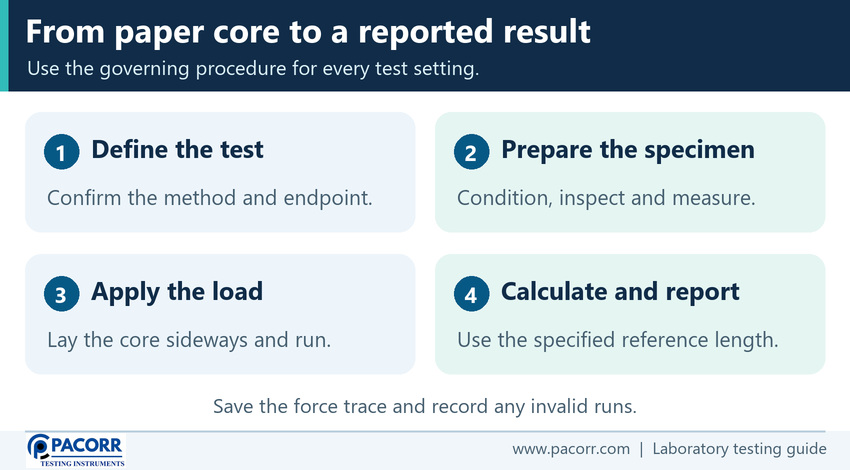
Use this sequence to organise the work. Take the specific cutting provisions, number of test pieces, conditions, platen rate and endpoint rules from the controlled standard or agreed procedure. Follow the equipment instructions for operation.
- Identify the required test direction, method edition, lot and result units. Confirm the relevant length category and acceptance requirements.
- Sample the cores, cut the pieces and check their dimensions and condition. Condition them for the prescribed atmosphere.
- Verify the instrument's force range, units, platen suitability and alignment. Check how it will record the required force–deformation event.
- Place the piece centrally on its side between the parallel platens. Align the longitudinal axis parallel to both platen faces.
- Run the agreed relative platen movement and capture the required force event. Inspect the specimen and trace for abnormal seating, movement or endpoint ambiguity.
- Record the force in its original unit, confirm the length basis and calculate the separate force-per-length result. Repeat for the specified valid set.
- Apply the prescribed summary, rounding and acceptance rule. Retain the original readings, conditions and any recorded departures.
The controller's start, stop and tare functions vary by configuration. Verify alignment and the appropriate range before loading. A test that stops when a display first begins to rise may miss the actual crushing event. If automatic stopping or peak capture is used, confirm the configuration reproduces the method-defined evaluation with representative specimens.
What affects repeatability between lots and laboratories?
Check the specimen before deciding that a different result is a material change. Within one lot, examine dimensions, cut quality, visible damage, sample location and conditioning history. Check that the platen faces are sufficiently large to accommodate the specified specimen and that contact is centred. A piece bearing unevenly can concentrate load at one end and change the collapse response.
Next check the measurement. Compare the calibration and verification scope in compression over the expected force range. Check the actual platen motion under load and whether both laboratories recorded the same crushing event. A larger load cell can have capacity in reserve but limited suitability near the lowest force your procedure must resolve. ISO 11093-9 references ISO 7500-1 for the force-measuring system. A certificate for that system alone does not establish the complete flat crush setup. ISO 7500-1 force-system verification.
When laboratories disagree, exchange original force traces and check the selected event, units, length basis and specimen preparation. Divide a representative set between the labs and agree how deviations will be documented. Repeating convenient specimens and discarding earlier valid readings can hide genuine lot variation.
What should a paper core flat crush report include?
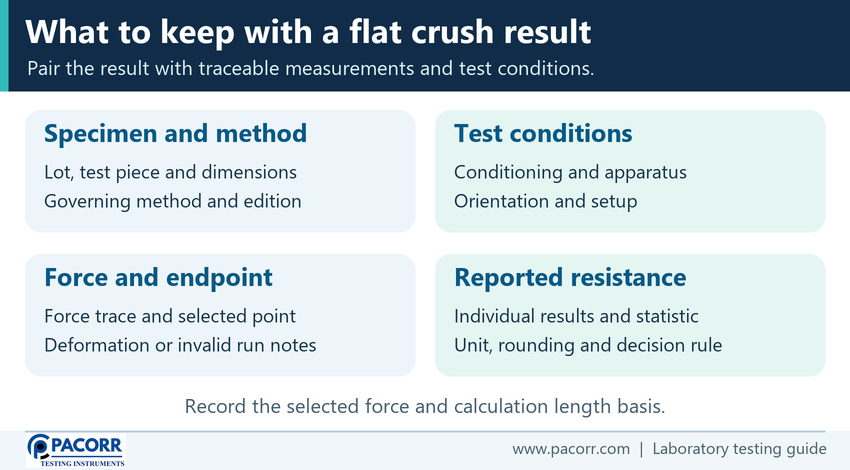
Record the method and edition, lot and core type, sampling information, test date and location, specimen count, actual lengths and calculation basis. Note internal diameter and wall thickness where relevant to the method or comparison. Retain individual forces, the event selected, the normalized results and the required summary. Keep the force–deformation record where available or required so a reviewer can examine how the endpoint was identified.
| Report item | Illustrative entry or instruction |
|---|---|
| Force event | 1,250 N at first valid radial crush event. |
| Specimen length and basis | Actual 100 mm, 100 mm basis in the worked example. |
| Calculated result | 12.5 kN/m. |
| Method and condition | Enter the controlled edition, orientation, conditions and instrument configuration. |
| Disposition | Use the customer limit and decision rule, and document any deviation. |
Approach the acceptance decision separately from the calculation. Verify whether the contract limits individual observations, a mean or another statistic. Review how it treats rounding, borderline results, measurement uncertainty and invalid tests. A kN/m figure by itself gives no universal acceptance decision and does not establish a product warranty.
How can flat crush help investigate a core failure?
Suppose a film converter sees several rolls with distorted cores near one end. Compare intact test pieces from the affected lot with an acceptable reference lot under the same conditioning and method. Review the core dimensions and the original damage location. If the standard specimens give similar radial results, investigate the mounting and handling at the damaged region, including any differences in contact and support. If the valid radial resistance changes, examine the wall construction, paper supply, winding and curing records for that lot.
Consider what else changed before assigning a cause. Grammage measures the mass per area of the paper used in the wall. It can help identify a material change, while flat crush tells you how the assembled core responded to a defined load. Bursting strength is another separate material property measured as rupture pressure. If the issue concerns roll handling or assembly loads, use relevant supplemental evaluation under the actual service conditions. Pacorr's grammage guide and bursting strength tester guide.
What specifications does Pacorr publish for the PCCCT-1500?
Pacorr identifies its core compression tester as PCCCT-1500. The current product listing gives the following details. These are equipment specifications and features.
| Published attribute | PCCCT-1500 listing |
|---|---|
| Force capacity | 1,500 kgf, approximately 14.7 kN. |
| Display and least count | Backlit digital LCD, 0.2 kgf listed increment. |
| Speed range | 10–50 mm/min. |
| Test plates | Dimensions according to the core requirements. |
| Drive and electrical supply | 1.5 hp geared induction motor, 220 V single phase at 50 Hz. |
| Published controls | Tare and peak hold, overload and overtravel protection, automatic return to home position. |
The 1,500 kgf figure describes capacity. It is neither the peak of a specific test nor proof of usable accuracy throughout that span. Likewise, the least count gives the display increment. Ask for the verified force range, calibration and evidence relevant to the expected low and high loads for your cores. Pacorr Core Compression Tester specifications.
How should you confirm the machine configuration for ISO use?
The public listing gives a 10–50 mm/min speed range. ISO 11093-9:2019 specifies a relative platen rate of 50–65 mm/min during loading. The two figures meet at 50 mm/min on paper. Confirm whether the quoted machine can demonstrate the prescribed rate under the expected test load, along with the platen parallelism, force verification range and method-specific event evaluation. Neither a display setting nor catalogue capacity establishes those conditions. Separate testing methods may use different equipment criteria.
Before ordering, share the expected force range, core internal diameter, wall thickness, required lengths and reporting workflow. Confirm platen dimensions and opening, trace availability, force verification documents and the approach to identifying a first maximum or levelling event. If a laboratory needs to compare core testing with corrugated board testing, discuss the separate apparatus and fixtures. Obtain a specification and price for the configuration you need. Pacorr Edge Crush Tester and separate fixture options.
Frequently asked questions
What is the formula for paper core flat crush resistance?
Divide the method-defined radial crushing force in newtons by the required axial length basis in millimetres. The numerical result in N/mm equals the result in kN/m. For ISO 11093-9:2019, use the nominal basis prescribed for the specimen category.
What is the result for 1,250 N on a 100 mm length basis?
1,250 ÷ 100 gives 12.5 N/mm, which equals 12.5 kN/m. These example values illustrate the conversion without setting a test condition or customer limit.
Is a 100 mm test piece mandatory for all cores?
No. ISO 11093-9:2019 specifies a 100 mm category for cores with nominal inside diameter up to 300 mm, and a 300 mm category for larger ones. Check its preparation tolerances and the edition required for your test.
Is the test-piece length the same as the core diameter?
No. The length runs along the longitudinal axis of the cut tube. Inside diameter can determine the applicable specimen category but does not directly replace the length in the calculation.
Should I use the highest force shown on the tester?
Use the valid method-defined crushing event. ISO 11093-9:2019 defines the force at the first maximum or levelling of the curve. A later increase from compacting the collapsed specimen may give a different peak.
What if the core shows no clear break point?
Keep the force trace and specimen observation. Review whether the method's endpoint can be evaluated and whether the sample is suitable. ISO 11093-9:2019 specifically flags the lack of a detectable break point for core walls below 5 mm.
Is core flat crush the same as corrugated board FCT?
No. The core test loads a tube across its diameter and reports force per axial length. Corrugated board FCT loads a board specimen through its faces and uses an area-based result under the applicable board method.
Does the PCCCT-1500 capacity prove it meets ISO 11093-9?
No. Capacity is one equipment attribute. Confirm the specified platen movement under load, force verification, platen alignment, specimen fit and valid event measurement against the controlled edition.
Is there a universal minimum value for paper core flat crush?
No. A purchase limit depends on the core construction, application and agreed method. Confirm the target, units, sample count and decision rule with the customer.
How can Pacorr help you select a Core Compression Tester?
Send your core drawings, nominal inside diameter, wall thickness, required specimen length, expected force range and controlled test method. Describe the radial or axial loading direction and the exact report values and records you require. Pacorr can review the needed fixture, force range, speed and data capture with you before preparing a configuration-specific quotation. Contact Pacorr for a core testing enquiry.