
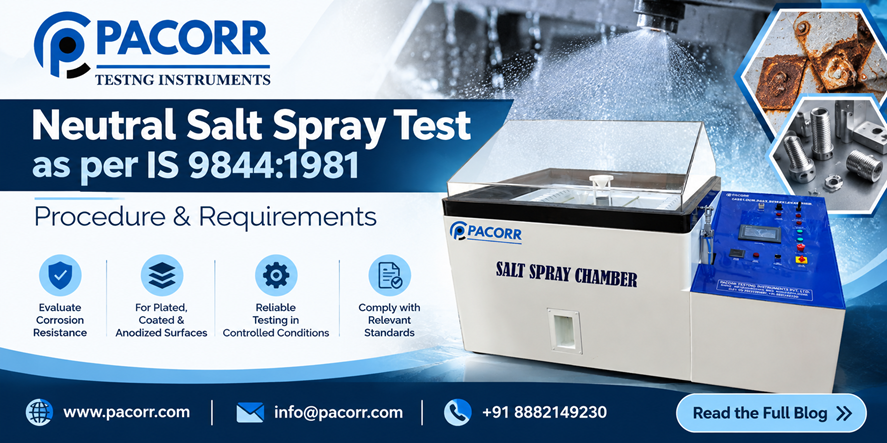
Corrosion can begin long before a metal component visibly fails. A coating may look perfect after production but start developing rust, blistering, pitting, or surface deterioration when exposed to moisture and salts. This is why manufacturers need a controlled method to evaluate corrosion resistance before a product reaches actual service conditions.
The Neutral Salt Spray Test, commonly performed in a Salt Spray Chamber, is one of the established laboratory methods used to evaluate the corrosion resistance of metallic coatings and anodized aluminium surfaces.
IS 9844:1981 was specifically developed for testing the corrosion resistance of electroplated and anodized aluminium coatings using a neutral salt spray environment. The standard defined the test solution, equipment, specimen positioning, chamber conditions, exposure procedure, and evaluation requirements.
Important standards update: IS 9844:1981 was withdrawn with effect from 25 December 2024. Salt spray testing requirements have since been consolidated under IS 5528:2024 / ISO 9227:2022 – Corrosion Tests in Artificial Atmospheres Salt Spray Tests. IS 9844:1981 may still appear in older drawings, purchase specifications, quality plans, tender documents, and customer requirements, so understanding its procedure remains useful. For new compliance testing, users should confirm the latest applicable standard and product specification.
What Is the Neutral Salt Spray Test?
The Neutral Salt Spray Test, or NSS test, is an accelerated corrosion testing method in which coated or metallic specimens are continuously exposed to a fine mist of sodium chloride solution inside a controlled chamber. The objective is not to reproduce years of outdoor exposure in an exact time ratio. Instead, salt spray testing creates a consistent corrosive environment that allows manufacturers to compare coatings, detect coating defects, verify production consistency, and check requirements specified for a particular product. IS 9844:1981 itself cautioned that salt spray performance should not be treated as a direct prediction of corrosion resistance under every real-life environment. Conditions in actual service can vary considerably. This distinction is important: 500 hours in a Salt Spray Chamber should not automatically be interpreted as a specific number of years of outdoor life.
What Does IS 9844:1981 Cover?
IS 9844:1981 was titled Methods of Testing Corrosion Resistance of Electroplated and Anodized Aluminium Coatings by Neutral Salt Spray Test. It described the apparatus, test solution, and procedure required for carrying out neutral salt spray testing to assess coatings according to the relevant coating or product specification. The standard did not independently define the test duration, specimen type, or final pass/fail criteria for every product. Those requirements were intended to come from the relevant product, coating, customer, or contractual specification. This is an important point for quality-control teams. Simply saying that a component has “passed IS 9844” is incomplete unless the required exposure period and acceptance criteria are also identified.
Key Test Conditions Under IS 9844:1981
For users working with legacy specifications referencing IS 9844:1981, some of the main neutral salt spray parameters include:
| Test Parameter | Requirement |
| Sodium chloride concentration for prepared solution | 50 ± 5 g/L |
| pH of collected spray | 6.5 to 7.2 |
| Chamber temperature | 35 ± 2°C |
| Compressed air pressure | 70 to 170 kPa |
| Specimen angle Preferably about | 20° from vertical |
| Permitted specimen angle | 15° to 30° from vertical |
| Fog collection rate | 1 to 2 ml/hour per 80 cm² collection area |
| Reuse of sprayed solution | Not permitted |
These controlled conditions help make corrosion tests more repeatable and comparable.
Neutral Salt Spray Test Procedure as per IS 9844:1981
A reliable corrosion test depends on much more than simply spraying salt water inside a cabinet. Solution preparation, specimen cleaning, positioning, temperature control, atomization, and fog collection all influence the results.
1. Prepare the Salt Solution
The test solution is prepared using sodium chloride dissolved in distilled or deionized water. IS 9844:1981 specifies a concentration of approximately 50 ± 5 grams of sodium chloride per litre for the prepared solution. The salt should be sufficiently pure so that unwanted contaminants do not influence corrosion behaviour. The solution should also be filtered before entering the reservoir to prevent solid particles from blocking the spray system.
2. Control the pH
The pH of the solution collected inside the Salt Spray Chamber should remain between 6.5 and 7.2. Maintaining a neutral pH is one of the characteristics that separates the Neutral Salt Spray Test from acidic methods such as AASS and CASS testing. Incorrect pH can change the aggressiveness of the environment and make test results difficult to compare.
3. Clean the Test Specimens
Specimens should be thoroughly cleaned before testing. The cleaning process should remove contaminants without damaging or chemically attacking the coating being evaluated. Abrasives or unsuitable solvents that may alter the surface should therefore be avoided. After cleaning, samples should also be handled carefully to prevent fingerprints, oils, or other contamination from affecting the test surface.
4. Position Specimens Correctly
Sample orientation is critical for obtaining consistent results. Under IS 9844:1981, flat test surfaces should face upward and ideally be positioned at approximately 20 degrees from vertical, with an acceptable range of 15 to 30 degrees. Samples should not touch each other or the walls of the chamber. They should also be arranged so that solution dripping from one specimen cannot fall onto another specimen below it. Supports should be made from an inert, non-metallic material that will not react with the salt environment.
5. Maintain the Test Chamber Temperature
The temperature inside the spray cabinet should be maintained at:
35 ± 2°C
Temperature stability matters because corrosion reactions can change significantly with temperature. A dependable Salt Spray Test Chamber therefore requires an accurate temperature-control system capable of maintaining consistent conditions throughout long-duration tests.
6. Generate Uniform Salt Fog
Clean compressed air is used to atomize the saline solution and generate a fine fog inside the chamber. The historical IS 9844 procedure specifies an air pressure range of approximately 70 to 170 kPa and requires the compressed air to be free from oil and solid contamination. The spray should be distributed uniformly through the test area rather than directly impinging on the specimens.
7. Check the Fog Collection Rate
Uniform fog distribution is one of the most important checks during salt spray testing. Collection devices are positioned within the chamber to measure the quantity of solution settling in the test area. Under IS 9844:1981, the average collection rate should be approximately:
1 to 2 ml per hour for an 80 cm² horizontal collection area, measured over a minimum period of 24 hours. A collection rate outside the required range may indicate problems with air pressure, atomization, nozzle condition, solution feed, or chamber distribution.
8. Continue Exposure for the Required Duration
The actual test duration depends on the applicable coating or product specification. IS 9844:1981 listed commonly used exposure periods including:
2, 6, 24, 48, 96, 240, 480 and 720 hours.
However, these durations should not automatically be treated as universal pass/fail requirements. The correct test duration must be determined from the relevant product specification, drawing, customer requirement, or quality plan. The salt spray should normally remain continuous during the specified exposure period.
What Happens After the Salt Spray Test?
Once the specified exposure period is complete, the samples are removed from the chamber. IS 9844:1981 describes allowing specimens to dry for approximately half an hour to one hour before gently removing residual salt solution. Samples may then be rinsed using clean water at a temperature not exceeding 40°C and dried appropriately before evaluation.
The surface is then examined according to the applicable product requirements.
Typical observations may include:
- Red rust formation
- White corrosion products
- Pitting
- Blistering
- Cracking
- Peeling
- Coating deterioration
- Loss of adhesion
- Distribution and number of corrosion defects
The final acceptance criterion must come from the relevant product or coating specification rather than from exposure time alone.
Why Is a Salt Spray Chamber Important?
A properly designed Salt Spray Chamber provides the controlled environment needed to maintain repeatable corrosion-test conditions. Without controlled temperature, clean compressed air, uniform atomization, correct specimen positioning, and measurable fog fallout, two laboratories could expose identical samples for the same number of hours and still obtain significantly different results.
For manufacturers, reliable salt spray testing can support:
- Incoming material inspection
- Coating-development studies
- Electroplating quality control
- Supplier comparison
- Production-process monitoring
- Failure investigation
- Research and development
- Customer-specific testing
- Product qualification
Industries using salt spray corrosion testing include automotive, metal finishing, electrical components, fasteners, construction hardware, appliances, aerospace components, marine equipment, coated sheet metal, and engineering products.
Pacorr Salt Spray Chamber for Controlled Corrosion Testing
For laboratories and manufacturing units that regularly evaluate the corrosion resistance of metals and coated components, the performance of the test equipment is as important as the written procedure.
Pacorr's Salt Spray Chamber is designed to create a controlled salt-fog environment for testing metals, plated components, painted surfaces, protective coatings, and other surface-treated products.
Pacorr's current Salt Spray Chamber range uses corrosion-resistant FRP construction and includes features such as digital PID temperature control, an air-saturation system, fog-collection arrangements, and test-duration monitoring. Pacorr currently lists 250-litre, 450-litre and 1000-litre chamber options, allowing laboratories to select equipment according to specimen size and testing volume.
The standard configuration is designed around neutral salt spray testing requirements commonly associated with ASTM B117 and ISO 9227. Where an older customer document specifically calls for IS 9844:1981, the laboratory should compare the contractual test parameters with its equipment configuration before declaring compliance.
Why Choose Pacorr for a Salt Spray Test Chamber?
Corrosion testing often runs continuously for hundreds of hours. Small variations in temperature, fog generation, or solution distribution can influence the quality of the test. Pacorr focuses on providing Salt Spray Chambers for controlled laboratory corrosion testing with features intended to simplify operation and routine quality-control work.
The equipment can be useful for manufacturers that need to:
- Evaluate corrosion resistance of coated products
- Compare different coating systems
- Conduct routine salt spray quality checks
- Test plated and painted components
- Monitor supplier quality
- Perform long-duration corrosion exposure
- Maintain controlled test conditions
- Document product-performance testing
For current specifications, chamber capacity, configuration, and compatibility with the test standard required for your application, the equipment should be selected according to the exact testing requirement.
IS 9844:1981 vs Current Salt Spray Testing Requirements
IS 9844:1981 remains a useful search and reference term because many historical engineering documents and specifications continue to mention it. However, laboratories should distinguish between understanding an older test method and claiming compliance with a current Indian Standard.
BIS established IS 5528:2024 / ISO 9227:2022, titled Corrosion Tests in Artificial Atmospheres Salt Spray Tests, and the earlier IS 9844:1981 was withdrawn effective 25 December 2024.
Therefore:
For an existing drawing or customer specification: follow the contractual requirement and clarify whether the legacy IS 9844 method is still required. For new testing programmes: check the latest applicable BIS/product standard and consider IS 5528:2024 / ISO 9227:2022 where appropriate.
This approach avoids confusion between legacy references and current standardization requirements.
Common Mistakes During Neutral Salt Spray Testing
Even a good Salt Spray Chamber cannot compensate for poor test practices. Some common errors include using contaminated salt or water, incorrect specimen angles, touching samples after cleaning, blocked atomizing nozzles, unstable chamber temperature, incorrect pH, poor compressed-air quality, allowing specimens to drip onto each other, and reusing solution that has already been sprayed.
Another common mistake is assuming that salt spray hours directly equal outdoor service life. Salt spray testing is primarily a controlled comparative corrosion test; field performance depends on many additional environmental and material factors.
Frequently Asked Questions
What is IS 9844:1981?
IS 9844:1981 was an Indian Standard describing neutral salt spray testing for assessing the corrosion resistance of electroplated and anodized aluminium coatings.
What temperature is used for the Neutral Salt Spray Test under IS 9844:1981?
The spray cabinet temperature is maintained at 35 ± 2°C.
What salt concentration is required?
The original test solution is prepared at approximately 50 ± 5 g/L sodium chloride using distilled or deionized water.
What is the pH requirement for the Neutral Salt Spray Test?
The pH of the collected salt spray should remain between 6.5 and 7.2.
What is the required salt-fog collection rate?
IS 9844:1981 specifies an average collection rate of approximately 1 to 2 ml per hour over an 80 cm² horizontal collection area, measured over at least 24 hours.
How long does a salt spray test take?
Test duration depends on the product or coating specification. The legacy standard referenced common exposure periods ranging from a few hours to several hundred hours, including 24, 48, 96, 240, 480 and 720 hours.
Does a 500-hour salt spray test mean 500 hours of real outdoor exposure?
No. Salt spray testing should not be converted directly into an exact outdoor service-life period. It is mainly used for standardized comparison and evaluation of corrosion behaviour.
Is IS 9844:1981 still current?
No. IS 9844:1981 was withdrawn effective 25 December 2024. Current testing requirements should be checked against the relevant product standard and IS 5528:2024 / ISO 9227:2022, where applicable.
What is a Salt Spray Chamber used for?
A Salt Spray Chamber creates a controlled salt-fog environment to evaluate corrosion behaviour in metals, plated parts, painted components, coatings, and other surface-treated products.
Where can I buy a Salt Spray Chamber in India?
Pacorr Testing Instruments manufactures Salt Spray Chambers for industrial and laboratory corrosion testing. Chamber capacity and configuration should be selected according to specimen dimensions, testing volume, and the standard required for the application.
Conclusion
Neutral salt spray testing provides manufacturers with a controlled way to examine how coatings and metal surfaces respond to an aggressive saline environment. IS 9844:1981 established important testing practices covering solution preparation, pH, temperature, specimen positioning, fog collection, exposure, and post-test evaluation. Although the standard has now been withdrawn, it remains relevant for understanding older engineering specifications and customer requirements that still reference it.
For reliable results, testing should be carried out in a properly controlled Salt Spray Chamber capable of maintaining stable test conditions throughout the exposure period.
Pacorr provides Salt Spray Chambers designed for accurate and repeatable corrosion testing across manufacturing, coating, plating, automotive, engineering, and quality-control applications.
For assistance in selecting the right Salt Spray Chamber for your testing requirement, contact Pacorr:
Pacorr Testing Instruments
Website: www.pacorr.com
Email: info@pacorr.com
Phone: +91 8882149230
Choose the test configuration according to your applicable product standard, customer specification, specimen dimensions, and required exposure conditions.
Recent Blogs
Enhance your understanding of testing and precise quality control indistinct applications with our
knowledge based articles coming from top editors of industry leaders.

Our USP's
Demonstration of Machine
- Try Before You Decide
- Experience Before You Invest
- See It in Action – Free Demo
Global Reach
- Delivering Excellence Worldwide
- Serving Across Borders
- Your Global Supply Partner
On-Site Support
- Support That Comes to You
- On-Ground Assistance, Anywhere
- We Reach Where You Are
Team Strength
- Powered by Expert Minds
- Driven by Skilled Professionals
- Engineering Excellence Team
Manufacturing
- Precision-Driven Manufacturing
- Smart & Automated Production
- Engineered In-House Excellence
