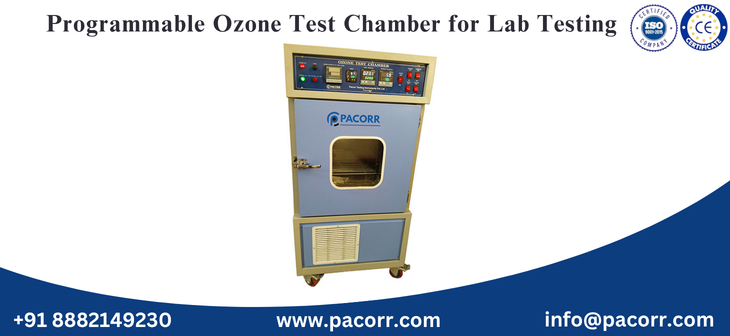
Pacorr understands that modern laboratories and manufacturing units need testing systems that do more than generate data—they must deliver reliable, repeatable, and standards-driven results. A programmable ozone test chamber is one of the most important instruments for evaluating how rubber, elastomers, plastics, seals, gaskets, and flexible materials perform when exposed to ozone-rich environments. For industries where material degradation can lead to cracking, leakage, product failure, or customer complaints, investing in the right ozone chamber is a practical step toward better quality assurance.
In many industrial applications, atmospheric ozone causes premature aging of materials. Even low ozone concentrations can attack stressed rubber surfaces and create fine cracks that grow over time. This is why a high-quality ozone test chamber is essential for lab testing, R&D validation, supplier approval, and production quality control. Engineers and quality professionals use these chambers to simulate long-term exposure in a controlled environment, making them a critical part of material durability testing and ozone resistance testing.
This article explains what an ozone test chamber is, how it works, why it matters, what features to evaluate, and how to select the right equipment from experienced ozone test chamber manufacturers.
What is Ozone Test Chamber
An ozone test chamber is a specialized environmental test chamber designed to expose test specimens to controlled ozone concentrations, temperature, humidity, and mechanical strain. Its purpose is to assess a material’s resistance to ozone-induced cracking, surface degradation, and loss of physical properties.
Ozone chamber definition in technical testing
An ozone chamber creates a precisely controlled atmosphere where ozone gas interacts with prepared test specimens under standard lab conditions. The instrument helps laboratories evaluate how materials behave under accelerated ozone exposure rather than waiting for natural weathering or field failure.
This makes the equipment useful for:
- Rubber ozone testing
- Ozone concentration testing
- Accelerated aging studies
- Product comparison and formulation development
- Quality verification of incoming and finished materials
Why a programmable ozone test chamber matters
A programmable ozone chamber gives operators full control over exposure parameters. Instead of running fixed and limited tests, technicians can set custom programs for ozone concentration, temperature, dwell time, and test duration.
This is especially useful when manufacturers need to:
- Reproduce internal quality standards
- Compare multiple compounds or formulations
- Simulate specific end-use conditions
- Validate design changes before commercialization
Ozone test chamber vs general environmental test chamber
A standard environmental test chamber can simulate heat, humidity, and temperature cycling. However, it cannot replace an ozone aging chamber when the goal is ozone resistance evaluation. Ozone testing requires precise ozone generation, uniform circulation, controlled concentration, and specimen mounting arrangements that allow stress exposure.
That is why dedicated laboratory testing equipment for ozone exposure is preferred in industries where elastomer reliability is critical.
Importance of Ozone Test Chamber in Quality Testing
An ozone test chamber is important because ozone degradation is often invisible in the early stages but severe in its long-term impact. Rubber components may appear acceptable during basic inspection, yet fail prematurely in real service conditions due to ozone attack.
Ozone resistance testing for product reliability
Ozone resistance testing helps manufacturers determine whether a material can withstand ozone exposure without cracking. This is critical for products such as:
- Rubber seals
- O-rings
- Hoses
- Gaskets
- Conveyor belts
- Cable insulation
- Flexible plastic parts
When such components fail, the result may be leakage, safety issues, downtime, or reduced product life.
Rubber ozone testing in quality control
In rubber ozone testing, the specimen is often placed under a defined strain because ozone cracking becomes more severe when the material is stressed. This helps labs detect weaknesses that may not appear in unstressed storage conditions.
For quality teams, the benefits include:
- Early detection of compound weakness
- Better comparison between raw material lots
- Stronger supplier quality evaluation
- Reduced field complaints
- Improved consistency in finished products
Ozone concentration testing for accelerated aging
An accelerated aging test chamber shortens evaluation time by increasing the stress level under controlled conditions. In ozone testing, this means exposing materials to a known ozone concentration for a specified time to simulate long-term service behavior.
This makes ozone concentration testing valuable for:
- New product development
- Failure analysis
- Benchmarking against competitor materials
- Compliance with test standards
- Predictive quality assurance
For manufacturers that depend on long-term durability, the ozone test chamber becomes an essential part of quality control testing equipment.
Need help selecting the right testing instrument?
If your lab is planning to upgrade its rubber testing instruments or install a reliable ozone chamber, connect with Pacorr for technical guidance on the right model and configuration.
Email: info@pacorr.com
Phone: +91 8882149230
Key Features of Ozone Test Chamber
Not all ozone test systems offer the same performance. The best ozone test chamber manufacturers focus on control accuracy, safety, uniformity, repeatability, and user-friendly programming.
Programmable ozone chamber controls
A modern programmable ozone chamber should include an advanced control interface that allows users to set and monitor:
- Ozone concentration
- Exposure time
- Temperature
- Humidity, if applicable
- Airflow and circulation conditions
- Alarm limits and safety cut-offs
Programmability improves repeatability and reduces operator error.
Uniform ozone distribution inside the ozone chamber
Uniform ozone exposure is essential for accurate results. Poor circulation can lead to uneven cracking patterns and unreliable comparisons between samples. A well-designed ozone chamber should provide consistent ozone distribution throughout the working space.
Precision ozone generation and sensing
The instrument should have:
- Stable ozone generation system
- Accurate ozone sensor or analyzer
- Tight concentration control
- Minimal fluctuation during the test cycle
This is especially important for labs conducting formal ozone resistance testing or supplier qualification.
Specimen mounting for rubber ozone testing
In many tests, specimens must be held under static or dynamic strain. Good specimen fixtures support proper positioning and repeatable exposure. This matters in rubber ozone testing, where stress condition directly affects cracking behavior.
Safety and durability features
Since ozone is highly reactive, the chamber should be built with ozone-resistant internal materials and reliable sealing. Important features include:
- Leak-resistant chamber construction
- Exhaust arrangement
- Safety interlocks
- Corrosion-resistant interior
- Clear digital monitoring
Data logging and operator convenience
For modern lab operations, useful features include:
- Test data logging
- Digital display and control
- Timer-based programming
- Trend monitoring
- Calibration support
These functions improve traceability and support audit-ready testing workflows.
Working Principle of Ozone Test Chamber
The working principle of an ozone test chamber is based on controlled ozone generation and uniform exposure of materials under specified environmental conditions.
How an ozone test chamber creates controlled ozone exposure
First, the chamber generates ozone using an ozone generator. The ozone is then introduced into the test area in a controlled quantity. Circulation systems distribute the gas evenly around the specimens.
The controller continuously monitors and adjusts the ozone level to maintain the target concentration.
Role of strain in ozone resistance testing
In most practical applications, ozone damage becomes more visible when a rubber sample is under tension. Therefore, test specimens are mounted on fixtures that apply a predefined elongation. This setup makes the ozone aging chamber more effective for predicting real-world cracking.
Step-by-step working cycle
A typical test process follows these steps:
- Prepare the specimen according to the required test method
- Mount the specimen in a stressed or unstressed condition
- Set the ozone concentration, temperature, and test duration
- Start the chamber and allow stabilization
- Expose the specimen for the specified time
- Inspect for cracks, surface changes, or performance loss
- Record and compare results
Why this method is effective for material durability testing
The chamber does not simply expose materials to ozone randomly. It provides a standardized, repeatable environment. That is why it is widely used for material durability testing, product development, and failure prevention.
It helps manufacturers answer important questions:
- Will the material crack during service?
- Is the current formulation more ozone-resistant than the previous one?
- Does a design change affect long-term durability?
- Are incoming materials suitable for demanding applications?
Applications of Ozone Test Chamber in Different Industries
A high-performance ozone test chamber serves multiple industries where elastomers and flexible materials are exposed to air, stress, and aging conditions.
Rubber ozone testing in automotive and transport
Automotive components often face ozone-related aging. Testing is important for:
- Door seals
- Window channels
- Wiper components
- Hoses
- Gaskets
- Suspension elastomers
For this sector, rubber ozone testing supports durability and warranty reduction.
Ozone chamber use in cable, wire, and electrical industries
Cable insulation, jackets, and flexible electrical parts must resist surface cracking. An ozone chamber helps manufacturers evaluate whether the material maintains integrity during storage and service.
Ozone test chamber for plastic and polymer manufacturers
Some polymer blends and flexible plastic materials are vulnerable to oxidative and ozone-related attack. A dedicated ozone test chamber supports formulation comparison and long-term performance analysis.
Packaging and sealing applications
For packaging manufacturers, ozone testing is particularly relevant for:
- Elastomeric closure systems
- Cap liners
- Sealing rings
- Flexible gasket materials
- Specialty industrial packaging components
In these cases, failure of a small seal can compromise the full package system. That is why ozone testing is an important part of advanced packaging validation.
Laboratory testing equipment for research and QA labs
Independent labs, academic labs, R&D centers, and corporate QA departments use laboratory testing equipment like ozone chambers to support:
- Standardized material testing
- Comparative analysis
- Product certification
- Root-cause failure investigation
- Development of improved compounds
How to Choose the Right Ozone Test Chamber
Selecting the right ozone test chamber requires more than comparing basic specifications. Engineers should consider application needs, test methods, reliability, service support, and total operating value.
Evaluate ozone test chamber manufacturers on technical capability
When comparing ozone test chamber manufacturers, look for more than catalog claims. Ask these questions:
- Is the ozone concentration control accurate and stable?
- Does the chamber offer programmable operation?
- Is the exposure uniform across specimens?
- Are specimen holders suitable for your test standards?
- Is the system easy to calibrate and maintain?
Reliable ozone test chamber manufacturers should be able to discuss test parameters clearly and recommend configurations based on your application.
Match chamber size to your lab workload
Choose a chamber that fits your specimen volume and test frequency. A larger chamber may improve flexibility, but it should still deliver good ozone uniformity and efficient control.
Check standards compatibility
Ensure the system is suitable for the type of ozone resistance test your lab performs. This is especially important for industries operating under internal validation protocols or customer-driven specifications.
Compare ozone test chamber price with lifecycle value
The lowest ozone test chamber price is not always the best choice. A more useful buying approach is to compare:
- Performance consistency
- Control accuracy
- Build quality
- Service support
- Ease of operation
- Downtime risk
- Long-term maintenance needs
This gives a clearer picture of actual value.
Consider supplier support and availability
Many buyers also compare ozone test chamber suppliers based on:
- Installation support
- Operator training
- Calibration assistance
- Spare parts availability
- After-sales response
A chamber is a long-term lab investment, so supplier reliability matters.
Why Choose Pacorr for Ozone Test Chamber
Pacorr brings a practical engineering approach to quality control testing equipment for industrial applications. For businesses that require dependable testing performance, Pacorr focuses on usability, test accuracy, and long-term reliability rather than unnecessary complexity.
Pacorr’s approach to programmable ozone chamber design
A programmable ozone chamber from Pacorr is designed to support controlled and repeatable lab testing. This helps engineers and QA teams perform ozone resistance evaluation with better consistency.
Key strengths typically valued by industrial users include:
- User-friendly programmable controls
- Reliable chamber construction
- Consistent testing conditions
- Suitable configuration for industrial quality labs
- Focus on practical testing needs across rubber, plastic, and packaging applications
Built for technical users, not just procurement lists
Pacorr understands that engineers need equipment that performs well in real testing conditions. That means stable operation, clear controls, and dependable outputs for comparison, validation, and quality release.
A dependable option among ozone test chamber manufacturers
Among ozone test chamber manufacturers, Pacorr stands out for combining technical understanding with application-focused support. Whether the requirement is for routine quality checks, material development, or specialized ozone aging evaluation, the goal is to provide testing instruments that fit industrial workflows.
Conclusion
A programmable ozone test chamber is an essential instrument for manufacturers and laboratories that need accurate insight into material behavior under ozone exposure. From rubber ozone testing and ozone concentration testing to broader material durability testing, this equipment supports stronger quality assurance, better formulation decisions, and more reliable end products.
For engineers, QA managers, and lab professionals, the right ozone chamber is not just a testing device—it is a preventive quality tool that helps reduce failures, improve product performance, and build confidence in material selection. When evaluating options from ozone test chamber manufacturers, focus on control accuracy, programmability, uniformity, support, and long-term value rather than only initial cost.
If you are looking for dependable testing instruments and expert guidance in selecting the right ozone test chamber, contact Pacorr today.
Email: info@pacorr.com
Phone: +91 8882149230
Frequently Asked Questions
What is an ozone test chamber?
An ozone test chamber is a laboratory instrument used to evaluate how rubber, elastomers, plastics, and similar materials respond to controlled ozone exposure. It helps detect cracking, aging, and surface degradation under accelerated conditions.
How does an ozone chamber work?
An ozone chamber generates ozone gas, maintains a controlled concentration, and exposes specimens under set temperature and time conditions. In many tests, samples are also kept under strain to evaluate ozone-induced cracking more effectively.
Why is ozone testing important for rubber materials?
Ozone testing is important because rubber can crack when exposed to ozone, especially under stress. Ozone resistance testing helps manufacturers predict durability, improve formulations, and prevent early product failure in real applications.
What industries use ozone test chambers?
Industries that commonly use ozone test chambers include automotive, rubber manufacturing, plastics, cable and wire, packaging, sealing products, research laboratories, and industrial quality control facilities.
How to choose ozone test chamber manufacturers?
When selecting ozone test chamber manufacturers, evaluate ozone control accuracy, chamber uniformity, programmability, specimen fixtures, service support, spare part availability, and suitability for your testing standards and workload.
What is ozone test chamber price?
Ozone test chamber price depends on chamber size, control system, ozone generation accuracy, programmability, construction quality, and support services. Buyers should compare long-term value, not just initial cost.
What is ozone resistance testing?
Ozone resistance testing is a method used to determine how well a material resists cracking and degradation when exposed to ozone under controlled environmental conditions. It is widely used in quality control and product development for rubber and elastomer materials.
Recent Blogs
Enhance your understanding of testing and precise quality control indistinct applications with our
knowledge based articles coming from top editors of industry leaders.
Our USP's
Demonstration of Machine
- Try Before You Decide
- Experience Before You Invest
- See It in Action – Free Demo
Global Reach
- Delivering Excellence Worldwide
- Serving Across Borders
- Your Global Supply Partner
On-Site Support
- Support That Comes to You
- On-Ground Assistance, Anywhere
- We Reach Where You Are
Team Strength
- Powered by Expert Minds
- Driven by Skilled Professionals
- Engineering Excellence Team
Manufacturing
- Precision-Driven Manufacturing
- Smart & Automated Production
- Engineered In-House Excellence
