
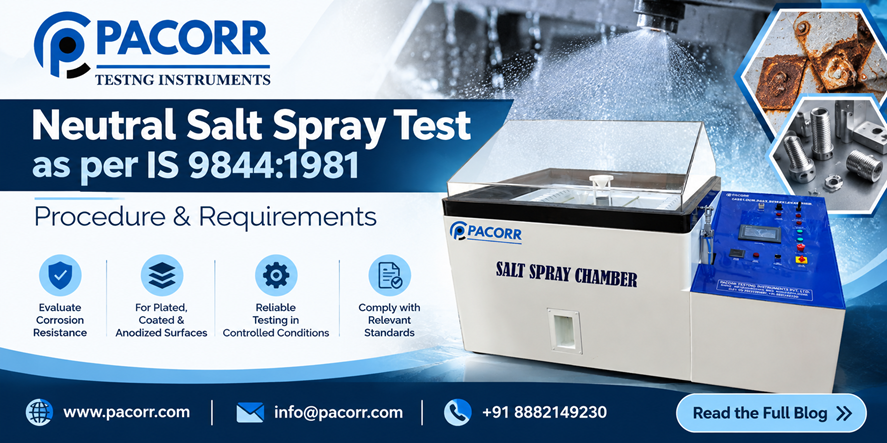
Pacorr's Salt Spray Chamber is an essential testing instrument designed to evaluate the corrosion resistance of materials, ensuring product durability and reliability. In today’s highly competitive industrial environment, corrosion testing has become crucial to guarantee the long-term performance of metals and coatings. Pacorr stands at the forefront of this industry, offering advanced Salt Spray Chambers to accurately assess corrosion levels under controlled, simulated environmental conditions.
Understanding the Salt Spray Chamber
A Salt Spray Chamber, also known as a Salt Fog Chamber, is an enclosed testing apparatus designed to evaluate how well materials resist corrosion under harsh, salt-laden environments. Pacorr's Salt Spray Chamber precisely replicates these corrosive conditions to help manufacturers determine the effectiveness of protective coatings, finishes, and treatments applied to metal components and products.
Core Functions of Pacorr Salt Spray Chamber
Controlled Corrosive Environment
Pacorr's Salt Spray Chamber meticulously recreates marine and coastal atmospheres by dispersing a fine mist of saltwater (typically sodium chloride solution) within a sealed environment. The test conditions, including temperature, humidity, and salt concentration, are accurately controlled and monitored. This consistency ensures reliable, repeatable, and compliant testing outcomes.
Corrosion Evaluation
The primary function of Pacorr’s Salt Spray Chamber is to detect potential corrosion on metals, coatings, and other protective layers. The controlled corrosive environment accelerates natural corrosion processes, enabling rapid and accurate assessment of material durability. Through this testing, manufacturers can proactively address corrosion issues, thereby preventing premature failures and costly product recalls.
Durability Testing
Another critical function of Pacorr's Salt Spray Chamber is to assess the durability of coatings and surface treatments. Whether testing galvanization, anodization, paint, or powder coatings, this equipment offers precise insights into how long a protective layer can maintain its effectiveness in resisting corrosion under specific conditions.
Key Benefits of Using Pacorr’s Salt Spray Chamber
Enhanced Product Quality
By using Pacorr's Salt Spray Chamber, manufacturers significantly enhance product quality and reliability. Identifying corrosion weaknesses before market release allows companies to improve product designs, adjust material selection, or enhance coating processes, ensuring better overall product quality and longevity.
Cost Efficiency
Corrosion damage can result in significant financial loss due to product recalls, warranty claims, and damage to brand reputation. Pacorr's Salt Spray Chamber helps minimize these risks by identifying potential problems early in the production process, ultimately leading to substantial cost savings and improved profitability.
Compliance with Industry Standards
Pacorr’s Salt Spray Chambers are engineered to adhere to rigorous international standards such as ASTM B117, ISO 9227, JIS Z 2371, and DIN 50021. Compliance with these globally recognized standards ensures manufacturers meet quality assurance requirements across various industries, including automotive, aerospace, electronics, and marine sectors.
Accelerated Testing and Fast Results
Traditional corrosion tests can take months or even years to yield meaningful results. Pacorr’s Salt Spray Chamber accelerates the corrosion process, delivering actionable insights within days or weeks. This swift testing cycle enables companies to rapidly iterate designs, streamline development timelines, and maintain competitive market positions.
Consistency and Repeatability
Pacorr's Salt Spray Chambers ensure consistent and repeatable results through precise control of test parameters. Automation and advanced sensor technologies maintain stable environmental conditions, eliminating human errors and variability in test outcomes. Such accuracy and reliability foster confidence among engineers, product designers, and quality control professionals.
Applications Across Industries
Automotive Industry
Corrosion resistance testing is vital in automotive manufacturing, where vehicles frequently encounter harsh environmental conditions. Pacorr's Salt Spray Chamber helps automotive companies evaluate the longevity of car bodies, chassis, components, and protective coatings, ensuring vehicles remain reliable and corrosion-free over extended periods.
Aerospace and Aviation
In aerospace applications, corrosion resistance is critical to maintaining structural integrity and safety. Pacorr’s Salt Spray Chamber supports rigorous testing of aircraft components, fuselage coatings, and other critical elements, ensuring compliance with stringent aerospace standards and enhancing overall safety.
Electronics and Electrical Equipment
Electronic devices exposed to salty or humid conditions are vulnerable to corrosion-induced failures. Pacorr’s Salt Spray Chamber allows manufacturers to rigorously test protective coatings and materials, ensuring electronic products withstand corrosive environments, particularly for outdoor or marine applications.
Marine and Shipping Industry
Given the naturally corrosive marine environment, maritime products require stringent corrosion resistance testing. Pacorr’s Salt Spray Chamber evaluates coatings and materials used in shipbuilding, offshore installations, and marine equipment, significantly extending their operational lifespan.
Tips for Effective Salt Spray Testing
- Ensure regular calibration and maintenance of the Salt Spray Chamber for accurate results.
- Follow recommended test durations and standardized conditions as specified by industry standards.
- Carefully document test procedures, conditions, and results to ensure traceability and reproducibility.
- Regularly inspect and maintain the quality of the salt solution and chamber cleanliness for consistent testing outcomes.
Conclusion
Pacorr’s Salt Spray Chamber is an invaluable asset for industries that prioritize quality, reliability, and compliance. By providing precise, reliable, and accelerated corrosion resistance testing, Pacorr empowers companies to deliver superior products, maintain competitive advantages, and significantly reduce corrosion-related risks and costs. With Pacorr’s advanced testing equipment, companies can confidently innovate and bring durable, high-quality products to market.
Recent Blogs
Enhance your understanding of testing and precise quality control indistinct applications with our
knowledge based articles coming from top editors of industry leaders.
Our USP's
Demonstration of Machine
- Try Before You Decide
- Experience Before You Invest
- See It in Action – Free Demo
Global Reach
- Delivering Excellence Worldwide
- Serving Across Borders
- Your Global Supply Partner
On-Site Support
- Support That Comes to You
- On-Ground Assistance, Anywhere
- We Reach Where You Are
Team Strength
- Powered by Expert Minds
- Driven by Skilled Professionals
- Engineering Excellence Team
Manufacturing
- Precision-Driven Manufacturing
- Smart & Automated Production
- Engineered In-House Excellence
