Pacorr recognizes that corrosion is one of the most persistent challenges in the metal industry. Whether the product is a coated steel panel, a plated fastener, a fabricated component, or an automotive part, exposure to moisture and salt can gradually weaken the surface, damage protective finishes, and reduce service life. This is why corrosion testing has become a necessary part of product development and quality assurance.
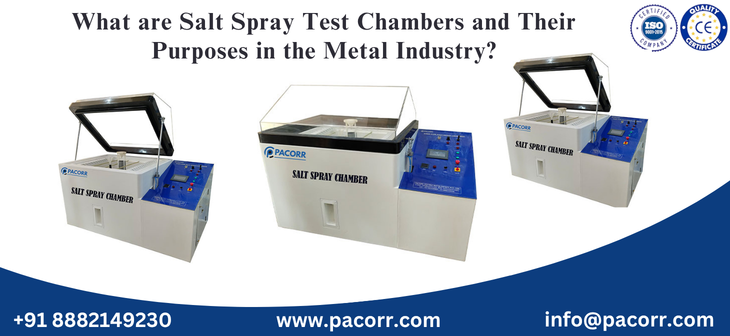
A Salt Spray Chamber is one of the most widely used systems for evaluating how metals and surface coatings respond to a corrosive environment. It allows manufacturers and QA professionals to simulate salt-laden conditions inside a controlled laboratory setting, making it easier to compare coating performance, detect weaknesses, and assess product durability in less time than natural outdoor exposure would require.
In simple terms, a salt spray test chamber helps answer an important industrial question: How well will this metal part or protective coating resist corrosion over time? For industries that depend on consistency, durability, and compliance, this type of testing is an important part of material validation.
What is a Salt Spray Chamber?
A Salt Spray Chamber is a specialized environmental testing chamber designed to create a fine mist of saline solution around test specimens. This mist, often referred to as salt fog, accelerates corrosion on metal surfaces so engineers can study how a material or coating behaves under harsh conditions.
The chamber is commonly used for testing:
- Painted metal surfaces
- Powder-coated products
- Zinc-plated and galvanized components
- Aluminum and alloy parts
- Industrial hardware and fasteners
- Automotive and engineering parts
A salt spray tester is especially useful when companies need to compare the corrosion resistance of different finishes, pretreatment methods, plating thicknesses, or coating systems. It provides a repeatable and controlled environment, which helps laboratories generate consistent results from one test to another.
This method is also closely associated with ASTM B117 testing, a widely recognized procedure used in corrosion testing programs. In industrial labs, the corrosion test chamber is considered essential corrosion analysis equipment because it helps turn durability concerns into measurable data.
Importance of Salt Spray Test Chamber in Corrosion Testing
Corrosion is costly. It can lead to rejected batches, poor field performance, higher maintenance costs, and reduced customer confidence. In industries where metal reliability matters, it is not enough to assume a coating will perform well. It has to be tested.
That is where a salt spray test chamber becomes valuable.
By accelerating corrosion under controlled conditions, the chamber helps businesses:
- Evaluate the protective quality of coatings and finishes
- Compare material performance before final selection
- Check consistency between production batches
- Validate supplier quality
- Reduce the risk of premature product failure
- Support quality control and product development decisions
For QA teams and engineers, corrosion resistance testing is not just about spotting rust. It is about understanding how a surface treatment performs when exposed to aggressive conditions over time. A part may look acceptable when newly manufactured, but hidden weaknesses in coating adhesion, plating quality, or surface preparation may appear during testing.
A salt fog test can reveal these issues early, when corrective action is still practical and less expensive. That is why this test is widely used as part of metal durability testing in manufacturing and engineering industries.
Key Features of a Salt Spray Tester
A reliable salt spray tester must create and maintain stable test conditions. The accuracy of the result depends on the consistency of the chamber environment.
Important features typically found in a high-quality Salt Spray Chamber include:
- Precise temperature control
- Uniform salt fog generation
- Durable, corrosion-resistant chamber construction
- Easy specimen placement and rack arrangement
- Clear digital controls for test settings
- Stable air pressure regulation
- Reliable spray atomization system
- Safe and continuous operation for long test cycles
The performance of the chamber matters because corrosion testing is highly sensitive to environmental stability. Even small fluctuations in temperature, fog distribution, or salt concentration can affect the outcome.
For this reason, good industrial testing instruments are designed to deliver repeatable test conditions with minimal operator variation. In a professional setting, this improves confidence in the results and supports better decision-making.
If your team is evaluating corrosion testing requirements, Pacorr can help you understand which Salt Spray Chamber configuration is best suited for your product type, testing volume, and application.
Working Principle of a Salt Spray Chamber
To understand the value of this equipment, it helps to know how a salt spray chamber works.
The operating principle is based on creating a controlled corrosive atmosphere using a salt solution and compressed air. The process generally follows these steps:
1. Preparation of Salt Solution
A salt solution is prepared using purified water and sodium chloride according to the test requirement.
2. Filling the Reservoir
The prepared solution is poured into the chamber’s solution tank or reservoir.
3. Atomization of Salt Mist
Compressed air passes through the spray nozzle and atomizes the solution into a fine mist. This creates the salt fog test environment inside the cabinet.
4. Exposure of Specimens
Test samples are placed inside the chamber in a fixed position so they receive uniform exposure to the salt fog.
5. Controlled Test Conditions
The chamber maintains the required temperature and exposure conditions throughout the test cycle.
6. Inspection After Exposure
At the end of the test, the samples are inspected for visible signs of corrosion such as rust formation, pitting, blistering, staining, coating delamination, or edge failure.
This controlled process makes a corrosion test chamber useful for comparing performance between different materials and coatings. Instead of waiting for months of outdoor exposure, manufacturers can gain practical comparative data in a shorter time frame.
Applications of Corrosion Test Chambers Across Industries
The use of corrosion test chambers is not limited to one field. They are used wherever metal parts must resist corrosion during storage, transport, or end use.
Automotive Industry
Automotive parts such as brackets, fasteners, underbody components, trims, and coated panels are commonly tested to evaluate finish durability and corrosion resistance.
Metal Finishing Industry
Electroplated, galvanized, anodized, and powder-coated products are often tested in a salt spray test chamber to compare finish quality and process consistency.
Construction and Infrastructure
Products such as railings, supports, fittings, poles, clamps, and structural hardware may be tested to assess long-term exposure performance.
Marine Applications
Metal parts used in coastal and marine environments are especially vulnerable to corrosion. Salt spray testing helps assess surface protection before field use.
Aerospace and Engineering
High-performance metal parts and assemblies often undergo corrosion resistance testing to ensure reliable performance in demanding environments.
Electronics and Electrical Components
Connectors, enclosures, housings, and metallic fittings are often exposed to humid or corrosive conditions and benefit from accelerated corrosion testing.
Across these sectors, the role of the Salt Spray Chamber is the same: to provide a repeatable way to study corrosion behavior and support better material decisions.
How to Choose the Right Salt Spray Test Chamber
Choosing the right salt spray test chamber requires attention to both technical and practical factors. The right chamber should fit your testing needs, not just your budget.
Here are some important points to consider:
Chamber Size
Choose a size based on the dimensions and number of samples you test regularly.
Test Standard Compatibility
Make sure the chamber supports your required procedures, including ASTM B117 testing if applicable.
Control Accuracy
Stable temperature and consistent fog generation are essential for dependable results.
Build Quality
Because the chamber operates in a corrosive environment, the materials of construction should be durable and resistant to long-term wear.
Ease of Use
A clear control panel, accessible tank design, and easy maintenance can improve daily lab efficiency.
Repeatability
For meaningful comparison, the chamber must produce consistent results across repeated test cycles.
Service Support
Technical support, calibration guidance, and maintenance assistance are valuable, especially for industrial labs with regular testing schedules.
When selecting corrosion analysis equipment, the goal should be reliable performance over time. A poorly matched system may create inconsistent data, increase downtime, or make testing more difficult than necessary.
Why Choose Pacorr for Salt Spray Testing Solutions
Pacorr offers Salt Spray Chamber solutions designed for industries that need practical, repeatable, and efficient corrosion testing. For manufacturers and laboratories, the real value of a testing instrument lies in its ability to support daily operations while delivering trustworthy results.
Pacorr’s approach to salt spray testing is relevant for organizations that need:
- Controlled corrosion testing for coated and plated metal parts
- User-friendly systems for quality control and R&D labs
- Testing support for routine product comparison and durability evaluation
- Reliable instruments for ongoing metal durability testing
- Equipment suited to industrial environments and regular use
From an informational standpoint, choosing the right supplier is about more than buying a machine. It is about finding a partner who understands the application, the testing objective, and the practical needs of industrial users. That is where experience, support, and application understanding become important.
Conclusion
A Salt Spray Chamber is an important testing system for understanding how metal products and protective finishes perform in corrosive conditions. It helps manufacturers evaluate coatings, compare surface treatments, identify potential failure points, and make more informed decisions about product durability.
In the metal industry, where corrosion can directly affect performance, quality, and reputation, a salt spray tester provides a practical way to perform accelerated corrosion resistance testing under controlled conditions. It remains one of the most widely used forms of corrosion test chamber technology because it is simple in concept, valuable in practice, and highly relevant across industrial sectors.
If you are planning to improve your corrosion testing process or select the right Salt Spray Chamber for your lab, Pacorr can help you explore the most suitable solution for your application.
Contact Pacorr
Email: info@pacorr.com
Phone: +91 8882149230
FAQs
What is a salt spray test chamber used for?
A salt spray test chamber is used to evaluate the corrosion resistance of metals, coatings, and plated surfaces by exposing them to a controlled salt fog environment. It helps manufacturers compare finishes and identify weaknesses before products are released.
How does a salt spray tester work?
A salt spray tester works by converting a salt solution into a fine mist inside a controlled chamber. The mist settles on the test specimen over time, allowing engineers to assess corrosion, coating breakdown, and overall surface durability.
What is ASTM B117 testing?
ASTM B117 testing is a commonly used method for generating a neutral salt fog environment for corrosion testing. It is widely used to evaluate the relative corrosion resistance of coated and metallic specimens in a controlled laboratory setting.
Why is a Salt Spray Chamber important in corrosion testing?
A Salt Spray Chamber is important because it helps detect corrosion-related issues early in product development or quality control. It supports faster evaluation of coatings and metal finishes without waiting for long-term natural exposure.
What industries use corrosion test chambers?
Corrosion test chambers are used in automotive, aerospace, construction, marine, electronics, metal finishing, and manufacturing industries. They are valuable in any field where metal parts need proven durability and corrosion resistance.
How long does a salt fog test usually take?
A salt fog test may last from several hours to many days, depending on the material, coating, and testing requirement. The duration is usually selected according to the product specification or quality standard being followed.
How do I choose the right salt spray chamber?
To choose the right salt spray chamber, consider chamber size, testing standard compatibility, control accuracy, construction quality, maintenance ease, and repeatability. The best option is one that fits your sample load and testing objectives.
Recent Blogs
Enhance your understanding of testing and precise quality control indistinct applications with our
knowledge based articles coming from top editors of industry leaders.
Our USP's
Demonstration of Machine
- Try Before You Decide
- Experience Before You Invest
- See It in Action – Free Demo
Global Reach
- Delivering Excellence Worldwide
- Serving Across Borders
- Your Global Supply Partner
On-Site Support
- Support That Comes to You
- On-Ground Assistance, Anywhere
- We Reach Where You Are
Team Strength
- Powered by Expert Minds
- Driven by Skilled Professionals
- Engineering Excellence Team
Manufacturing
- Precision-Driven Manufacturing
- Smart & Automated Production
- Engineered In-House Excellence
