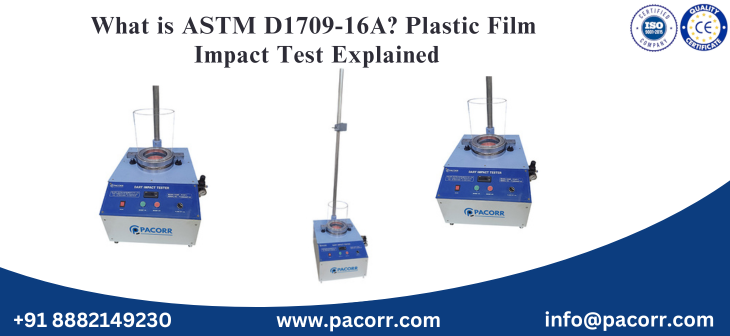
Pacorr understands that plastic film impact testing is a critical part of ensuring packaging materials can withstand real-world handling, storage, and transportation. In industries where plastic films are used for wrapping, sealing, and protecting products, even a minor failure can lead to damage, waste, and customer complaints. That is why the dart impact tester plays such an important role in modern plastic film testing, helping manufacturers measure film toughness, improve quality, and meet recognized standards such as ASTM D1709-16A.
Understanding ASTM D1709-16A
ASTM D1709-16A is a standard test method used to determine the impact resistance of plastic film by the free-falling dart method. In simple terms, it measures the amount of impact energy needed to cause a plastic film specimen to fail under controlled conditions. The result is expressed as the weight or mass of the dart that produces failure in 50% of the tested specimens.
This ASTM D1709 standard is widely used in the plastic film and packaging sectors because it gives manufacturers a practical way to evaluate film durability. It is especially valuable for films used in flexible packaging, industrial wrapping, food packaging, agricultural film, and other applications where puncture or impact resistance matters.
Why Plastic Film Impact Testing Matters
Plastic films are expected to perform under many different conditions. During packaging, shipping, stacking, and unloading, films may face accidental drops, sharp impacts, or concentrated loads. If the material is too weak, it can puncture or tear, putting the product inside at risk.
This is where plastic film testing becomes essential. A properly conducted dart impact test method helps manufacturers:
- Evaluate the toughness of plastic films
- Compare the performance of different film grades
- Maintain consistency in production
- Reduce packaging failures in transit
- Support compliance with industry and customer specifications
For quality control teams, the dart impact tester is not just a lab instrument. It is a decision-making tool that helps verify whether the film being produced is strong enough for its intended use.
What Is the Purpose of ASTM D1709-16A?
The main purpose of ASTM D1709-16A is to measure the impact resistance of plastic films under specified test conditions. The standard explains that the test determines the energy that causes the film to fail when struck by a falling dart. It also notes that Test Methods A and B are used to establish the dart weight at which 50% of specimens fail.
Key Objectives of the Test
1. Determine Film Strength Under Impact
The test simulates a sudden impact event and shows how much force the film can tolerate before rupturing.
2. Support Material Comparison
Manufacturers can compare raw materials, film structures, and processing conditions using a consistent method.
3. Improve Packaging Quality Testing
The results help companies optimize film formulations and ensure reliable performance in end-use conditions.
ASTM D1709-16A Test Methods: Method A and Method B
One important point about the ASTM D1709 standard is that it includes two different test methods: Method A and Method B. These methods differ in dart and test conditions, and the results from one method cannot be directly compared with the other. ASTM also notes that results depend on factors such as film quality, thickness uniformity, contaminants, and specimen condition.
For example, industry references describing ASTM D1709 note that the dart head diameter for Method A is 38.1 ± 0.13 mm, while for Method B it is 50.8 ± 0.13 mm.
In many routine packaging applications, Method A is commonly discussed, which is why ASTM D1709-16A is often referenced in relation to plastic packaging film performance testing.
How the Dart Impact Test Method Works
The dart impact test method is designed to be systematic and repeatable. Although exact setup details should always follow the standard and the instrument manual, the basic procedure is easy to understand.
Step 1: Prepare the Film Specimen
A sample of plastic film is cut and mounted securely in the test fixture. The specimen must be flat, properly clamped, and free from visible defects that could distort the result.
Step 2: Select the Dart and Weight
A dart with the required dimensions is used. The operator selects an initial weight based on the expected strength of the film.
Step 3: Drop the Dart from a Specified Height
The dart is released from the required height so it falls freely onto the film specimen.
Step 4: Observe Failure or Non-Failure
The operator checks whether the film failed, such as by rupturing or tearing, after impact.
Step 5: Adjust the Weight Using the Staircase Approach
ASTM D1709 is commonly described as a staircase method. After each drop, the dart mass is increased or decreased depending on whether the specimen failed, until enough results are collected to calculate the impact failure level associated with 50% failure.
This method makes the dart impact tester highly useful for both product development and routine packaging quality testing.
Significance of ASTM D1709-16A in the Packaging and Plastic Film Industry
In the packaging world, strength alone is not enough. Films must combine flexibility, puncture resistance, sealability, and overall durability. A film that looks acceptable in basic thickness checks may still fail during transport if its impact resistance is poor.
That is why ASTM D1709-16A remains so relevant. It helps manufacturers and quality assurance professionals:
- Validate packaging film performance before market release
- Control variation between production batches
- Reduce the risk of damaged goods and returns
- Demonstrate compliance with recognized testing practices
- Build confidence with customers who require standardized test data
The standard also points out that impact resistance does not have a simple correlation with thickness alone, which means thickness data by itself cannot reliably predict actual impact performance.
How a Pacorr Dart Impact Tester Supports Quality and Compliance
A Pacorr dart impact tester is designed to help manufacturers carry out accurate, repeatable, and efficient plastic film testing in line with recognized industry requirements. When companies need to verify the toughness of flexible films, a dependable testing instrument becomes essential.
With a Pacorr Dart Impact Tester, laboratories and production units can:
Achieve Reliable Test Results
Consistent testing conditions help reduce operator error and improve confidence in the measured film performance.
Strengthen Quality Control
Routine testing allows manufacturers to detect material inconsistencies before products reach customers.
Improve Durability Assessment
By understanding how films respond to impact, companies can refine materials for better real-world performance.
Support Standard-Based Testing
Using a quality dart impact tester helps organizations align their testing process with standards such as ASTM D1709-16A, which is important for compliance-driven industries and export-oriented manufacturers.
For engineers and QC professionals, this means better control over film quality, stronger packaging reliability, and more informed production decisions.
Who Should Use a Dart Impact Tester?
A dart impact tester is valuable for a wide range of industries, including:
- Flexible packaging manufacturers
- Plastic film producers
- Food and pharmaceutical packaging companies
- Quality control laboratories
- R&D teams developing new film structures
- Exporters requiring standardized packaging quality testing
Wherever film durability matters, the Pacorr dart impact tester can help ensure performance and consistency.
Final Thoughts
ASTM D1709-16A is an important benchmark for measuring the impact resistance of plastic films through the free-falling dart method. For companies involved in plastic film testing, understanding this standard is essential for improving product quality, reducing packaging failures, and meeting customer expectations. A reliable dart impact tester enables manufacturers to carry out accurate evaluations, strengthen quality assurance, and support compliance with the ASTM D1709 standard.
If your business is looking to improve packaging quality testing and ensure the durability of plastic films, Pacorr is here to help. To learn more about the Pacorr Dart Impact Tester or to discuss your testing requirements, contact Pacorr today at +91 8882149230 or email info@pacorr.com.
Recent Blogs
Enhance your understanding of testing and precise quality control indistinct applications with our
knowledge based articles coming from top editors of industry leaders.
Our USP's
Demonstration of Machine
- Try Before You Decide
- Experience Before You Invest
- See It in Action – Free Demo
Global Reach
- Delivering Excellence Worldwide
- Serving Across Borders
- Your Global Supply Partner
On-Site Support
- Support That Comes to You
- On-Ground Assistance, Anywhere
- We Reach Where You Are
Team Strength
- Powered by Expert Minds
- Driven by Skilled Professionals
- Engineering Excellence Team
Manufacturing
- Precision-Driven Manufacturing
- Smart & Automated Production
- Engineered In-House Excellence
