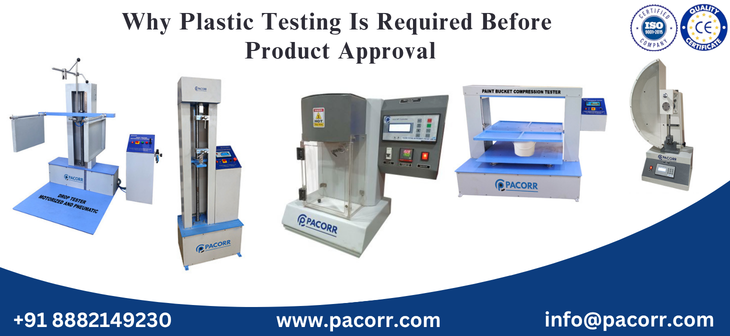
Pacorr helps manufacturers, converters, packaging companies, and quality professionals make confident product approval decisions through reliable Plastic Testing Instruments and advanced Polymer Testing Instruments. In today’s competitive industrial environment, product approval is not just a checkpoint. It is a technical validation process that confirms whether a plastic product is safe, durable, process-ready, and compliant with expected performance standards.
Plastic materials are used across packaging, automotive, consumer goods, construction, electronics, pharmaceuticals, and many other sectors. But every plastic product behaves differently depending on resin type, additives, processing parameters, thickness, environmental conditions, and end-use demands. A product that looks perfect on the production line may still fail during storage, transportation, sealing, loading, impact, or customer use.
That is exactly why plastic material testing is required before approval. Manufacturers need measurable data to verify that the material can perform under real-world conditions. This includes checking strength, flexibility, melt behavior, toughness, compression resistance, and overall consistency. With the help of the right Plastic Testing Equipment and Polymer Testing Equipment, companies can reduce rejection rates, improve quality assurance, protect brand reputation, and bring better products to market faster.
In simple terms, without testing, approval becomes guesswork. With testing, approval becomes evidence-based.
What is Plastic Testing Instruments / Polymer Testing Instruments
Plastic Testing Instruments and Polymer Testing Instruments are specialized machines designed to assess the physical, mechanical, thermal, and processing characteristics of plastic and polymer materials. These instruments play a critical role in quality control, R&D, process optimization, raw material inspection, and final product validation.
The main purpose of Plastic Material Testing Instruments is to determine whether a plastic sample meets the required technical specifications before it is approved for production, packaging, distribution, or customer use. These instruments generate accurate data that helps manufacturers judge the quality, consistency, and suitability of the material for a specific application.
Typical properties measured using Plastic Testing Equipment include:
- Tensile strength and elongation
- Melt flow rate
- Compression strength
- Impact resistance
- Load-bearing performance
- Hardness
- Heat resistance
- Burst strength
- Seal integrity
- Dimensional stability
For example, if a packaging company is producing PET bottles, it may need to confirm bottle top load capacity, wall strength, and stress resistance. If a polymer processor is manufacturing molded components, it may need melt flow index testing and tensile testing of plastic to ensure process consistency and product strength.
This is where industrial testing instruments become essential. They help transform material behavior into testable, reportable, and approval-ready values.
Importance of Plastic Testing Instruments in Quality Testing
The role of Plastic Testing Instruments in quality testing is central to product approval because quality cannot be verified visually alone. A plastic product may appear defect-free and still fail due to weak mechanical properties, poor melt consistency, or low impact strength.
They validate product performance
A product must perform not only in the factory but also in real-life use. Polymer quality testing ensures that the plastic material can withstand handling, pressure, stress, stacking, transport, and environmental exposure.
They reduce product rejection and field failures
Without proper testing, businesses risk market complaints, damaged goods, returns, and product recalls. Using dependable Plastic Testing Equipment helps catch problems early, before they become costly.
They support regulatory and customer compliance
Many industries require plastic products to meet internal QA benchmarks and external testing standards. Reliable quality control testing equipment helps maintain traceable documentation for audits, approvals, and customer specifications.
They improve production consistency
Even with the same resin grade, minor changes in temperature, machine settings, or batch formulation can influence product behavior. Testing helps identify variation and maintain consistent output.
They strengthen brand credibility
Customers trust suppliers who deliver quality products consistently. Testing supports this trust by ensuring that each approved product meets expected performance levels.
They help optimize material selection
Different plastic grades behave differently. Plastic material testing helps engineers and buyers choose the right material for the right application based on data rather than assumption.
For businesses that want fewer failures, better compliance, and stronger market credibility, investing in the right Polymer Testing Instruments is not just a quality move. It is a business decision.
Key Features of Plastic Testing Instruments
Modern Plastic Testing Instruments are built to provide fast, accurate, repeatable, and user-friendly testing for plastic and polymer products. The best systems do more than test samples. They improve lab efficiency, support documentation, and simplify quality decisions.
Important features to look for in Polymer Testing Equipment include:
- High testing accuracy
- Repeatable results across multiple samples
- Digital controls and smart display systems
- Rugged industrial design
- User-friendly operation
- Standard-based testing capability
- Fast sample handling
- Easy calibration and maintenance
- Data storage and reporting support
Different types of Plastic Testing Equipment serve different testing needs.
Tensile testing instruments
These are used for tensile testing of plastic to measure tensile strength, yield point, elongation, and material deformation. They are widely used for plastic films, sheets, molded components, and flexible materials.
Melt flow index testers
These are used for melt flow index testing, which helps determine how easily a polymer flows under heat and load. This is essential for process control in molding and extrusion.
Impact testers
These instruments are used for impact resistance testing to evaluate the ability of plastic materials to absorb sudden force without cracking or breaking.
Compression and top load testers
These systems are especially important for bottles, jars, and rigid packaging. They help test how much vertical force a product can withstand during storage and transport.
Seal strength and burst testers
These are highly useful in packaging applications where sealed plastic products must resist leakage, bursting, and pressure-related failure.
The right combination of Plastic Material Testing Instruments gives manufacturers a stronger basis for approval, performance verification, and process reliability.
Looking for the right Plastic Testing Instruments for your packaging or polymer application? Pacorr offers application-specific solutions backed by technical expertise. Contact us at info@pacorr.com or call +91 8882149230 for expert guidance.
Working Principle of Plastic Testing Instruments
The working principle of Plastic Testing Instruments is based on applying controlled mechanical, thermal, or process-related conditions to a material sample and measuring how the sample reacts. The results are then used to evaluate whether the product meets predefined quality and performance standards.
Mechanical testing
In tests such as tensile, compression, and flexural analysis, the sample is placed inside the instrument and subjected to a controlled force. Load cells and sensors measure the amount of force applied and the degree of deformation.
In tensile testing of plastic, the sample is pulled at a defined speed until it stretches or breaks. The instrument records values such as tensile strength, elongation at break, and modulus.
Flow testing
In melt flow index testing, the polymer is heated to a set temperature inside the barrel of the tester. A standard load is applied, and the molten material flows through a die. The flow rate indicates the processing behavior of the polymer and helps check material consistency.
Impact testing
For impact resistance testing, the plastic sample is exposed to a sudden strike or force. The equipment measures the amount of energy absorbed before failure. This indicates material toughness and resistance to cracking.
Compression and load testing
In packaging applications, containers or test samples are subjected to vertical compression or top load. The system records the force at which deformation starts or failure occurs. This is especially useful in bottle and packaging validation.
Thermal testing
Thermal plastic testing checks how polymer materials behave under elevated or reduced temperatures. These tests are important when the product is expected to perform in hot-fill, transport, outdoor, or temperature-sensitive environments.
The principle is simple but highly valuable: controlled testing creates objective data, and objective data supports faster and safer product approval.
Applications of Plastic Testing Instruments in Different Industries
The use of Plastic Testing Instruments in different industries continues to grow because nearly every sector depends on reliable polymer performance.
Packaging industry
The packaging industry is one of the biggest users of packaging testing equipment and Plastic Testing Equipment. Plastic bottles, films, containers, pouches, caps, and trays must withstand compression, drop stress, sealing forces, and transportation conditions.
Key tests include:
- Top load testing
- Compression testing
- Seal strength testing
- Burst testing
- Melt flow index testing
- Thickness and performance checks
Automotive industry
Automotive plastic parts must offer strength, impact resistance, dimensional stability, and heat endurance. Polymer Testing Instruments are used for dashboards, trims, clips, housings, and under-the-hood components.
Consumer goods industry
Storage products, toys, household plastics, and appliance components need to perform consistently in daily use. Plastic material testing helps reduce cracking, deformation, and customer complaints.
Medical and pharmaceutical industry
Plastic packaging and components used in healthcare require strict validation. Testing helps verify structural integrity, consistency, and suitability for sensitive applications.
Electronics industry
Plastic casings, insulators, and connectors in electronics must handle mechanical and thermal demands. Industrial testing instruments help verify their reliability before approval.
Construction industry
Pipes, insulation products, panels, and fittings made from plastic must withstand pressure, environmental exposure, and load conditions. Testing ensures these materials are fit for use.
Polymer manufacturing and compounding
Resin and compound producers rely heavily on Polymer Testing Equipment to validate raw materials, confirm batch consistency, and support customer requirements.
Across all these industries, testing is not just a lab activity. It is a quality safeguard and a market-enabling tool.
How to Choose the Right Plastic Testing Instruments
Choosing the right Plastic Testing Instruments is critical because the wrong equipment may produce incomplete or irrelevant data. A smart selection process helps businesses improve approval speed, quality accuracy, and return on investment.
Understand your product type
Start by identifying whether you are testing plastic films, rigid containers, molded parts, granules, sheets, pipes, or packaging materials. Different products require different Plastic Testing Equipment.
Define the properties that matter most
Your testing requirement depends on what the product must achieve.
- For strength and elongation, choose tensile testing systems
- For processability, choose melt flow index testers
- For toughness, choose impact testers
- For bottles and packaging, choose top load or compression testers
- For sealed packs, choose burst and seal strength testers
Check industry standards
The instrument should support standard-based testing aligned with ASTM, ISO, or your customer’s approval criteria.
Focus on accuracy and repeatability
Reliable decisions need reliable data. High-quality quality control testing equipment provides repeatable performance over time.
Review ease of use
A machine with intuitive controls, quick setup, and digital reporting improves daily lab productivity and reduces operator error.
Evaluate supplier expertise
A supplier should understand the practical application of the instrument, not just the machine itself. This is where Pacorr adds value by recommending suitable systems based on real testing goals.
Think long term
Choose Polymer Testing Instruments that fit both current production needs and future quality expansion plans.
The right testing partner does more than supply equipment. They help build a stronger quality system.
Why Choose Pacorr for Plastic Testing Instruments
When businesses search for reliable Plastic Testing Instruments, they need a supplier that combines technical knowledge, consistent quality, and responsive support. Pacorr delivers that combination through application-focused testing solutions built for real industrial needs.
Application-driven expertise
Pacorr understands the challenges faced by packaging manufacturers, polymer processors, converters, and industrial quality teams. This makes it easier for customers to choose the right Plastic Testing Equipment without trial and error.
Reliable range of Polymer Testing Instruments
Pacorr offers advanced testing solutions for plastic material testing, packaging validation, strength testing, flow analysis, and performance verification. This helps companies manage multiple testing needs through a trusted brand.
Accuracy that supports approval decisions
Product approval depends on dependable results. Pacorr instruments are designed to deliver precise, repeatable, and quality-focused performance.
Strong support and service
From product consultation to installation and technical support, Pacorr works closely with customers to ensure they get the best value from their testing investment.
Built for modern quality control
Pacorr’s industrial testing instruments are developed to support production environments where speed, consistency, and quality reporting matter.
Trusted by quality-focused businesses
Manufacturers choose Pacorr when they want to reduce uncertainty, improve test confidence, and strengthen approval processes with better data.
If your business is serious about improving product validation, reducing material risk, and strengthening customer trust, Pacorr is the right partner for your testing requirements.
Conclusion
Plastic testing is required before product approval because product quality, process consistency, and market performance must be proven, not assumed. A plastic material may pass visual inspection and still fail under load, stress, impact, heat, or transport conditions. That is why Plastic Testing Instruments, Polymer Testing Instruments, Plastic Testing Equipment, Polymer Testing Equipment, and Plastic Material Testing Instruments play such a vital role in quality assurance.
From tensile testing of plastic and melt flow index testing to impact resistance testing and packaging performance evaluation, every test helps manufacturers make safer, smarter, and more profitable decisions. Testing reduces risk, supports compliance, improves consistency, and protects brand reputation before the product reaches the market.
Pacorr empowers manufacturers with dependable, user-focused, and performance-driven testing solutions designed for modern plastic and packaging applications. If you are looking for a trusted source for polymer quality testing and quality control testing equipment, now is the right time to upgrade your approval process with Pacorr.
Connect with Pacorr today to find the right Plastic Testing Instruments for your quality goals. Email: info@pacorr.com | Phone: +91 8882149230
Frequently Asked Questions
1. Why are Plastic Testing Instruments required before product approval?
Plastic Testing Instruments are required before product approval because they confirm whether a plastic product meets strength, durability, safety, and performance requirements. They help manufacturers approve products based on real test data rather than assumptions.
2. What do Polymer Testing Instruments measure?
Polymer Testing Instruments measure properties such as tensile strength, elongation, melt flow rate, impact resistance, compression strength, hardness, and thermal behavior. These properties are essential in polymer quality testing.
3. Which Plastic Testing Equipment is commonly used in packaging?
Common Plastic Testing Equipment used in packaging includes top load testers, compression testers, burst strength testers, seal strength testers, and melt flow index testers. These help validate packaging performance and durability.
4. What is the purpose of melt flow index testing in plastic material testing?
Melt flow index testing is used to measure how easily molten polymer flows under standard heat and load conditions. It helps evaluate processability, consistency, and raw material quality before production approval.
5. Why is tensile testing of plastic important?
Tensile testing of plastic is important because it measures how much pulling force a plastic sample can withstand before deforming or breaking. It helps determine material strength and suitability for end-use applications.
6. How does impact resistance testing help in product approval?
Impact resistance testing shows how well a plastic product can resist sudden force or shock. This is important for products that may face rough handling, transport stress, or demanding field conditions.
7. How do I choose the best Plastic Material Testing Instruments for my business?
Choose Plastic Material Testing Instruments based on your product type, testing standards, critical performance requirements, and reporting needs. Working with an experienced supplier like Pacorr helps ensure the right fit for your application.
Recent Blogs
Enhance your understanding of testing and precise quality control indistinct applications with our
knowledge based articles coming from top editors of industry leaders.
Our USP's
Demonstration of Machine
- Try Before You Decide
- Experience Before You Invest
- See It in Action – Free Demo
Global Reach
- Delivering Excellence Worldwide
- Serving Across Borders
- Your Global Supply Partner
On-Site Support
- Support That Comes to You
- On-Ground Assistance, Anywhere
- We Reach Where You Are
Team Strength
- Powered by Expert Minds
- Driven by Skilled Professionals
- Engineering Excellence Team
Manufacturing
- Precision-Driven Manufacturing
- Smart & Automated Production
- Engineered In-House Excellence
