
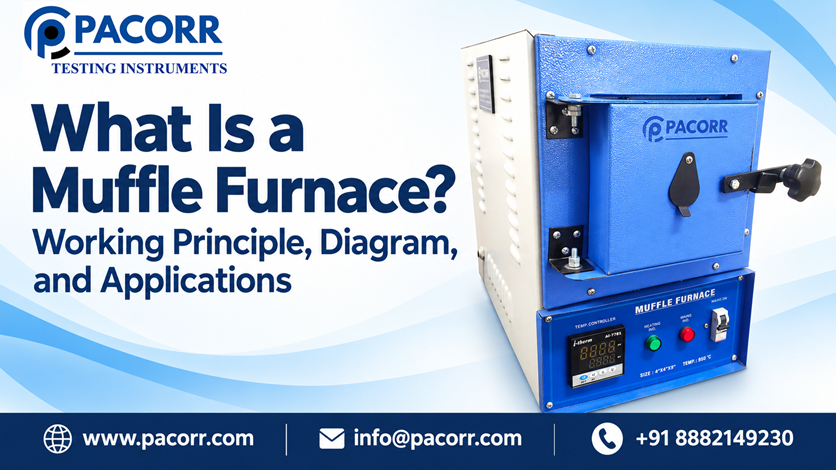
A muffle furnace is an insulated, high-temperature chamber used to heat samples under controlled conditions. Laboratory models commonly use electric resistance elements. Applications include ash-content determination, ignition tests, calcination and selected heat-treatment processes. The correct furnace depends on the test temperature, sample chemistry, atmosphere, chamber capacity and required temperature uniformity.
For a quality-control laboratory, reaching a high temperature is only part of the job. The heating cycle must also produce a result that can be repeated, compared with a specification and traced to a documented method. A furnace that removes organic material from one sample may give a misleading residue from another if the temperature or atmosphere is unsuitable.
This guide explains how a muffle furnace works, what its components do, where different industries use it, and how to choose and operate equipment for meaningful laboratory results.
In this guide
- Definition and atmosphere
- Working principle
- Diagram and components
- Types and heating elements
- Temperature selection
- Step-by-step workflow
- Ash calculation and interpretation
- Industrial applications
- Furnace and oven comparison
- Selection, troubleshooting and maintenance
- Frequently asked questions
What is a muffle furnace?
A muffle furnace surrounds a sample with a heated, insulated working chamber. Historically, the muffle separated the workpiece from fuel and combustion products. In modern electric laboratory equipment, resistance elements heat the chamber without a fuel flame contacting the sample.
The term is sometimes used broadly for laboratory chamber furnaces. Construction varies: some models separate elements from the working space behind refractory material, while others have elements exposed to the chamber. Buyers should check the actual chamber design instead of assuming that all products called muffle furnaces have identical construction.
Does a muffle furnace provide an oxygen-free environment?
No. A standard air-operated muffle furnace is not inherently oxygen-free, gas-tight or suitable for vacuum operation. Ashing generally needs oxygen to remove combustible material. Dedicated ashing equipment may provide managed air supply and exhaust, Nabertherm, for example, describes an air-management system that supplies oxygen during incineration.
If a process requires an inert gas, reducing conditions or vacuum, choose equipment designed and approved for that atmosphere. Closing a furnace door does not create those conditions. Likewise, separating the sample from a flame does not prevent contamination from dirty crucibles, previous samples or unsuitable chamber materials.
What is the working principle of a muffle furnace?
An electric muffle furnace converts electrical energy into heat through resistance elements. Heat passes to the chamber and sample, while a temperature sensor supplies feedback to the controller. The controller adjusts heater power to approach and maintain the programmed temperature.
Heat generation and transfer
The elements resist the flow of electrical current and become hot. Thermal radiation from hot surfaces becomes particularly important at elevated temperatures. Conduction transfers heat through the crucible and contact surfaces, while convection within the chamber also contributes. The balance depends on temperature and construction.
Insulation reduces heat loss through the furnace walls. It does not make every position inside the chamber identical in temperature. Loading density, door openings and the location of the sample can affect the conditions experienced by the material.
Temperature feedback and PID control
A thermocouple produces a signal related to temperature. A PID controller uses the difference between the measured temperature and the setpoint, together with the history and rate of change of that difference, to regulate heating power.
The controller reading describes conditions at the sensor location. A large crucible or dense sample can still be heating after the display reaches its target. For repeatable work, the method must define loading, stabilization and the start of the holding period.
Muffle furnace diagram and main components
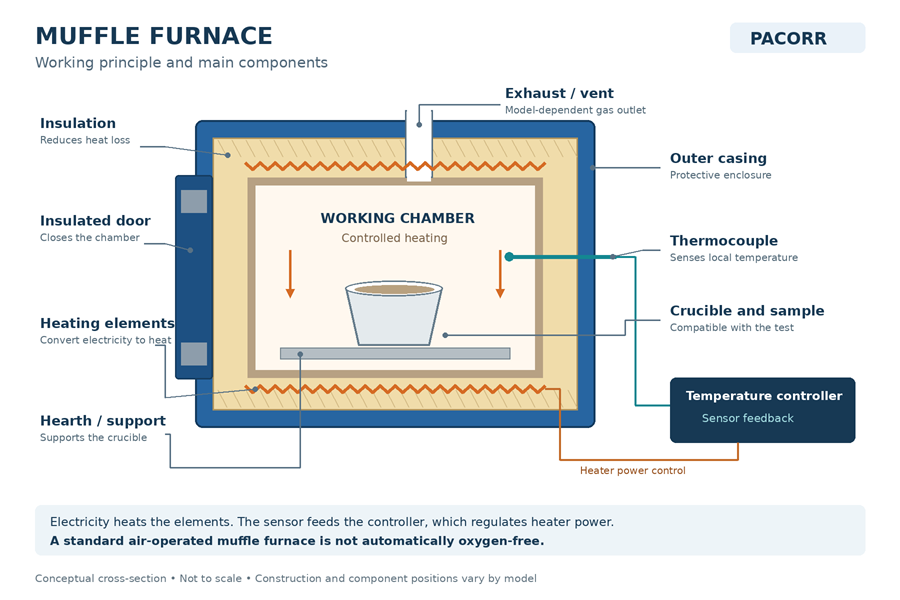
A muffle furnace contains an insulated working chamber, heating elements, a crucible support, a temperature sensor, a controller and an exhaust or vent appropriate to the design. The component table below explains their functions.
|
Component
|
Function
|
Why it matters
|
|---|---|---|
|
Working chamber and hearth
|
Hold crucibles and support the load
|
Material compatibility and usable space affect safe loading.
|
|
Heating elements
|
Convert electricity into heat
|
Element material limits temperature and atmosphere compatibility.
|
|
Insulation
|
Reduce heat escaping through the walls
|
Damage can increase losses and alter heating behaviour.
|
|
Thermocouple
|
Measure temperature at its installed position
|
Sensor drift can produce a stable but incorrect reading.
|
|
Controller and power switching
|
Regulate heater output
|
Available programming determines whether ramps and holds can be automated.
|
|
Door and protective devices
|
Contain heat and provide model-specific protection
|
Confirm interlocks and independent overtemperature protection rather than assuming they are fitted.
|
|
Vent or exhaust connection
|
Provide a path for gases
|
A furnace outlet alone is not a complete laboratory fume-control system.
|
Types of muffle furnace
Furnaces can be classified by heating source, application, element material or control system. These categories overlap: an ashing furnace can be electrically heated and programmable.
|
Type
|
Typical purpose
|
Selection question
|
|---|---|---|
|
General-purpose electric furnace
|
Routine laboratory heating and ignition work
|
Does its working range and uniformity meet the method?
|
|
Dedicated ashing furnace
|
Removal of combustible material before residue weighing
|
Is airflow and exhaust provision suitable for the sample load?
|
|
Programmable furnace
|
Cycles with controlled heating rates and multiple holds
|
How many program steps are available, and how is data recorded?
|
|
High-temperature furnace
|
Selected ceramic, mineral and materials-research processes
|
Are the chamber, elements and crucibles compatible with the required cycle?
|
|
Gas-fired muffle furnace
|
Specialized industrial heating with a separating chamber
|
What fuel, combustion control and exhaust infrastructure are required?
|
Heating-element materials
Metallic resistance alloys, including nickel-chromium and iron-chromium-aluminium alloys, serve many laboratory heating applications. Silicon carbide and molybdenum disilicide elements are used in equipment designed for higher temperatures. The material name alone does not specify the safe temperature of the complete furnace.
When comparing suppliers, ask for the chamber temperature rating, continuous operating limit and permitted atmosphere. An element's own temperature capability should never be presented as the guaranteed operating temperature of a finished furnace.
What temperature does a muffle furnace reach?
There is no single temperature range for every muffle furnace. General laboratory and specialist high-temperature models have different ratings. Pacorr's published PCMF-1 specification lists ambient-to-900°C and ambient-to-1200°C range options. These are equipment specifications, not recommended temperatures for every sample. [1]
Four temperature terms buyers should distinguish
- Maximum temperature: the upper rated limit under the manufacturer's stated conditions.
- Continuous operating temperature: the permitted temperature for sustained operation, which may be lower.
- Temperature stability: how much the temperature changes over time at a defined measurement point.
- Temperature uniformity: how much temperature differs between locations in a defined working volume.
Display resolution is different again. A display that changes in 1°C steps does not establish ±1°C measurement accuracy or chamber uniformity. Specify the tolerance required by the test, then request evidence that the selected configuration can achieve it.
Choose the test setpoint from the relevant method and material specification. Increasing temperature to finish faster can alter the residue, damage a crucible or change the property being measured. For work near a model's upper limit, confirm duty-cycle suitability before purchase.
How to use a muffle furnace: a controlled laboratory workflow
The following sequence explains the decisions involved. The approved test method, laboratory procedure and equipment manual determine the actual sample mass, loading temperature, heating rate, holding time and handling conditions.
- Define the measurement. Establish whether the test concerns ash, loss on ignition or a heat-treatment response. Confirm the required reporting basis and acceptance criteria before preparing the sample.
- Check compatibility and hazards. Review the material composition, expected decomposition products, crucible compatibility and required extraction. Unknown, reactive or hazardous materials require an approved procedure.
- Prepare the sample and crucible. Use representative sampling. Apply drying, conditioning and crucible pre-treatment only as required by the selected method. Record masses with a suitable balance.
- Inspect and load the furnace. Check the chamber, sensor area and door. Arrange crucibles within the qualified working space with appropriate separation. Keep the load clear of elements and sensors.
- Set the specified cycle. Enter the temperature, permitted heating rate and holding time. Some methods require staged heating or controlled preliminary treatment to prevent foaming and sample loss.
- Monitor the run. Record loading conditions, deviations and relevant temperature information. Avoid unnecessary door opening. Determine the holding-time start according to the procedure.
- Cool and handle correctly. Follow the manual and method. Use suitable tools and protective equipment, transfer to an appropriate desiccator only when permitted by the procedure and its temperature limits.
- Weigh, calculate and review. For gravimetric work, apply any prescribed repeat-heating and constant-mass checks. Investigate unusual results before releasing the report.
Ash-content testing: formula, example and interpretation
Ash testing measures the residue remaining after the sample undergoes a specified heating procedure. The result is meaningful only when the method, sample basis and conditions are known.
Ash (%) = [(m₂ − m₀) ÷ (m₁ − m₀)] × 100
- m₀: mass of the prepared empty crucible.
- m₁: mass of the crucible plus the initial test portion.
- m₂: mass of the crucible plus the final residue.
Worked example
Suppose an empty crucible weighs 28.420 g, the crucible plus sample weighs 33.420 g, and the crucible plus final residue weighs 28.670 g. The sample mass is 5.000 g and the residue mass is 0.250 g.
Ash = (0.250 ÷ 5.000) × 100 = 5.00%
This is an illustrative calculation, not a Pacorr test result or an acceptance limit. If the original mass includes moisture, the value is on the as-tested basis. A dry-basis result requires the appropriate dry sample mass or a method-approved moisture correction.
What the result does and does not show
For plastics, ASTM D5630 describes measurement of inorganic residue and explicitly distinguishes it from identifying individual ash constituents. It also notes that some filler systems do not yield an absolute filler-content result. [3] A residue percentage therefore should not be labelled a complete chemical analysis.
Two batches may have the same residue percentage yet contain different fillers. Conversely, different results may arise from moisture, incomplete combustion, contamination or a change in the heating method rather than a formulation change. Compare results only after confirming that the procedures are comparable.
Relevant test standards
ASTM D5630 addresses ash content in plastics. ISO 3451-1:2026 provides general methods for determining ash in plastics and points to material-specific parts of the series. [3] [4] Use the edition required by the customer or specification and obtain the full method. Naming a standard does not establish that every furnace, material or test cycle complies with it.
What is a muffle furnace used for in different industries?
The same heating equipment can support different measurements, but the procedure and equipment configuration must suit the material. These are application categories, not claims that every Pacorr model performs every listed process.
Plastics, polymers and masterbatch
Ash determination can help investigate batch consistency and inorganic residue in compounded materials. A useful laboratory report connects the result to the resin, filler system, method and reporting basis. It should not treat ash content as a direct measurement of tensile strength, impact resistance or every additive in the formulation.
Food and agricultural laboratories
Dry-ashing methods can support residue measurements in suitable food and agricultural samples. Product-specific methods matter because different matrices behave differently during heating. There is no universal ash percentage that establishes acceptable quality for all foods, and total ash does not by itself identify individual nutritional minerals.
Pharmaceutical and chemical laboratories
Furnaces may support specified residue-on-ignition or related analytical procedures. These tests need the correct method, reagents where applicable and compatible exhaust arrangements. A furnace should not be described as a general drug-stability chamber: routine stability studies answer a different question under controlled storage conditions.
Metals and heat treatment
Suitable chamber furnaces can support selected annealing, tempering and other laboratory heat treatments. The alloy and desired result determine the cycle. Where oxidation, surface chemistry or atmosphere control matters, an ordinary air furnace may be unsuitable even if its temperature rating is sufficient.
Ceramics, glass and advanced materials
Appropriately rated equipment can support calcination, firing trials and selected sintering or fusion experiments. Sample supports, crucibles, atmosphere and cooling schedules are part of the process design. Laboratory capability should not be confused with production-scale capacity or assumed suitability for molten materials.
Textiles, paper, rubber, paints and coatings
Method-defined ignition or residue testing can help investigate inorganic constituents in these materials. The measurement does not replace physical performance tests. In particular, routine paint drying or curing should use the specified equipment and conditions, a high-temperature furnace is not automatically the appropriate choice.
Aerospace, research and biomedical work
Materials laboratories may use furnaces for controlled thermal exposure or sample preparation. Such work does not automatically establish aircraft fire performance. Biomedical use also needs a defined analytical purpose: a general laboratory furnace should not be treated as an approved clinical-waste incinerator or universal sterilizer.
Muffle furnace vs hot air oven vs tube furnace
|
Equipment
|
Typical role
|
Main selection consideration
|
|---|---|---|
|
Muffle or chamber furnace
|
High-temperature treatment of crucibles and other compatible loads
|
Working volume, temperature, uniformity and atmosphere
|
|
Hot air oven
|
Drying, conditioning and other method-defined thermal processes
|
Air circulation, temperature range and load compatibility
|
|
Tube furnace
|
Heating within a tubular work zone, some configurations support controlled gas flow
|
Tube material, heated length, seals and gas-system design
|
Equipment names alone are not enough to select a system. Confirm the process requirements against the manufacturer's specification. A tube furnace is not automatically vacuum-rated, and an oven should not be substituted for a furnace merely because both have temperature controllers.
How to select a muffle furnace for your laboratory
Start with the method and expected workload, then compare equipment. A clear enquiry should specify:
- Materials and purpose: sample composition, expected fumes and the measurement or treatment required.
- Operating cycle: setpoint, duration, heating-rate requirements and batches per day.
- Usable capacity: crucible dimensions, quantity and spacing, not just chamber litres.
- Measurement requirements: accuracy, stability, uniform working zone and calibration needs.
- Controls: single-setpoint or programmable operation, records and alarm requirements.
- Installation: power supply, extraction, clearances and permitted installation conditions.
- Lifecycle support: replacement elements, sensor availability, maintenance and service access.
Carbolite's guidance distinguishes a furnace's uniform working volume from its overall chamber dimensions. This distinction matters when a laboratory wants to increase throughput: fitting another crucible inside the door does not prove that the additional position meets the required tolerance.
Pacorr muffle furnace options
Pacorr's published muffle furnace product page lists the PCMF-1, digital PID temperature control, and chamber options of 4 × 4 × 9, 5 × 5 × 10 and 6 × 6 × 12 inches. [1] Confirm the current quotation, continuous-duty rating, usable loading area and protective features for the selected configuration.
When requesting a quotation, send your test method, sample type, crucible count, target temperature and daily workload. That information helps the supplier evaluate suitability more effectively than a request for the highest temperature or lowest purchase price alone.
Common problems and what to investigate
|
Observation
|
Possible explanation
|
Useful investigation
|
|---|---|---|
|
Unexpectedly high ash result
|
Incomplete combustion, contamination or a calculation error
|
Review the method endpoint, crucible condition and recorded masses.
|
|
Unexpectedly low ash result
|
Sample loss, inappropriate heating conditions or weighing error
|
Check preparation, spattering, the heating record and balance data.
|
|
Poor repeatability between crucibles
|
Uneven loading, sample heterogeneity or position-dependent heating
|
Compare sample preparation and loading locations, assess the working zone.
|
|
Longer time to reach temperature
|
Changed load, power issue, heat loss or element deterioration
|
Compare like-for-like cycles and arrange qualified inspection if needed.
|
|
Overshoot or erratic display
|
Sensor, controller or power-control fault
|
Stop work if operation is unsafe, have qualified personnel diagnose the system.
|
These are starting points for investigation, not diagnoses. Do not compensate for unexplained results by repeatedly increasing temperature or changing hold times without validating the revised procedure.
Safety and preventive maintenance
High-temperature work requires suitable eye protection, handling tools and temperature-rated protective equipment. Keep the area around the furnace clear and use the manufacturer's installation clearances. The University of Washington's laboratory guidance also emphasizes awareness of fragile thermocouples and the melting behaviour of loaded materials. [6]
Do not heat sealed containers or unapproved volatile, reactive or hazardous loads. Do not bypass interlocks or assume an exhaust opening makes the room safe. Extraction and any gas treatment must be appropriate for the expected emissions.
Inspect the cool furnace at scheduled intervals. Look for damaged insulation, deposits, door problems and changes in heating performance. Follow the manual for cleaning and isolate power before authorized maintenance. Electrical repairs and component replacement should be handled by qualified personnel.
Maintain records of calibration, repairs and performance checks. Reassess the process after changes that can affect temperature measurement or heat distribution. A well-maintained furnace still needs a defined method and trained operator to produce a defensible result.
Frequently asked questions
What is the main function of a muffle furnace?
Its main function is controlled high-temperature heating of compatible samples. In analytical laboratories, a common use is preparing and measuring residue after a specified ignition or ashing procedure.
Is ash content the same as filler content?
Not necessarily. Ash is the residue from a defined test. Some fillers change during heating, and other inorganic constituents can contribute to the residue. Relate the result to the material system and method before interpreting it as filler content.
How long does an ash test take?
There is no universal duration. Preparation, heating, holding, cooling and any repeat-weighing cycles all contribute. Follow the endpoint and timing requirements of the applicable method.
Which crucible should be used?
Choose a crucible compatible with the sample chemistry, atmosphere, temperature and test method. Its capacity and shape must also suit the test portion and furnace loading arrangement. Do not assume one crucible material is suitable for every analysis.
Can a 1200°C furnace be used for a lower-temperature method?
Potentially, provided its specified control performance, calibration and working-zone uniformity meet the lower-temperature requirement. The maximum rating alone does not demonstrate suitability.
Why is a desiccator used before weighing?
Where specified, controlled cooling in a suitable desiccator helps limit moisture uptake before weighing. Use the method's transfer conditions and respect the temperature limits of the desiccator and its components.
Can a furnace identify which minerals are present?
No. Furnace-based residue weighing measures mass. Identifying or quantifying individual elements or compounds requires appropriate additional analytical techniques.
Choose the furnace around the result you need
A reliable furnace process combines suitable equipment, representative sampling, a controlled heating cycle and careful measurement. Temperature capacity matters, but so do atmosphere, loading, crucibles and the interpretation of the final result.
Explore Pacorr's muffle furnace specifications and share your application with Pacorr at info@pacorr.com. Include the test method and workload so the proposed configuration can be assessed against your laboratory's requirements.
Recent Blogs
Enhance your understanding of testing and precise quality control indistinct applications with our
knowledge based articles coming from top editors of industry leaders.
Our USP's
Demonstration of Machine
- Try Before You Decide
- Experience Before You Invest
- See It in Action – Free Demo
Global Reach
- Delivering Excellence Worldwide
- Serving Across Borders
- Your Global Supply Partner
On-Site Support
- Support That Comes to You
- On-Ground Assistance, Anywhere
- We Reach Where You Are
Team Strength
- Powered by Expert Minds
- Driven by Skilled Professionals
- Engineering Excellence Team
Manufacturing
- Precision-Driven Manufacturing
- Smart & Automated Production
- Engineered In-House Excellence
