
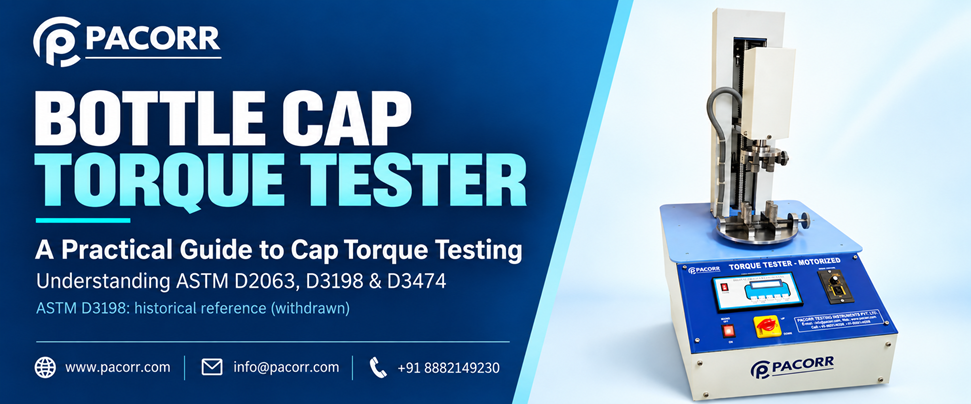
A leaking bottle and a cap that refuses to open may seem like different problems, but both can point to poor control of cap tightness. For manufacturers, finding the right balance matters. The closure needs to stay secure during handling and storage without becoming difficult for the customer to remove.
A Bottle Cap Torque Tester helps turn that balance into a measurable quality check. Instead of relying on how tight a cap feels, packaging teams can record torque values, compare samples and investigate changes in the capping process.
What Is a Bottle Cap Torque Tester?
A bottle cap torque tester measures the turning effort required to tighten or loosen a closure. The bottle is held securely while the cap is rotated, and the instrument records the resulting torque.
Two measurements are particularly useful. Application torque describes the torque used when fitting the cap. Removal torque describes the torque needed to loosen it afterward.
These readings do not necessarily match. A closure’s behaviour can change after capping as its materials and sealing components settle. This is why checking bottles immediately after filling may not tell the whole story.
Why Cap Tightness Deserves Attention
Tightening every cap as much as possible is not a reliable packaging strategy. Excessive torque can damage threads, distort components or leave customers struggling to open the product. Insufficient torque can contribute to loosening or leakage.
Consider a shampoo bottle. It needs to survive transportation and everyday handling, but the customer should also be able to open it comfortably. Similar concerns apply to beverage bottles, sauce containers and many other screw-capped packages.
Routine torque checks help manufacturers spot inconsistent results and investigate whether the cause lies in the capping settings, closure components or bottle neck finish. However, torque testing alone does not prove that a package is leakproof; separate seal-integrity testing may also be necessary.
Understanding the ASTM Standards
The standards below address different parts of torque measurement. They should not be treated as interchangeable.
ASTM D2063: Torque Retention
ASTM D2063/D2063M addresses the torque retention of continuous-thread closures using non-automated, manual torque-testing equipment. It evaluates closure performance over time under predetermined environmental conditions. ASTM D2063/D2063M
For packaging teams, this is useful when investigating how a bottle-and-cap combination behaves after storage, rather than looking only at its initial tightness. The equipment and procedure must match the applicable method.
ASTM D3198: Application and Removal Torque
ASTM D3198 addressed application and removal torque for threaded or lug-style closures. It was withdrawn in 2016, although its designation may still appear in older specifications and equipment literature. ASTM D3198
If a customer specification references this standard, clarify the required edition and agreed procedure. It should not be presented as a currently active ASTM standard.
ASTM D3474: Torque Meter Calibration and Use
ASTM D3474 covers the calibration and use of torque meters employed in packaging applications. Its scope includes instruments used to assess closure application and removal torque. ASTM D3474
This distinction matters: having a digital reading is not enough. The instrument must be properly calibrated and used correctly for that reading to support a dependable quality decision.
How Bottle Cap Torque Testing Works
Testing begins with a clearly defined procedure. The operator secures the container without crushing or distorting it, checks the instrument settings and rotates the closure as required by the selected method.
For removal testing, the relevant torque reading is recorded and compared with the approved specification. Depending on the closure design, the procedure may need to distinguish initial loosening from other events, such as tamper-band breakage.
Useful test records include:
- Bottle and closure identification
- Batch number and sample quantity
- Time elapsed since capping
- Conditioning and storage details
- Torque reading and measurement unit
- Instrument identification and operator name
This is a general overview, not a substitute for the full standard or an approved laboratory procedure.
What Can Affect the Results?
Cap design, liner construction, bottle neck dimensions and material differences can all influence torque behaviour. Test technique matters too.
An uneven turning motion or inconsistent downward pressure can make results harder to compare. Clamping a flexible bottle too tightly may distort the sample. Comparing recently capped bottles with samples stored for several days can also create misleading conclusions.
For meaningful comparisons, keep the sampling and testing conditions consistent. Use separate, appropriately prepared samples where required; opening and reclosing a bottle can change its subsequent performance.
Choosing a Suitable Bottle Cap Torque Tester
Start with your actual bottles and closures. Check that the fixture can hold them securely and that the measuring range suits the expected torque values.
Ask about accuracy, resolution, repeatability, calibration documentation and measurement in both directions. These are separate considerations—a display with more decimal places does not automatically mean better accuracy.
Also confirm whether peak capture, data export or controlled-speed operation is needed. Manual and motorized systems serve different requirements, and a motorized model should not automatically be assumed suitable for a method specifically covering manual equipment.
Before claiming compliance, verify the supplied configuration and complete test procedure against the relevant standard.
Is There One Correct Torque Value for Every Bottle?
No. A small cosmetic closure and a large container lid should not be judged against the same torque limit.
Acceptance limits should come from the closure supplier’s guidance, packaging development work and validation of the actual bottle-cap combination. The goal is a package that remains secure and performs as intended—not simply the highest possible reading.
Discuss Your Testing Requirements with Pacorr
When enquiring about a Bottle Cap Torque Tester from Pacorr, share your bottle dimensions, closure type, expected torque range and applicable test method. Sample evaluation can help establish fixture suitability and the configuration needed for routine checks.
With a suitable instrument and consistent procedure, torque testing becomes a practical way to monitor closure quality, investigate capping variations and improve packaging decisions.
Website: www.pacorr.com
Email: info@pacorr.com
Phone: +91-8882149230
Recent Blogs
Enhance your understanding of testing and precise quality control indistinct applications with our
knowledge based articles coming from top editors of industry leaders.

Our USP's
Demonstration of Machine
- Try Before You Decide
- Experience Before You Invest
- See It in Action – Free Demo
Global Reach
- Delivering Excellence Worldwide
- Serving Across Borders
- Your Global Supply Partner
On-Site Support
- Support That Comes to You
- On-Ground Assistance, Anywhere
- We Reach Where You Are
Team Strength
- Powered by Expert Minds
- Driven by Skilled Professionals
- Engineering Excellence Team
Manufacturing
- Precision-Driven Manufacturing
- Smart & Automated Production
- Engineered In-House Excellence
