
Published: 28 October 2026
Verified by: Kishore Gupta - Technical Expert
A hot air oven is an electrically heated chamber that uses dry air to heat materials under controlled conditions. Laboratories and manufacturers use it for drying, thermal conditioning and heat-exposure testing. Equipment designed and validated for dry-heat sterilization can also process compatible heat-resistant items.
The right temperature and duration depend on the job. Removing moisture from a sample, checking a component’s response to heat and sterilizing laboratory items require different procedures. A dry-looking sample is not evidence of sterility, and a temperature shown on the display does not necessarily represent every item in the chamber.
This guide explains the parts of an oven, how they work together, and what to check before selecting a heating process.
Diagram of Hot Air Oven with Labels
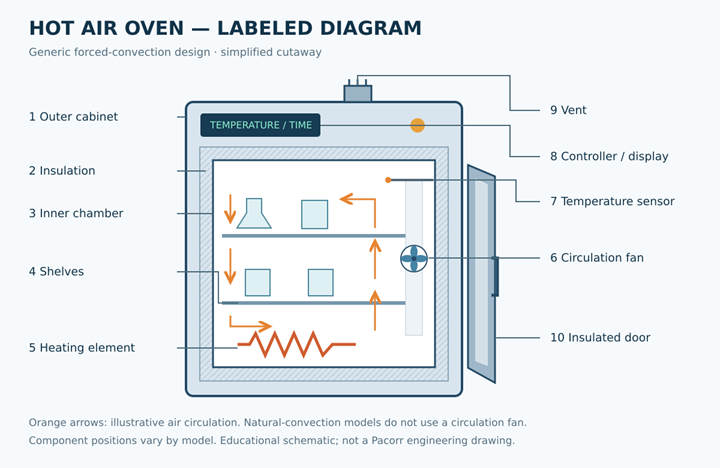
Simplified cutaway of a forced-air laboratory oven. Component locations and airflow paths vary by design. This is an educational schematic, not a Pacorr model drawing.
What are the main parts of a hot air oven?
| Label | Part | Function |
| 1 | Outer cabinet | Supports and protects the assembly. |
| 2 | Insulation | Reduces heat transfer between the chamber and surroundings. |
| 3 | Inner chamber | Holds the load within the heated working space. |
| 4 | Shelves | Support samples while allowing space for air movement. |
| 5 | Heating element | Converts electrical energy into heat. |
| 6 | Circulation fan | Moves air in forced-convection models; absent in natural-convection designs. |
| 7 | Temperature sensor | Supplies a temperature measurement to the controller. |
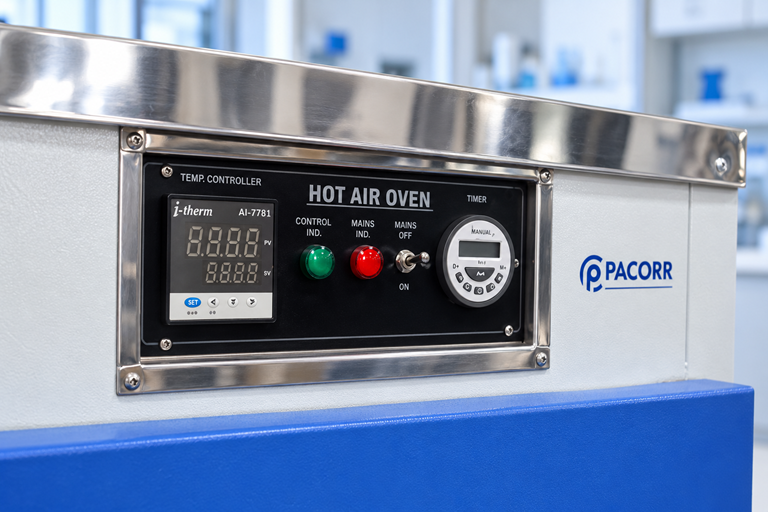
| 8 | Controller and display | Lets the operator set a target and observe the measured temperature. |
| 9 | Vent | Provides an air exchange path where the design includes ventilation. |
| 10 | Insulated door | Closes the chamber and limits heat loss. |
When reading a hot air oven diagram with labels, distinguish the sensor from the heater. The sensor measures conditions; the heater supplies energy. The controller connects these functions by adjusting heating in response to the measurement. The drawing also shows why samples need clearance. Filling every available shelf area may leave too little room for the air to move around the load.
What Is the Working Principle of a Hot Air Oven?
A hot air oven transfers heat from its heating system to the chamber air and then to the load. A temperature controller uses sensor feedback to regulate heating around the selected setpoint.
In a natural-convection oven, air movement develops as heated air rises. In a forced-convection oven, a fan drives circulation. Fan-assisted designs can improve heat transfer, but actual performance still depends on the oven and loading arrangement.
A useful way to follow the process is:
- Set the requirement. Choose the temperature and duration specified by the test method.
- Heat the chamber. Electrical elements supply energy.
- Distribute heat. Air moves through the working space.
- Measure and regulate. The sensor and controller manage the heating output.
- Complete the exposure. Hold the required conditions, then cool and handle the load as the procedure specifies.
For sterilization, the objective is microbial destruction. Dry heat acts primarily through oxidation of cell constituents, according to CDC guidance. This application needs a validated process rather than a general heating setting.
What Are the Uses of a Hot Air Oven?
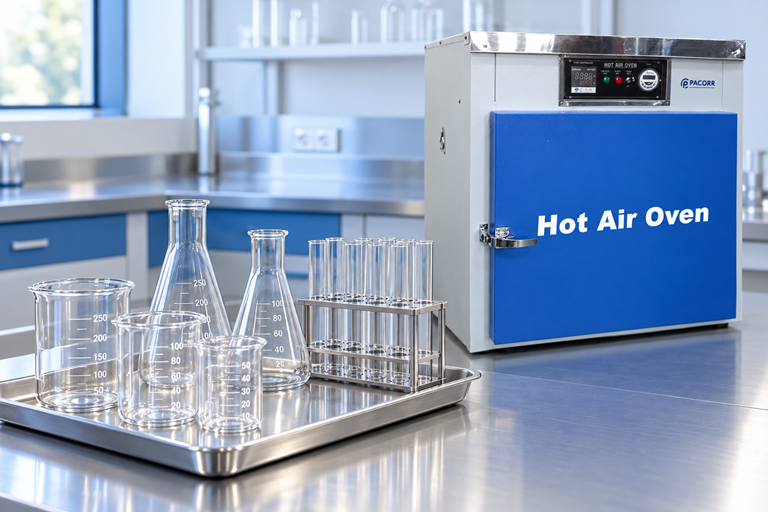
Drying laboratory items
A compatible oven can remove residual moisture from washed glassware and other suitable laboratory items. Check the temperature limits of every part of the load, including lids, seals, labels and attachments.
Drying is a preparation step. It does not, by itself, establish that an item is sterile.
Thermal conditioning before testing
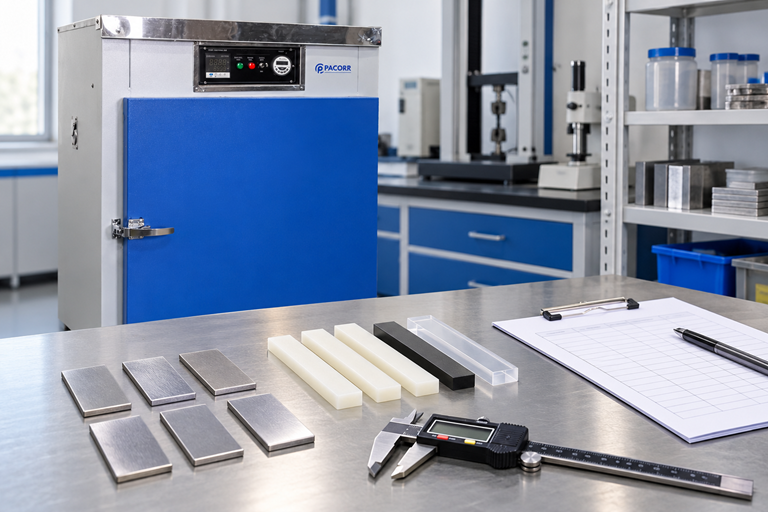
Industrial laboratories may expose specimens to controlled heat before measuring a property. The value of this step comes from documenting the treatment well enough to compare results.
For example, a hypothetical component comparison could use two matched groups: one tested without heat exposure and one tested after a defined heating and cooling procedure. The report should state the conditions, sample arrangement and subsequent measurement method. The example is a study design, not a universal test standard.
Evaluating changes caused by heat
A heating study can examine whether a suitable material changes shape, appearance or another specified property after exposure. The oven provides the environment; the inspection or measuring instrument establishes the result.
A finding such as “the specimen was heated” is incomplete. A useful record connects the temperature, exposure period and sample identity to an observation or measurement.
Curing compatible materials
Some materials require controlled heating during curing. Use the material supplier’s instructions and confirm that the oven is suitable for any vapours released. A standard laboratory oven must not be assumed suitable for solvent-bearing products.
Dry-heat sterilization
Appropriate dry-heat sterilizers can process certain heat-resistant materials, including compatible glassware, metal items, powders and oils. Suitability depends on the material and validated procedure. An ordinary drying oven should not be treated as a qualified sterilizer merely because it can reach a high temperature.
Hot Air Oven Temperature and Time
There is no single temperature and time for every hot air oven application. Drying, curing, conditioning and sterilization each require their own acceptance criteria.
For dry-heat sterilization, CDC lists these common temperature time relationships:
| Temperature | Exposure time listed by CDC |
| 150°C | 150 minutes |
| 160°C | 120 minutes |
| 170°C | 60 minutes |
Follow the equipment manufacturer’s instructions and the validated cycle for the actual load. Do not shorten exposure because the chamber reaches its setpoint quickly.
When does the exposure timer start?
For dry-heat sterilization, the required exposure must apply to the material being processed, not simply to the controller reading. WHO guidance describes maintaining the entire contents at the specified temperature for the required time.
For general heating tests, follow the method’s definition of the start point. Some procedures specify conditions after equilibration; others define a different sequence.
Planning example: If a hypothetical procedure requires 60 minutes after load equilibration, 20 minutes of warm-up cannot be counted as part of that 60-minute exposure. Cooling adds further time. This example explains scheduling only; it does not establish a sterilization cycle.
What settings should be used for drying or curing?
Use the applicable material specification, validated laboratory procedure or supplier’s curing schedule. Avoid borrowing a generic setting from an unrelated application.
Before choosing a cycle, answer three questions:
- What outcome must be achieved?
- What temperature can the material and its container tolerate?
- What measurement or criterion will show that the process is complete?
For a drying study, the endpoint might be a method-defined mass criterion. For a heat-exposure test, it might be a fixed treatment followed by inspection. These are different objectives and should be recorded differently.
Natural-Convection vs Forced-Convection Ovens
The circulation method and the control system describe different features. “Digital” refers to the controls; it does not, on its own, tell you how air moves.
| Feature | Natural convection | Forced convection |
| Air movement | Driven by buoyancy | Driven by a fan |
| General consideration | Gentler airflow can suit airflow-sensitive samples | Air circulation can support faster recovery and improved uniformity |
| Selection question | Will the load heat adequately under the required conditions? | Could airflow disturb the sample, and can the load be arranged correctly? |
Choose according to the application, supported by the manufacturer’s performance information. A fan is useful, but it does not eliminate the need to assess the working space and intended load.
Hot Air Oven vs Autoclave: What Is the Difference?
A hot air oven uses heated dry air. An autoclave uses steam under pressure. The equipment choice depends on whether the material tolerates the process and whether the required treatment can be validated.
| Comparison | Hot air oven | Autoclave |
| Heating medium | Dry air | Steam |
| Typical pressure condition | Approximately atmospheric | Pressurized during steam sterilization |
| Common purpose | Drying and heat treatment; sterilization in suitable equipment | Steam sterilization of compatible loads |
| Material consideration | Must tolerate the specified dry-heat exposure | Must tolerate heat and moisture |
| Cycle selection | Application-specific | Depends on equipment, load and cycle type |
Steam sterilization requires direct steam contact under specified conditions. CDC notes that exposure requirements vary with the item, wrapping and sterilizer type. A single generic autoclave time is therefore an unreliable basis for comparing all equipment.
Select the process first, then choose equipment that can deliver it.
How Should a Laboratory Plan a Hot Air Oven Run?
Use the instrument manual and approved laboratory procedure. The following workflow helps identify the information a procedure should contain; it does not replace a sterilization SOP.
1. Define the task and acceptance criteria
Write down the sample type, purpose, temperature, duration and result to be measured. Decide how the start and end of exposure will be identified.
2. Confirm material and equipment compatibility
Review the sample, container and accessories together. Check for substances that could release hazardous or flammable vapours. Confirm that the proposed use falls within the equipment’s intended applications.
3. Specify the loading arrangement
Describe shelf positions, sample spacing and batch size. For repeated comparisons, record enough detail to reproduce the arrangement.
A photograph or simple loading sketch can be useful supporting documentation. It should accompany the sample list rather than replace it.
4. Run and monitor the procedure
Record the setpoint and the relevant measured conditions. Follow the required response if there is a power interruption, alarm or temperature deviation.
Do not quietly extend or restart a cycle without documenting the decision. A reviewer should be able to tell what actually happened to the load.
5. Cool, inspect and document
Follow the specified cooling and handling procedure. Record the result, any deviations and the disposition of the samples.
A compact run record can contain:
| Record field | What to enter |
| Equipment | Instrument identification |
| Load | Sample IDs, quantity and arrangement |
| Method | Procedure reference and revision |
| Conditions | Setpoint and required monitoring data |
| Timing | Start criterion, exposure start and finish |
| Outcome | Observations, measurements and deviations |
Why Might Oven Results Differ Between Runs?
Before changing a temperature setting, compare how the runs were performed. A useful investigation separates differences in the samples, loading, equipment and measurement.
| Question to investigate | Evidence to compare |
| Was the load different? | Quantity, sample dimensions, containers and starting condition |
| Was the arrangement reproduced? | Shelf locations, spacing and loading photographs |
| Was exposure timed consistently? | Start criterion and temperature records |
| Was there an interruption? | Door openings, alarms and power records |
| Was the measurement comparable? | Instrument identification, calibration status and test method |
This approach avoids treating every unexpected result as a heater problem. For example, two runs with the same displayed setpoint may still differ if one procedure starts timing immediately and another waits for the required conditions.
If the investigation points to equipment performance, follow the manufacturer’s service and verification procedures.
What Should You Check Before Buying a Hot Air Oven?
Write a short application requirement before comparing quotations. A maximum temperature alone does not describe whether an oven will suit the work.
Ask suppliers about:
- Working temperature: the range needed for your actual procedures.
- Usable space: sample dimensions, shelf loading and necessary clearance.
- Performance evidence: how temperature uniformity and stability are specified and tested.
- Controls: timing behaviour, alarms and any required recording functions.
- Verification: calibration documentation and application-specific qualification needs.
- Installation: electrical supply, ventilation and available bench or floor space.
For an application requiring sterilization, ask specifically about intended use and validation support. For materials testing, share the method and acceptance requirements.
A useful enquiry might read: “We need to heat 12 specimens per batch. Each specimen measures 80 × 50 × 20 mm. Please confirm the usable loading arrangement and performance at our method’s working temperature.” These dimensions are illustrative, not a Pacorr specification.
Pacorr Laboratory Hot Air Oven for Industrial Testing
Pacorr’s Laboratory Hot Air Oven is presented for controlled heating, drying, thermal conditioning and heat-resistance testing. Its published features include forced-air circulation, digital temperature control, an insulated body and a stainless-steel chamber.
For a suitable configuration, share your material, specimen dimensions, batch quantity, working temperature and test method with Pacorr. Confirm the required performance and documentation before ordering.
Frequently Asked Questions
Q1. Does every hot air oven have a fan?
No. Natural-convection ovens rely on buoyancy-driven air movement. Forced-convection ovens use a fan. Check the circulation method rather than assuming that all laboratory ovens have the same construction.
Q2. Does a digital display prove that the whole load is at temperature?
No. The display represents the instrument’s measurement at its sensor. Establishing the conditions throughout a load requires the verification approach specified for the application.
Q3. Can plastics be placed in a hot air oven?
Only when the material, temperature and equipment are compatible with the intended test. Suitability for a controlled heat-exposure test does not establish suitability for a high-temperature sterilization cycle.
Q4. Is a hot air oven the same as an incubator?
No. An oven is generally used for drying and heat treatment. An incubator maintains conditions intended for incubation. Select equipment by the required temperature, control performance and intended use.
Q5. What matters most in a labeled diagram?
The diagram should identify the chamber, insulation, shelves, heating system, sensor, controls and door. If it shows a fan, it should state that the design is forced convection. Airflow arrows should be presented as illustrative unless they come from the specific model’s engineering documentation.
Q6. How can I obtain a hot air oven price?
Send the supplier your required working temperature, chamber capacity, sample dimensions and application. Ask the quotation to identify the supplied controls, accessories, performance specifications and documentation so that options can be compared fairly.
Recent Blogs
Enhance your understanding of testing and precise quality control indistinct applications with our
knowledge based articles coming from top editors of industry leaders.

Our USP's
Demonstration of Machine
- Try Before You Decide
- Experience Before You Invest
- See It in Action – Free Demo
Global Reach
- Delivering Excellence Worldwide
- Serving Across Borders
- Your Global Supply Partner
On-Site Support
- Support That Comes to You
- On-Ground Assistance, Anywhere
- We Reach Where You Are
Team Strength
- Powered by Expert Minds
- Driven by Skilled Professionals
- Engineering Excellence Team
Manufacturing
- Precision-Driven Manufacturing
- Smart & Automated Production
- Engineered In-House Excellence
