
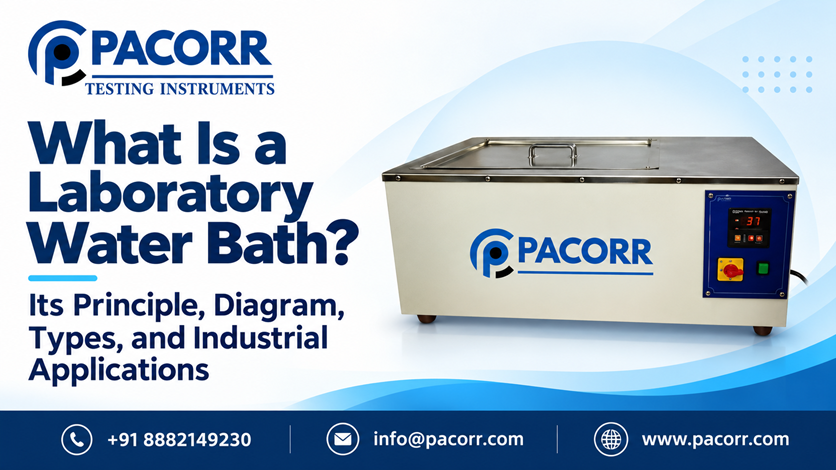
A laboratory water bath is a temperature-controlled instrument that uses water to heat or maintain samples at a selected temperature. Samples are usually held in tubes, flasks or other suitable containers immersed in the bath. A heater, temperature sensor and controller work together to regulate the water, allowing indirect heating without placing the sample vessel directly on a hot plate or flame.
Consistent temperature can be essential to a laboratory result. A reagent warmed for preparation, a material conditioned before testing and a sample held during a reaction may all respond differently if their temperatures vary. A water bath provides a controlled thermal environment, but obtaining reliable results requires more than selecting a number on its display.
This guide explains how laboratory water baths work, which designs suit different tasks, and how to manage temperature, loading and operating conditions in industrial laboratories.
In This Guide
What Is the Working Principle of a Water Bath?
A water bath works through heat transfer and feedback temperature control. An electric heater supplies thermal energy to the water. The water transfers heat to the immersed vessel and then to its contents. A sensor measures bath temperature, and the controller adjusts heater output to keep that measurement close to the setpoint.
How heat reaches the sample
Convection moves heat through the water, while conduction transfers it through the wall of a sample container. In an unstirred bath, warmer and cooler regions move naturally because of density differences. A stirred or circulating bath adds mechanical movement to reduce temperature differences around the working area.
The heating element produces heat; the temperature sensor measures it. These are separate functions. Depending on the construction, the heater may be positioned beneath the tank or elsewhere in the heating assembly.
How the controller maintains temperature
A thermostatically controlled water bath compares the measured temperature with the selected target. Basic systems switch heating on and off. More advanced controllers can vary the heating response to limit fluctuations. The control method, insulation, water movement and sample load all influence performance.
A stable bath reading does not mean the sample has already reached the same temperature. A large bottle, thick container or viscous liquid may heat slowly. Where sample temperature matters, establish an equilibration period using an appropriate measurement method rather than assuming that the display represents the sample interior.
Laboratory Water Bath Diagram and Main Components
A laboratory water bath combines a tank, heating element, temperature sensor and controller. The table below explains the main components and their functions.
| Component | Function | Practical consideration |
|---|---|---|
| Tank and housing | Contain the bath water and support the heating assembly. | Check usable depth, material compatibility and access for cleaning. |
| Heating element | Converts electrical energy into heat. | Operate only with the required fluid level. |
| Temperature sensor | Measures temperature at its installed location. | One reading does not establish uniformity throughout the tank. |
| Controller and display | Set the target and regulate heating. | Display resolution is different from measurement accuracy. |
| Lid | Reduces evaporation and heat loss. | Leave clearance for vessels and handle hot condensate carefully. |
| Rack or platform | Supports containers at a repeatable depth. | Keep water pathways clear and prevent tipping. |
| Stirrer or circulation system, if fitted | Moves bath water to improve mixing. | Do not obstruct its inlet, outlet or moving parts. |
| Protection devices, model dependent | Limit overheating or respond to unsuitable operating conditions. | Confirm the actual protections supplied with the unit. |
Types of Laboratory Water Bath
Water baths can be classified by water movement, sample movement and control system. These categories overlap: a digital water bath can also be circulating, and an unstirred bath can have electronic temperature control.
| Type | How it operates | Typical use | Selection point |
|---|---|---|---|
| Non-circulating or unstirred | Relies primarily on natural convection. | Routine warming and general sample preparation. | Check performance at the intended load and vessel positions. |
| Stirred or circulating | Actively moves the bath liquid. | Work requiring more consistent temperatures across the bath. | Distinguish internal mixing from an external circulation connection. |
| Shaking | Moves the sample platform while controlling temperature. | Protocols needing simultaneous incubation and agitation. | Check motion, speed, travel and suitable clamps. |
| Analog-controlled | Uses a dial or similar control interface. | Basic heating tasks with suitable independent verification. | Evaluate measured performance rather than the appearance of the controls. |
| Digital-controlled | Uses an electronic interface for setting and monitoring temperature. | Routine laboratory and industrial workflows. | Compare documented accuracy, stability and uniformity. |
| Refrigerated circulating bath | Adds active cooling to temperature control. | Applications below room temperature or requiring cooling. | Fluid compatibility and cooling capacity become essential. |
A shaking bath moves the containers; a circulating bath moves the bath liquid. These functions solve different problems. Also, a heating-only bath cannot actively cool its contents below the surrounding room temperature.
What Temperature Does a Laboratory Water Bath Operate At?
The operating range depends on the instrument and approved bath fluid. Many heating-only models start a specified margin above ambient temperature and operate toward the boiling region of water. Some have lower maximum ratings. Always use the model's rated range rather than treating 100°C as a universal operating limit.
Water boils at approximately 100°C at standard atmospheric pressure, but its boiling point falls at higher altitude. Close to boiling, evaporation and steam increase. A setpoint near this region may require a purpose-designed bath, lid and operating procedure.
Below-freezing operation generally requires a suitable refrigerated system and an approved fluid, such as a specified water-glycol mixture. An ordinary water-filled heated bath cannot simply be set to a negative temperature. Never substitute oil, glycol or another fluid unless the equipment manufacturer approves it.
Accuracy, stability, uniformity and resolution are different
- Accuracy: agreement of the indicated or controlled temperature with a reference measurement under stated conditions.
- Stability: how much temperature changes over time at a location.
- Uniformity: how much temperature differs between locations in the bath.
- Resolution: the smallest increment the display or setting can show.
A display showing tenths of a degree does not establish accuracy to a tenth of a degree. For a demanding method, compare all relevant performance specifications and include measurement uncertainty in the acceptance decision.
Working Procedure of a Water Bath: From Setup to Shutdown
The basic procedure is to inspect the unit, fill it correctly, set and verify the temperature, load samples, allow equilibration, complete the timed treatment and shut down safely. Use the instrument manual and your laboratory's approved method for the exact sequence and acceptance limits.
- Define the task. Record the required temperature, tolerance, exposure time, container type and sample quantity. Establish whether time begins at loading, bath recovery or sample equilibration.
- Inspect and position the equipment. Check the tank, cord, rack and accessible fittings. Use a stable bench and the electrical supply specified for the unit.
- Fill with approved water. Follow the stated minimum and maximum levels, allowing for displacement by samples. Use the water grade specified in the manual.
- Set the target temperature. Select the required setpoint and any permitted protection settings. Use the actual model instructions rather than a generic button sequence.
- Allow stabilization and verify. Position a suitable calibrated probe in the working zone without touching the tank walls or base. Compare the result with the method's acceptance criteria.
- Load and support samples. Use compatible vessels and a stable rack. Maintain the specified immersion depth, leave circulation space and keep water out of containers unless direct contact is required by the test.
- Allow recovery and equilibration. Adding cool samples changes the thermal load. Begin the timed stage at the point defined by the method, and record temperature as required.
- Remove samples and close the run. Use suitable handling protection, record any deviations, switch off and allow cooling before draining or cleaning according to the manual.
For a separate operator-oriented walkthrough, see Pacorr's step-by-step guide to operating a digital water bath . The manual supplied with your instrument remains the reference for its controls and limits.
Why the start of the timer matters
Consider two runs using the same setpoint: one contains a few small tubes and the other several large bottles. Both may show the target bath temperature, yet the bottle contents can take longer to equilibrate. Starting both timers immediately after loading could produce different actual exposure conditions. Validate the timing rule for the vessel, volume and load used.
Industrial Applications of a Laboratory Water Bath
A water bath supplies a controlled temperature condition. What that condition tells you about a product depends on the test method, sample preparation and measurement performed afterward.
| Industry or laboratory | Application | What needs control | Important boundary |
|---|---|---|---|
| Pharmaceutical and analytical laboratories | Warming reagents and holding prepared samples for specified analytical steps. | Temperature, duration, vessel compatibility and contamination control. | A general water bath does not replace a stability chamber or a dedicated dissolution apparatus. |
| Food and beverage laboratories | Tempering samples or conducting method-defined incubation and thermal-treatment studies. | Actual sample temperature, timing and hygienic handling. | A bench experiment does not by itself validate a commercial pasteurization process. |
| Plastics and rubber testing | Conditioning compatible specimens at a prescribed water temperature before evaluation. | Immersion conditions, time and the interval before subsequent testing. | The bath does not measure tensile strength or replace mechanical test equipment. |
| Chemical laboratories | Indirect warming during dissolution, sample preparation or temperature-sensitive reactions. | Chemical compatibility, heat release and temperature limits. | Flammable, reactive or pressure-generating processes require a specific suitability assessment. |
| Coatings and adhesives laboratories | Conditioning compatible samples or carrying out specified warm-water exposure studies. | Exposure geometry and assessment criteria. | Water immersion cannot substitute for every heat-aging or humidity test. |
| Biotechnology and research | Incubation or thawing where the approved protocol allows a water bath. | Sample integrity, mixing requirements and contamination risk. | Do not assume one temperature or procedure suits all biological materials. |
For broader quality-control context, explore Pacorr's article on digital water baths in product-quality testing . Select equipment against the actual method requirements; temperature exposure alone does not establish a product's compliance or service life.
Water Bath vs Steam Bath, Dry Bath and Hot Air Oven
| Equipment | Heating environment | When it may be suitable | Key difference |
|---|---|---|---|
| Water bath | Temperature-controlled liquid water around vessels or suitable specimens. | Indirect warming and controlled immersion. | Requires water management and compatible containers. |
| Steam bath | Steam contacting an appropriate vessel surface. | Methods specifically requiring steam heating. | Does not provide the same adjustable liquid environment as a water bath. |
| Dry block bath | A heated solid block fitted around compatible tubes. | Small-container workflows that should avoid bath water. | Heat transfer depends on contact and block-to-vessel fit. |
| Hot air oven | Heated air in an enclosed chamber. | Drying or dry-heat conditioning under the specified method. | Uses a different heat-transfer medium and sample environment. |
A steam bath in chemistry is not simply another name for a water bath. Likewise, an ordinary water bath is not an autoclave: it does not supply the validated pressurized-steam cycle used for autoclave sterilization.
Advantages and Limitations of a Water Bath
Advantages
- Provides indirect heating with an adjustable bath temperature.
- Accommodates different vessel shapes when suitable racks and sufficient working space are available.
- Supports repeatable thermal conditioning when temperature, load and timing are controlled.
- Allows independent temperature checks in the liquid working zone.
Limitations
- The instrument rating and bath fluid restrict the usable temperature range.
- Evaporation changes water level and requires attention, especially at higher temperatures.
- Shared bath water can become contaminated or develop deposits.
- Large or poorly arranged loads can affect recovery and temperature distribution.
- Materials sensitive to moisture may require another heating method.
- The bath display does not directly measure every sample's internal temperature.
Water Bath Precautions, Cleaning and Maintenance
Keep the liquid within the manufacturer's operating limits and never run a water-only bath dry. Use appropriate racks, prevent overflow and protect electrical connections from splashes. Treat the lid, vessels, water and escaping steam as potential burn sources.
Removing an open flame does not make an ordinary water bath suitable for every flammable chemical. Consider vapours, electrical ignition sources, vessel pressure and the equipment's permitted use. Do not heat tightly closed containers unless the vessel and procedure are designed for that condition.
For cleaning, disconnect as directed, let the bath cool, drain safely and use compatible cleaning agents. Follow the manual for water replacement and storage. Avoid adding disinfectants or corrosion inhibitors without checking compatibility; more concentrated treatment is not automatically better.
Keep a maintenance record covering water changes, cleaning, unusual alarms and temperature checks. Investigate drift before adjusting the controller: a misplaced reference probe, low level or obstructed circulation can resemble a calibration problem.
Common Water Bath Problems and What to Check
| Observation | Possible explanation | First check |
|---|---|---|
| Samples warm slowly | High load, large volume or unsuitable immersion depth. | Compare loading and equilibration time with the approved method. |
| Reference probe and display disagree | Probe location, incomplete stabilization or measurement error. | Check the probe's calibration status and placement before adjustment. |
| Temperature differs between positions | Obstructed water movement or a crowded working area. | Review rack spacing and any circulation system. |
| Water level falls quickly | Evaporation or a leak. | Check operating temperature, lid use and accessible drain fittings. |
| Deposits or cloudy water appear | Unsuitable water quality or contamination. | Stop as necessary, clean using the approved method and replace the water. |
| Protection trips or alarms repeat | Unsuitable operating conditions or an equipment fault. | Follow the manual; stop use and seek service if the fault persists. |
Do not bypass protective devices or open electrical assemblies as part of routine operator troubleshooting.
How to Select a Water Bath for Industrial Testing
Begin with the test requirement and sample arrangement. Tank capacity alone is insufficient: the working depth, rack geometry and free space around containers determine whether the bath can accommodate your actual workload.
- Temperature requirement: minimum and maximum temperatures, including the effect of room conditions.
- Performance tolerance: required accuracy, stability and uniformity at your operating temperature.
- Sample load: vessel dimensions, number of samples, immersion depth and expected recovery time.
- Movement: natural convection, active circulation or sample shaking.
- Materials and cleaning: compatibility of the tank, rack, fluid and cleaning procedure.
- Documentation: manual, calibration arrangements, maintenance support and any required data recording.
For procurement discussions, review the Pacorr Water Bath Digital Model and provide your required setpoint, tolerance, sample sizes and test method. Confirm the current model-specific specifications with Pacorr before ordering.
Frequently Asked Questions About Laboratory Water Baths
What is a water bath in a chemistry laboratory?
It is a temperature-controlled water reservoir used to warm suitable sample vessels indirectly. A water bath in a chemistry lab can support preparation or reaction steps where the method requires controlled heating and the materials are compatible with the equipment.
What is a hot water bath or warm water bath in laboratory work?
These are informal descriptions of a heated water bath. They do not specify a temperature, accuracy or equipment class. A reproducible procedure should state the setpoint, tolerance and exposure time instead of relying on the words “hot” or “warm.”
Which water should be used in a laboratory water bath?
Use the water grade approved by the manufacturer. Distilled or appropriately filtered water is specified for many instruments, but requirements differ. Do not assume highly purified deionized water, tap water or an additive is suitable for every tank and circulation system.
Is a digital water bath always more accurate than an analog model?
No. Digital describes the control or display interface. Accuracy must be established from the instrument specification and appropriate verification. A fine display increment is not proof of equally fine temperature control.
Can a water bath measure tensile strength?
No. A water bath may condition specimens if the test method calls for it. Tensile strength is measured with suitable mechanical testing equipment using the required specimen geometry and loading procedure.
How is water bath temperature verified?
Compare readings with a suitable calibrated reference probe after stabilization. Check relevant positions and depths, and assess performance under representative loading. Record the conditions and acceptance limits. A single centre-point reading cannot establish uniformity throughout the usable space.
Can a laboratory water bath sterilize equipment?
An ordinary laboratory water bath should not be treated as a validated sterilizer. Select a sterilization process appropriate to the material and required microbiological outcome. Routine warming, incubation and sterilization are different operations.
How long should samples stay in a water bath?
The test method determines the duration. Sample volume, container material and starting temperature affect equilibration, so there is no universal holding time. State clearly whether the timed exposure begins before or after the sample reaches its required temperature.
Conclusion
A laboratory water bath creates a controlled liquid environment for indirect heating, sample preparation and method-defined conditioning. Reliable results depend on choosing the right design, verifying temperature where samples are placed, allowing adequate equilibration and keeping loading and timing consistent.
For industrial applications, specify the complete requirement rather than only the tank volume or maximum temperature. Match the bath's performance to the method, document the operating conditions and confirm that the sample and bath fluid are compatible.
Planning a temperature-controlled testing setup? Explore Pacorr's digital water bath and discuss your sample load, temperature tolerance and application with the team to identify a suitable configuration.
Recent Blogs
Enhance your understanding of testing and precise quality control indistinct applications with our
knowledge based articles coming from top editors of industry leaders.

Our USP's
Demonstration of Machine
- Try Before You Decide
- Experience Before You Invest
- See It in Action – Free Demo
Global Reach
- Delivering Excellence Worldwide
- Serving Across Borders
- Your Global Supply Partner
On-Site Support
- Support That Comes to You
- On-Ground Assistance, Anywhere
- We Reach Where You Are
Team Strength
- Powered by Expert Minds
- Driven by Skilled Professionals
- Engineering Excellence Team
Manufacturing
- Precision-Driven Manufacturing
- Smart & Automated Production
- Engineered In-House Excellence
