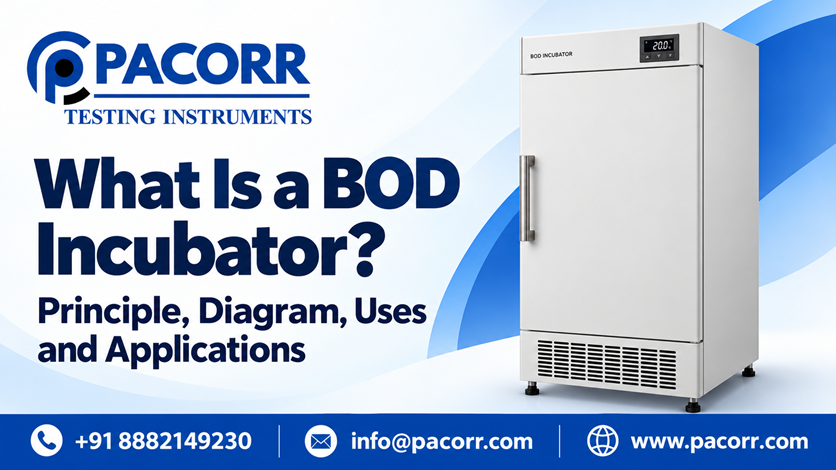
A BOD incubator is a refrigerated laboratory chamber that maintains a controlled temperature for biochemical oxygen demand testing and other suitable incubation work. It provides the thermal conditions for the test; dissolved oxygen measurements or a separate respirometric system determine oxygen demand.
For a quality-control laboratory, the important question is whether the chamber can hold the required conditions around the actual sample load for the full incubation period. A stable display, sufficient bottle space, reliable cooling and documented temperature checks all matter. They influence whether the laboratory can interpret its results with confidence.
This guide explains the BOD incubator working principle, construction, diagram, uses and applications, together with practical selection and operating considerations for industrial and environmental laboratories.
What does BOD mean, and what does the incubator do?
BOD stands for biochemical oxygen demand. It describes oxygen consumed through biological activity under defined test conditions and is normally reported as milligrams of oxygen per litre of sample, or mg/L. The temperature and incubation period belong with the result because they affect its meaning.
An industrial effluent sample may contain material that microorganisms can break down. During that activity, dissolved oxygen is consumed. Incubation creates a consistent temperature environment so the laboratory can evaluate that oxygen demand using its selected analytical method. The chamber does not identify every pollutant or establish that water is safe for drinking.
| Term | What it describes |
|---|---|
| BOD | Oxygen demand associated with biological activity during the specified test. |
| Dissolved oxygen (DO) | Oxygen present in the water at the time of measurement. |
| Chemical oxygen demand (COD) | The oxygen equivalent of material oxidized by the chemical procedure used. |
BOD and COD results should not be treated as interchangeable. A relationship established for one wastewater stream may change when the process or waste composition changes.
What is the working principle of a BOD incubator?
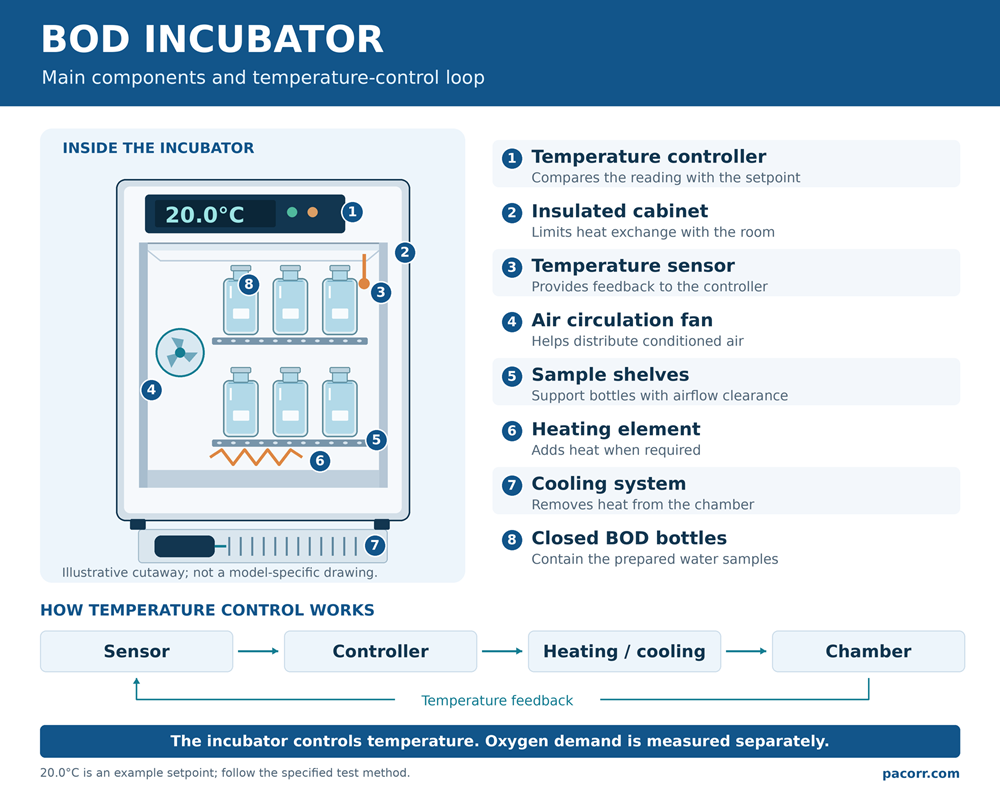
A BOD incubator uses temperature feedback to regulate heating and cooling around a selected setpoint. A sensor measures chamber conditions, a controller compares the reading with the target, and the thermal system adjusts its output. Air movement helps distribute the conditioned air through the usable space.
Heating, refrigeration and feedback control
When the laboratory is warmer than the required incubation temperature, the chamber must remove heat. When additional heat is needed, a heater supplies it. In compressor-based equipment, the refrigeration circuit transfers heat from inside the cabinet to the surrounding room. Thermoelectric designs use a different cooling mechanism.
A PID controller uses proportional, integral and derivative control actions to manage the response to temperature error. Its presence alone does not establish the performance of the entire chamber. Insulation, sensor placement, cooling capacity, load arrangement and controller settings also influence the result. Heating and cooling strategies vary; the compressor and heater do not necessarily operate continuously or simultaneously in every design.
Why airflow and room conditions matter
A bottle placed against an air outlet may experience different conditions from one behind a tightly packed rack. Leave the circulation paths specified by the manufacturer clear. Similarly, a chamber that performs well in an air-conditioned room may not deliver the same performance outside its permitted ambient range. Confirm both laboratory conditions and the intended sample arrangement before selecting a model.
BOD incubator diagram and main components
The functional diagram below shows the relationship between the controls, thermal system and sample chamber. It is a conceptual explanation, not a construction drawing; component locations vary by model.
Compares the target with sensor feedback
Adds or removes heat as required
Circulating air • Shelves • Closed BOD bottles
4. Temperature sensor
Returns a measurement to the controller
| Component | Function and practical relevance |
|---|---|
| Insulated cabinet and door | Reduce heat exchange with the room. Door seals and insulation condition affect recovery and control. |
| Inner chamber and shelves | Support bottles and other permitted vessels. Usable shelf area matters more than gross cabinet volume alone. |
| Temperature sensor | Measures conditions at its location. A control sensor does not measure every bottle or shelf. |
| Controller and display | Allow setpoint selection and indicate temperature or status. Display resolution is not the same as accuracy. |
| Cooling system and heater | Provide the thermal capacity needed for the permitted operating range and ambient conditions. |
| Circulation system | Moves conditioned air where fitted. Clearances around loads help preserve the intended airflow. |
| Protection and monitoring | May include an independent safety thermostat, deviation alarms, access ports or data logging. Verify the supplied configuration. |
What types of BOD incubator are available?
BOD incubators can be described by cooling technology, temperature control, cabinet size and monitoring capability. These categories overlap: a large compressor-cooled cabinet may also have programmable controls and data logging.
- Compressor-cooled incubators: use a refrigeration circuit. Check the supported temperature range, room-temperature limits and requirements for heat rejection.
- Thermoelectric or Peltier incubators: use solid-state heat transfer. Suitability depends on the model’s cooling capacity and the difference between chamber and room temperature.
- Fixed-temperature BOD cabinets: concentrate on a defined operating point. For example, some commercial BOD cabinets regulate at a constant 20°C.
- Adjustable refrigerated incubators: offer multiple setpoints for compatible laboratory methods. Programmability, alarms and recording may be standard or optional.
A shaking incubator adds controlled sample movement. A CO₂ incubator regulates a culture atmosphere. Neither feature automatically belongs to a BOD incubator. Specify the functions required by the method rather than relying on a broad equipment name.
What temperature should a BOD incubator maintain?
The analytical method determines the incubation temperature and duration. The familiar five-day BOD test uses 20°C; Indian testing practice also includes a three-day test at 27°C. These are distinct reporting conditions, not a single acceptable 20–27°C operating band.
| Test or specification | Temperature and duration | What to check |
|---|---|---|
| Conventional BOD₅ | Commonly 20 ± 1°C for five days. | Use the prescribed tolerance, timing and dark-incubation requirements of the adopted method. |
| Indian three-day BOD | 27°C for three days, where the applicable procedure specifies it. | Confirm the tolerance and reporting requirements in the current method or laboratory SOP. |
| Other incubation work | Defined by the culture or experimental protocol. | Confirm every required condition, including light, atmosphere or humidity where relevant. |
| Equipment operating range | A model rating, not a BOD test instruction. | Verify performance at the actual working setpoint and permitted ambient temperature. |
Why are BOD bottles incubated in darkness?
Photosynthesis can add oxygen to a sample containing photosynthetic organisms. That can interfere with interpreting oxygen depletion. Follow the method’s dark-incubation requirement, including management of internal illumination and external light. The bottle closure prevents unwanted exchange with outside air; the incubator cabinet itself is not an oxygen-measurement vessel.
Why cannot a warmer test simply replace a five-day test?
Changing temperature changes biological activity, but it does not provide a universal conversion between three-day and five-day results. Report the actual method, duration and temperature. Do not replace a specified test with a faster condition solely to increase laboratory throughput.
Which BOD incubator specifications matter most?
Compare specifications at the intended working conditions. A brochure’s broad temperature range or fine display increment is insufficient evidence that every loaded shelf will remain inside the method’s tolerance.
| Specification | What the buyer should establish |
|---|---|
| Operating range | Includes the required setpoints under the laboratory’s expected ambient conditions. |
| Indication accuracy | Agreement between the indicated temperature and an appropriate reference measurement. |
| Temperature stability | How much temperature changes over time after stabilization. |
| Temperature uniformity | Differences between relevant positions within the working space. |
| Resolution | Smallest displayed or selectable increment; it is not a performance tolerance. |
| Usable capacity | Bottle diameter, height, rack arrangement, shelf load and airflow clearance. |
| Recovery and continuous operation | Behaviour after loading or door opening, and ability to maintain the full test duration. |
| Monitoring and protection | Independent verification access, alarms, recording, power-failure behaviour and protective controls. |
Calibration practice distinguishes spatial variation, variation over time and the influence of loading. Ask how a quoted value was measured and whether it represents an empty or loaded chamber.
For a product-specific starting point, Pacorr’s BOD incubator for water and wastewater testing lists a 5°C to 60°C range, PID control, a PT100 sensor, an LED display, an SS304 inner chamber and two shelves. Confirm current configuration, usable bottle capacity and performance at your test setpoint with Pacorr before purchasing.
How do you use a BOD incubator?
Prepare the chamber, verify the required conditions, load correctly prepared samples, and document incubation throughout the test. The following workflow explains the equipment’s role. Sample treatment, analytical controls, timing and acceptance criteria must follow the laboratory’s approved method.
- Define the test. Record the method, incubation temperature, duration, bottle requirements and temperature acceptance limits before preparing the batch.
- Check readiness. Confirm that the cabinet is clean, shelves are secure, vents are unobstructed and temperature verification is current. Install and power the equipment according to its manual.
- Stabilize and verify. Select the setpoint and allow conditions to settle. Check the working zone with an appropriate calibrated reference device rather than relying only on the panel display.
- Prepare samples and controls. For a dilution-based method, prepare the required dilutions, seed where needed, and quality-control bottles. Pretreatment depends on sample characteristics.
- Measure initial dissolved oxygen. Use the analytical procedure and instrument checks required by the selected method. Record sample identification and preparation times.
- Load and protect the bottles. Arrange them upright with suitable spacing. Use the prescribed closures and dark conditions. Avoid air bubbles or unintended headspace where the bottle method requires their exclusion.
- Maintain and record incubation. Follow the method’s timing convention. Record temperature checks, alarms, door openings that affect conditions and any power interruption.
- Complete the analytical measurement. Measure final DO at the required time, assess controls, and apply the method’s dilution and seed corrections.
- Review and release results. Evaluate temperature excursions and analytical acceptance criteria before reporting. Clean and restore the chamber under the laboratory’s operating procedure.
An incubator does not correct unsuitable sample preparation. Residual disinfectant, insufficient active seed, contaminated dilution water or excessive oxygen depletion can undermine a result even when temperature control is satisfactory.
How is BOD calculated after incubation?
For an illustrative dilution calculation, subtract final DO and the applicable seed correction from initial DO, then divide by the original-sample fraction in the bottle. The exact calculation and acceptance criteria depend on the adopted method and seeding arrangement.
D₁ = initial DO; D₂ = final DO; C = applicable seed oxygen-demand correction in the prepared bottle; P = original-sample volume divided by total prepared volume.
Illustrative example: a prepared 300 mL bottle contains 15 mL of original sample, so P = 15/300 = 0.05. Suppose initial DO is 8.4 mg/L, final DO is 3.4 mg/L and the applicable seed correction is 0.4 mg/L. The calculated BOD is (8.4 − 3.4 − 0.4)/0.05 = 92 mg/L. These are hypothetical values, not Pacorr test results.
Without dilution or a required correction, the calculation may reduce to a DO difference. Do not apply that shortcut to every wastewater sample. If the oxygen is exhausted, the measured depletion cannot establish the full demand. Review valid dilutions and quality-control results before reporting.
Respirometric systems use a separate measurement arrangement, commonly tracking a pressure change associated with oxygen consumption while managing the carbon dioxide produced. Follow that system’s operating procedure; the DO-difference example above is not its calculation method.
Where are BOD incubators used in industry?
The main application is controlled incubation for water and wastewater oxygen-demand testing. Other laboratory uses depend on whether the equipment meets all conditions of the relevant method, not simply on whether its temperature range includes a chosen value.
Effluent treatment plants and wastewater laboratories
Environmental laboratories use BOD results to assess oxygen-demanding pollution and support evaluation of treatment performance. Manufacturers with effluent treatment plants may compare appropriately collected inlet and outlet samples using the same analytical basis. The result helps characterize a treatment process; an incubator alone does not demonstrate discharge compliance.
Practical example: a dairy plant investigating a change in effluent quality can compare consistently sampled batches before and after a process adjustment. Record production conditions and wastewater flow alongside laboratory findings. A lower concentration caused by dilution is different from a reduction in the mass of pollution discharged.
Food, beverage, textile, paper and chemical manufacturing
These facilities can generate wastewater with different organic loads and potential interferences. A laboratory should select dilution and pretreatment from the sample characteristics and method requirements. A single preparation recipe should not be assumed suitable for a lightly contaminated rinse-water sample and a concentrated industrial effluent.
For food-quality or shelf-life research, a refrigerated incubator may also hold samples at a protocol-defined temperature. It does not itself establish shelf life, microbial identity or food safety; those conclusions require the relevant measurements and study design.
Microbiology, biotechnology and agricultural research
Suitable models can support controlled-temperature studies involving permitted microorganisms, seeds or other biological materials. Some experiments need additional lighting, humidity, gas control or agitation. A basic BOD incubator does not supply those functions automatically. Compatibility must be established for the equipment, organisms, vessels and laboratory procedures.
Pharmaceutical quality and research laboratories
An incubator can support method-defined incubation work, but it is not automatically a replacement for a pharmaceutical stability chamber or a CO₂ culture incubator. Stability protocols may require controlled humidity and documented storage conditions, while particular cell-culture systems require a controlled atmosphere.
For work involving both moisture and temperature, read Pacorr’s guide to temperature and humidity testing in quality control. Match the chamber to the full experimental requirement before selecting it.
BOD incubator vs bacteriological incubator and other equipment
The useful distinction is the environment each instrument is designed to provide. A familiar cabinet shape or similar digital controller does not make two instruments interchangeable.
| Equipment | Primary control or purpose | Selection boundary |
|---|---|---|
| BOD / refrigerated incubator | Temperature-controlled incubation with cooling capability. | Confirm the required setpoint, dark conditions, load and method performance. |
| Heating-only bacteriological incubator | Incubation above the permitted room-temperature margin. | Cannot actively cool below ambient; confirm the minimum achievable temperature. |
| CO₂ incubator | Temperature and specified gas conditions for compatible cultures. | CO₂ regulation is a separate function, not an assumed BOD feature. |
| Stability or humidity chamber | Specified environmental exposure, potentially including relative humidity. | Choose it when the protocol requires moisture control and appropriate monitoring. |
| Laboratory water bath | Temperature-controlled liquid surrounding suitable vessels. | Use only where the method permits it and temperature control, immersion and light exclusion are suitable. |
| Hot air oven | Dry heating or a validated dry-heat process. | An oven’s operating purpose and range differ from routine BOD incubation. |
Pacorr’s laboratory water bath guide explains liquid-based temperature control. Its humidity and conditioning chamber page is relevant when controlled moisture exposure is required. These are related equipment options, not universal substitutes for a BOD incubator.
What are the advantages and limitations?
- Controlled conditions: supports repeatable incubation when performance is verified and the chamber is operated correctly.
- Below-ambient operation: cooling helps maintain suitable setpoints in laboratories warmer than the test condition.
- Organized batch work: shelves and suitable racks can accommodate identified samples and controls over multi-day tests.
- Potential versatility: adjustable models may serve other compatible protocols within their validated operating scope.
Limitations include occupied capacity during long tests, electricity consumption, refrigeration maintenance and sensitivity to poor loading or unsuitable room conditions. Temperature control also cannot remove analytical interferences or replace the required DO measurement. Assess the whole workflow when estimating the cost of a reliable result.
How do you choose the right BOD incubator?
Begin with the method, workload and laboratory conditions, then compare models. Specify what the chamber must achieve around the samples, rather than choosing only by its maximum temperature or nominal litres.
Estimate bottle capacity across overlapping batches
Count samples, dilutions, replicates and controls, then consider how many batches remain in incubation together. In an illustrative workload, ten samples prepared at two dilutions in duplicate require 40 sample bottles before adding controls. If one such batch starts each day and five daily batches overlap, the chamber may need space for approximately 200 sample bottles plus controls and operating clearance.
Translate that requirement into actual rack and shelf space. Bottle height, stoppers, shelving load and air circulation can limit usable capacity before the advertised chamber volume is filled. Also plan access so retrieving a completed batch does not unnecessarily disturb all the others.
Ask for evidence at the intended setpoint
- Temperature-performance data at the intended operating points, with clear definitions of accuracy, stability and uniformity.
- Permitted ambient conditions, installation clearances, electrical supply and room ventilation requirements.
- A loading arrangement that accommodates the actual bottles, including controls and peak workloads.
- Monitoring options, alarm behaviour, access for independent sensors and arrangements for power interruptions.
- Calibration support, service availability, spare parts and documentation appropriate to the laboratory’s quality system.
For a BOD incubator price enquiry, provide the required method, temperature tolerance, daily sample count and vessel dimensions. Ask which features are included in the quotation. A lower purchase price may be less useful if the cabinet cannot accommodate the workload or requires substantial additional monitoring equipment.
How should temperature be verified and the incubator maintained?
Verify temperature using suitable calibrated reference equipment at representative locations and operating conditions. Comparing one centre-point reading with the display checks only part of the chamber’s performance.
Calibration, mapping and routine checks
Calibration relates an indication to a reference measurement. Temperature mapping examines the distribution across the working space. Routine checks establish that operation remains acceptable between formal assessments. These activities answer different questions and should be defined in the laboratory’s quality system.
A useful assessment records the setpoint, room conditions, loading pattern, measurement positions, stabilization period and variation over time. Evaluate the results against the method’s limits, including measurement uncertainty where relevant. The PTB climatic-chamber calibration guide discusses spatial variation, temporal instability and loading effects.
Set the calibration interval from risk, usage, previous drift and applicable quality requirements. Review performance after relocation, significant repair or a change affecting the working environment. Do not assume that a certificate issued for a different setpoint or loading arrangement proves suitability for every future use.
Cleaning and preventive maintenance
Keep records of cleaning, door-seal condition, unusual alarms and service interventions. Use cleaning agents compatible with the chamber, shelves and seals. Prevent liquid from reaching electrical components, and follow the manual for shutdown, cooling and access to serviceable areas. Remove spills promptly under the laboratory’s sample-handling procedure.
Maintain the specified ventilation around the refrigeration system. Persistent temperature drift, icing or repeated protection trips require investigation. Operators should not bypass protective devices or open electrical or refrigerant assemblies as routine troubleshooting.
Common BOD incubation mistakes and how to avoid them
| Mistake | Why it matters | Better practice |
|---|---|---|
| Treating 20–25°C as one test band | A method specifies particular conditions. | Use its stated temperature, tolerance and duration. |
| Packing bottles tightly | Obstructed airflow can change the thermal environment. | Use the qualified rack arrangement and required clearance. |
| Trusting only the display | A sensor reading cannot establish all shelf conditions. | Use independent checks and appropriate temperature mapping. |
| Ignoring bottle preparation | Bubbles, leakage or contamination can affect oxygen measurements. | Follow the method’s preparation and closure requirements. |
| Reporting after an undocumented outage | Incubation conditions may no longer satisfy the method. | Record the interruption and assess result validity before release. |
| Assuming more heat means a valid faster test | Changing temperature changes the analytical basis. | Use the specified method; report duration and temperature. |
| Blaming all low results on the incubator | Seed activity, toxicity or analytical technique may be responsible. | Review sample preparation, controls and DO measurement as well. |
Which standards and methods are relevant?
A BOD incubator is one part of an analytical system. A reference to a test standard in a brochure does not establish that every laboratory result complies with that standard. Use the method and edition required for the reporting purpose.
| Reference | Relevance |
|---|---|
| Standard Methods 5210 B | The five-day BOD method within Standard Methods for the Examination of Water and Wastewater. Confirm the adopted edition and procedure. |
| ISO 5815-1:2019 | A dilution and seeding method with suppression of nitrification; its published scope includes five-day or seven-day incubation. |
| IS 3025 (Part 44):2023 | The BIS second revision covering biochemical oxygen demand in water and wastewater. Consult the full standard for its requirements. |
| Approved DO / BOD procedures | Specify preparation, measurement, controls, calculation and acceptance for the chosen analytical approach. |
BOD and carbonaceous BOD are not automatically identical. Where the method suppresses nitrification, identify the measurement correctly in the report. Keep the method, sample identification, dilution information and incubation conditions traceable to each reported result.
Frequently asked questions about BOD incubators
What is the full form of BOD incubator?
BOD means biochemical oxygen demand. A BOD incubator maintains the temperature environment needed during oxygen-demand testing and may support other compatible incubation methods.
Why is a BOD incubator called a refrigerated incubator?
It includes cooling capability to maintain temperatures below the surrounding room temperature when needed. The actual operating range and ambient limits depend on the model.
Is 20°C the only temperature a BOD incubator can maintain?
No. Some cabinets are designed for a fixed BOD temperature, while adjustable models cover a broader range. The equipment range must be distinguished from the temperature prescribed by a test method.
Why are some BOD tests performed for three days at 27°C?
Indian practice includes a three-day test at 27°C under the applicable procedure. Use it when required by the adopted method; do not assume its result can be converted directly into a five-day result at 20°C.
Does a BOD incubator measure dissolved oxygen?
The chamber controls temperature. A separate DO measurement procedure or compatible respirometric system supplies the analytical measurement used to determine oxygen demand.
Does every BOD incubator control humidity and CO₂?
No. Those functions require suitable hardware and controls. Confirm them explicitly when a culture or study protocol needs them; a temperature specification does not establish humidity or gas-control capability.
Can a BOD incubator be used for bacterial or fungal cultures?
A suitable model may support a defined culture protocol, provided its temperature performance and other required conditions are appropriate. Follow the laboratory’s organism-specific procedures and contamination controls.
Can a domestic refrigerator replace a BOD incubator?
Do not assume it can. Suitability requires evidence for the method’s temperature, stability, uniformity, loading, monitoring and light-control requirements. Domestic storage performance alone does not establish analytical suitability.
How often should a BOD incubator be calibrated?
Use the interval established by the laboratory’s quality system, considering risk, usage and performance history. Reassess after changes such as significant repair or relocation that may affect temperature performance.
What information is needed to request a BOD incubator quotation?
Provide the test method, setpoint and tolerance, expected room conditions, bottle dimensions, batch size, overlapping workload and monitoring requirements. Include installation, calibration and service expectations.
Selecting a BOD incubator for dependable laboratory work
A suitable BOD incubator provides controlled incubation conditions for a defined method and workload. Reliable results also require correct sample preparation, independent temperature verification, appropriate analytical controls and traceable records. Select the chamber around those needs, then confirm its performance in the conditions where it will operate.
Explore Pacorr’s environmental chamber testing instruments for related equipment, or discuss your BOD incubation requirements with Pacorr. Share your method and sample-load details so the proposed configuration can be reviewed against your laboratory’s needs.